by Brian Thomas, Ph.D., and Frank Sherwin D.Sc,(Hon)*
Recently, the prestigious Royal Society published a fascinating paper regarding partial haemoglobin preservation in dinosaur fossils. The study’s authors are from North Carolina State University—a world leader in this area. They wrote,
Still soft, hollow, flexible structures morphologically consistent with blood vessels, vascular contents, cells (osteocytes) and collagenous matrix were recovered from demineralized bone of a number of Mesozoic vertebrate remains, but the origin of these materials is hotly debated, in part because it refutes taphonomic [fossil formation] models of degradation.1
What exactly makes this and similar discoveries “hotly debated?” The authors point to “models” of how fossils may have formed. But how reliable are these models?
If they relied only on imagination to fill in unknowns—such as how long proteins can last—the debate would fizzle out. In that case, one could simply assume that the tissues could have lasted tens of millions of years regardless of these proteins and even tissue remnants that persist in fossils. Thus, the fact that these discoveries remain hotly debated must mean that the decay models are based on more than imagination.
In fact, these models come directly from experiments. Studies show that even the longest-lasting proteins would completely decay in under a million years under the best conditions.2 The real reason for this hot debate is that standard chemical reactions reduce all soft tissue to dust before one tenth these fossils’ assigned ages would have elapsed.3
Raman spectroscopy gives information about chemistry in a sample. This team’s results showed that what looks like blood in these fossils actually contains blood proteins. They confirmed this by using antibodies that attach to blood-specific chemical parts called epitopes. Their results “support the presence of epitopes of a haeme-containing compound consistent with haemoglobin.”1
The Raman results also showed an iron-rich mineral called hematite around the blood vessels. Some hematite has a geologic origin, but others can have a biological origin when iron from body tissues bonds with oxygen atoms. The study authors found that Raman spectroscopy can tell the difference in origin. Since the hematite in these dinosaurs was bonded to blood proteins, they confirm that it came not from surrounding rocks but from dinosaur bodies. In fact, a 2025 study confirms partial hemoglobin preservation in dinosaur remains.4
Quality science has again confirmed original biomaterial in these fossils. But prior assumptions have again crept in, affecting interpretations. Is this dinosaur blood? Raman results suggest yes. Has it really lasted tens of millions of years? Only if one assumes that before concluding it.
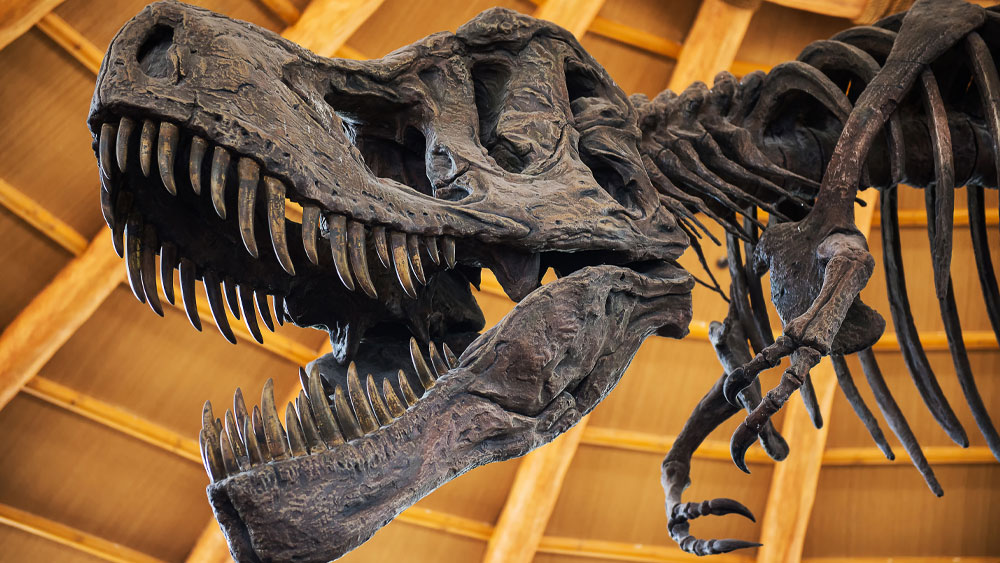
To conclude, scientists used a sophisticated technique called Raman spectroscopy to confirm that blood vessels found in hadrosaur and tyrannosaur fossils came from those very creatures.1 So it is hardly surprising dinosaur soft tissues continue to perplex conventional paleontologists. Although they feel certain that dinosaurs went extinct 66 million years ago, unremitting soft tissue discoveries from dinosaur fossils openly challenge such age options5 and validate the creation model.
References
- Long, B. et al. 2025. Resonance Raman Confirms Partial Haemoglobin Preservation in Dinosaur Remains. Proceedings of the Royal Society A. 481 (2321).
- Buckley, M. and M. J. Collins. 2011. Collagen Survival and Its Use for Species Identification in Holocene-Lower Pleistocene Bone Fragments from British Archaeological and Paleontological Sites. Antiqua. 1 (1): e1.
- Thomas, B. Skeptics Analyze Original Tissues with Lousy Logic. Creation Science Update. Posted on ICR.org June 28, 2019, accessed October 15, 2025.
- New Study Confirms Partial Hemoglobin Preservation in Dinosaur Remains. Sci.News. Posted on sci.news September 16, 2025, accessed October 2, 2025.
- Thomas, B. and S. Taylor. 2019. Proteomes of the Past: The Pursuit of Proteins in Paleontology. Expert Review of Proteomics. 16 (11–12): 881–895.
* Dr. Sherwin is a science news writer at the Institute for Creation Research. He earned an M.A. in invertebrate zoology from the University of Northern Colorado and received an honorary doctorate of science from Pensacola Christian College.