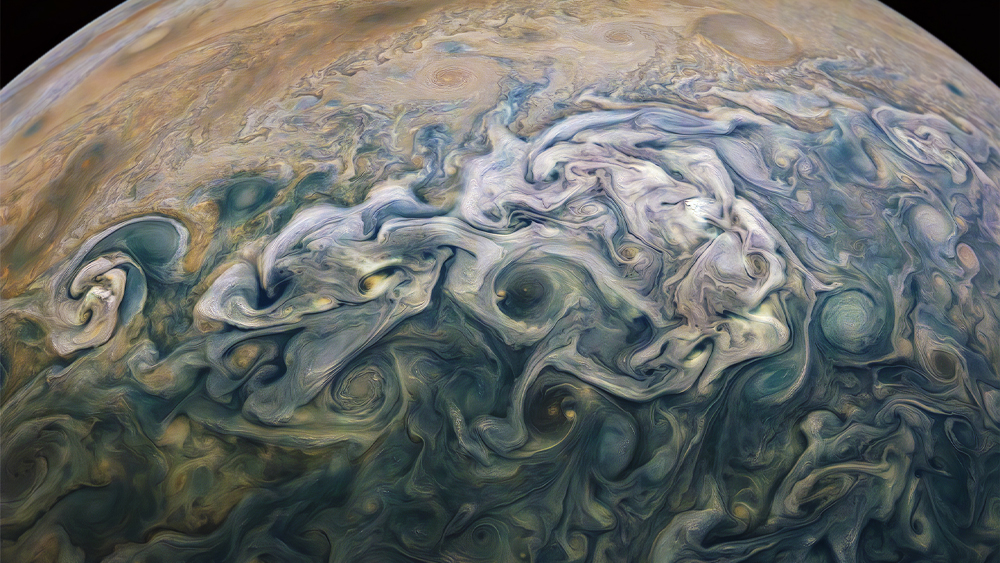
NASA’s Juno spacecraft recently unveiled breathtaking images of Jupiter during its 66th flyby of the colossal planet. Juno has been exploring Jupiter and its surroundings, including its rings and numerous moons, to uncover the planet’s secrets. According to a NASA statement, understanding Jupiter could provide valuable insights into understanding the entire solar system.1
Did you know that Jupiter plays a significant role in making life on Earth possible? This massive gas giant, sometimes called the “protector of Earth,” has a profound influence on our planet. Let’s dive into the ways Jupiter helps us live safely and thrive.
One of Jupiter’s most important jobs is to act as a cosmic shield. Because of its massive size and strong gravity, Jupiter can pull in or deflect many asteroids and comets that might otherwise collide with Earth. Imagine Jupiter as a giant vacuum cleaner sucking up debris that could cause catastrophic effects on our planet. Without Jupiter, the frequency and magnitude of impacts on Earth would be much higher, potentially making our planet a much more hazardous place to live.2
Jupiter also plays a crucial role in influencing the asteroid belt located between Mars and Jupiter. This region contains numerous rocky bodies that could potentially be a danger to Earth. Jupiter's strong gravitational field helps to keep many of these asteroids in their place, preventing them from drifting into the inner solar system where they could pose a threat to Earth. By maintaining the stability of the asteroid belt, Jupiter reduces the chances of large asteroid impacts that could be devastating to life on our planet.3
Jupiter’s gravity doesn’t just protect us from space debris; it also helps keep the solar system stable. The giant planet’s gravitational pull affects the orbits of other planets, including Earth’s. This gravitational influence helps maintain the relatively stable orbits that we observe, which is essential for a stable climate on our planet. Accordingly, a stable climate means Earth can support diverse ecosystems and, thus, life.4
Another vital role Jupiter plays is in protecting Earth’s atmosphere. When comets and asteroids are deflected by Jupiter, they are often flung out of the solar system or into the sun rather than colliding with Earth. This protection helps preserve our atmosphere. A stable atmosphere is critical for maintaining the conditions necessary for life, such as an optimal temperature and protection from harmful space radiation.5,6
Jupiter is more than merely a beautiful planet in the tapestry of the night sky. Its massive size and powerful gravity make it a mighty guardian of Earth. From protecting us from dangerous space debris to helping maintain stable orbits, Jupiter’s influence is essential for life on our planet.
Proof of our solar system’s complex design is everywhere around us. It’s easy to see that our world seems purposely made rather than just being a result of random chance causes. From the stars to the tiniest particles, everything in our universe is balanced and works together in a coordinated system. As science progresses and uncovers more about our solar system, scientists keep finding out how perfectly suited our solar system is for life.
“For since the creation of the world His invisible attributes are clearly seen, being understood by the things that are made, even His eternal power and Godhead, so that they are without excuse” (Romans 1:20).
References
- Juno: The Science Mission. NASA Science. Posted on science.nasa.gov.
- Johnstone, D. 2022. Jupiter: The Giant Protector. Astronomy Today. 39 (4): 56–60.
- Howells, K. Does Jupiter Protect Earth from Asteroids and Comets? The Planetary Society. Posted on planetary.org July 30, 2024.
- Smith, K. 2021. Planetary Influences: How Jupiter Shapes Our Solar System. Space Science Journal. 12 (2): 112–125.
- Williams, M. 2021. Jupiter: Guardian of Earth's Atmosphere. Journal of Planetary Science. 14 (2): 78–91.
- See Corrado, J. Earth's Atmosphere Is Vital to Life. Creation Science Update. Posted on ICR.org November 24, 2021.
* Dr. Corrado earned a Ph.D. in systems engineering from Colorado State University and a Th.M. from Liberty University. He is a freelance contributor to ICR’s Creation Science Update, works in the nuclear industry, and is a captain in the U.S. Navy Reserve.