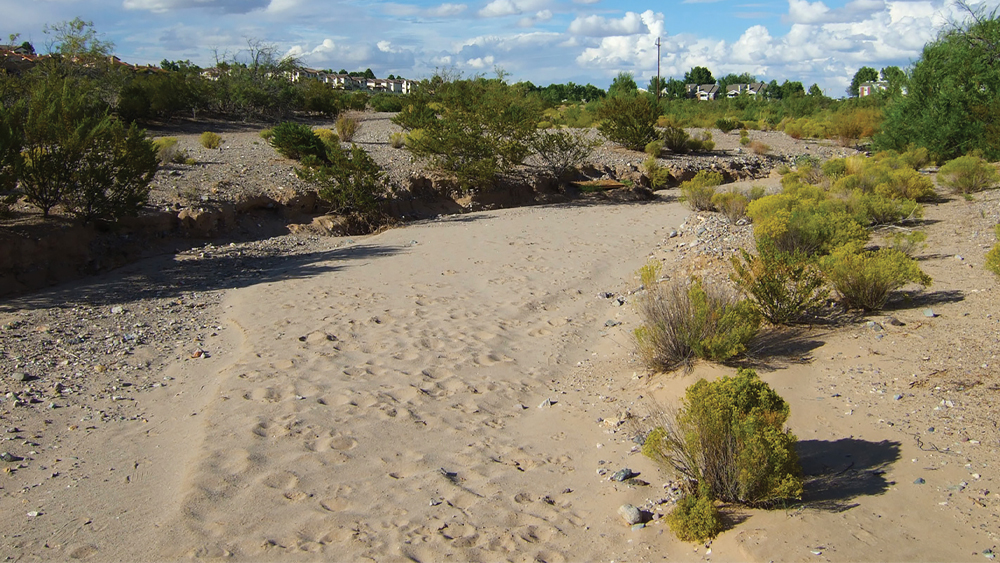
 Should a desert’s dryland arroyo that goes a year or more without any rainfall be called a “wetland” or a “navigable river”?1
Consider the baffling case of Ocie and Carey Mills, a father-son pair sentenced to $10,500 in fines and 21 months of jail time because they doubted that their tree-bearing dryland lots qualified as a navigable river.
This case presents the disturbing implications of the expansive jurisdiction which has been assumed by the United States Army Corps of Engineers under the Clean Water Act. In a reversal of terms that is worthy of Alice in Wonderland, the regulatory hydra, which emerged from the Clean Water Act, mandates…that a landowner who places clean fill dirt on a plot of subdivided dry land may be imprisoned for the statutory felony offense of “discharging pollutants into the navigable waters of the United States.”1
In other words, in the Alice in Wonderland world of federal politics, dry land such as a rain-deprived desert arroyo or a wooded lot can be jurisdictionally deemed a “navigable river” regulated by the U.S. Army if that dry land can be topographically linked to a navigable river or an ocean coast.1,2
Politicians are not alone in using disorienting and deceptive terminology. In fact, manipulating, mystifying mumbo-jumbo is a typical trick of the trade for evolutionists.3 Consider these perplexing, loaded terms with distorted definitions that distract more than inform.
Natural Selection. This Darwinian phrase presupposes an agent who “selects” something or someone. But there’s no selection unless a true selector considers relevant information against comparative values (i.e., better or worse options) and then consciously chooses (i.e., selects) an option.3 But inanimate geophysical environments can’t prefer, favor, or select anything.
Prokaryotic vs. Eukaryotic Cells. Eukaryotic means “true nucleus,” and prokaryotic denotes “before” a nucleus. This terminology implies that primordial bacteria and viruses evolved their nucleic acids before any proper cell nuclei evolved, whereas eukaryotic cells (e.g., mammal cells, plant cells) evolved late enough to have developed a proper nuclei inside their cells.
Cambrian Explosion. Evolutionists recognize that some of the earliest geologic sediments contain fossils of all kinds of life, so they assume that all major biodiversity categories of life forms phylogenetically “exploded” from a common-ancestry family tree.
This clashes with events of the creation week, when Christ created a pristine “forest” of different created kinds of ancestral life forms. Instead of fully developed creatures inexplicably appearing on a “tree of life” with no trace of evolutionary ancestors, these created kinds all show up as fossils within the earliest Flood-burial zone of Cambrian sediments.4
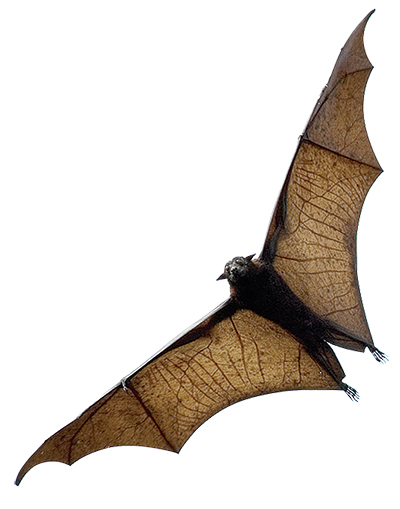
Homology and Convergence. Evolutionists say that forelimbs of humans and animals (e.g., birds, bats, bobcats, bears) are similar in form and function because they all trace back to a universally common phylogenetic ancestor. This supposedly “homologous” common ancestry, plus later imagined independently converging traits, are invoked to explain why humans and animals have comparable body parts and traits.5
But evolutionists ignore the purposeful wisdom of the Creator, who designed humans and animals to share the same planet (Isaiah 45:18; Psalm 104) and use the same air, water, and food for proteins, carbohydrates, salts, etc. They have a common Designer—not a common ancestor.
Don’t be swayed by the implied assumptions baked into evolutionist vocabulary! No semantic shenanigans can erase the clearly seen evidence the Creator placed into His creation (Romans 1:20).
References
- United States v. Mills. 817 F.Supp. 1546, 1548 (N.D. Fla. 1993). Emphasis in original.
- Johnson, J. J. S. and W. L. Logan III. 1994. How an Uncodified Appropriations Act has Partially Cured a Constitutional Problem about How Wetlands are Defined for Federal Regulatory Purposes. Temple Environmental & Technology Journal. 13 (173): 174–192. See also Johnson, J. J. S. Do You Really Have a Jaguar? Creation Science Update. Posted on ICR.org April 5, 2020.
- Johnson, J. J. S. 2011. Bait and Switch: A Trick Used by Both Anglerfish and Evolutionists. Acts & Facts. 41 (1): 10–11.
- Tomkins, J. P. 2021. The Fossils Still Say No: The Origin of Vertebrates. Acts & Facts. 50 (1): 10–12.
- “What appear as homologous or convergent traits are actually rapid, repeatable, and tightly regulated solutions for a range of conditions to which animals are exposed.” Staff writer. 2023. The Myths of Darwinian Homology and Convergence. Acts & Facts. 52 (5): 19. See also Guliuzza, R. J. 2017. Major Evolutionary Blunders: Convergent Evolution Is a Seductive Intellectual Swindle. Acts & Facts. 46 (3): 17–19.
Stage image: Dry arroyo in Las Cruces, New Mexico
Stage image credit: Copyright © All2humanuk, public domain. Used in accordance with federal copyright (fair use doctrine) law. Usage by ICR does not imply endorsement of copyright holder.
* Dr. Johnson is the associate professor of apologetics and chief academic officer at the Institute for Creation Research.