 The oyster species Crassostrea virginica, also known as the eastern oyster, is a prized seafood. Research has demonstrated that a fossil version of the Crassostrea oyster lived much longer than its modern-day counterparts. Called Crassostrea titan because of its large size, it provides evidence that at least some animals in the pre-Flood world experienced much longer lifespans, just as humans did (Genesis 5).
Years ago, creation researchers Don Patten and Greg Beasley predicted that giantism and delayed maturation accompanied the extreme longevity of creatures living before the Flood.1,2 Fossil representatives of many creatures were once much larger than their descendants. The pre-Flood world was filled with giant turtles, fish, camels, sharks, snakes, penguins, dinosaurs—you name it! But how can you show that a fossil creature lived longer and took longer to mature than its descendants?
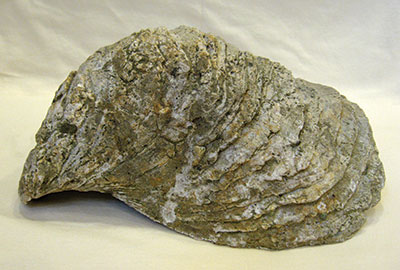
One way is to count growth rings in the hard parts of some organisms, like the shells of clams and oysters. This enables scientists to construct growth curves that show how large the oysters grew, how long they lived, and how long it took them to mature. This can be done for both living and fossil oysters.
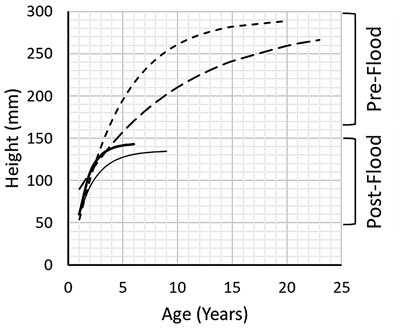
The accompanying figure is my reconstruction of a graph from the mainstream technical journal Paleobiology.3 It compares growth curves constructed from three groups of fossil Crassostrea oysters and one group of contemporary Crassostrea oysters. Two of the fossil groups living in the pre-Flood world were found in Flood strata. A third fossil group was found in likely Ice Age post-Flood deposits. The final group consisted of contemporary (“recent”) Crassostrea oysters.
Used by permission of the Creation Research Society.
The Flood and post-Flood growth curves show a dramatic difference. The adult Flood oysters are more than twice as long as the post-Flood oysters (about 275 mm compared to about 135 mm). The post-Flood curves indicate that none of those oysters lived past nine years. But the pre-Flood oysters lived as long as 20 and 23 years!
Also, the slopes of the growth curves trace how long it took the oysters to mature. At the age when growth stops, the slope of the curve flattens. Comparing the slopes of the four groups shows that the Flood oysters took much longer to reach adulthood than the post-Flood oysters. Thus, on a single graph we see evidence of greater adult body size, delayed maturation, and greater longevity in pre-Flood oysters, just as Patten and Beasley predicted!
But can we be reasonably sure the growth bands are annual? What about possible objections to this research conclusion? Space doesn’t permit a detailed discussion in this article, but I address these issues in a recent research paper that can be freely read online.4
Obviously, more fossil animals need to be examined and possible objections addressed before we can make a strong claim. Nevertheless, I’m very excited about what we’re finding. As always, thank you for your faithful prayers and financial support that make this research possible.
References
- Patten, D. W. 1982. The longevity accounts in ancient history. Creation Research Society Quarterly. 19 (1): 40–52.
- Beasley, G. 1990. Pre-Flood Giantism: A Key to the Interpretation of Fossil Hominids and Hominoids. Journal of Creation. 4 (1): 5–55.
- Kirby, M. X. 2001. Differences in growth rate and environment between Tertiary and Quaternary Crassostrea oysters. Paleobiology. 27 (1): 84–103.
- Hebert, J., R. Overman, and F. J. Sherwin. 2024. Crassostrea Oyster Fossils Show Evidence of Extreme Longevity. Creation Research Society Quarterly. 60 (3): 171–190.
* Dr. Hebert is a research scientist at the Institute for Creation Research and earned his Ph.D. in physics from the University of Texas at Dallas.