Dr. Richard Bliss, the former chair of ICR’s department of science education, authored a pioneering study demonstrating that students who were taught both sides in the creation-evolution debate exhibited a greater mastery of the material than students who were only exposed to the evolutionary position.1 This led ICR to adopt the two-model approach for teaching the creation-evolution controversy.2 In that same spirit, ICR recently published an introductory college-level textbook, Earth Systems: An Introduction to Earth System Origins, Structures, and Processes.
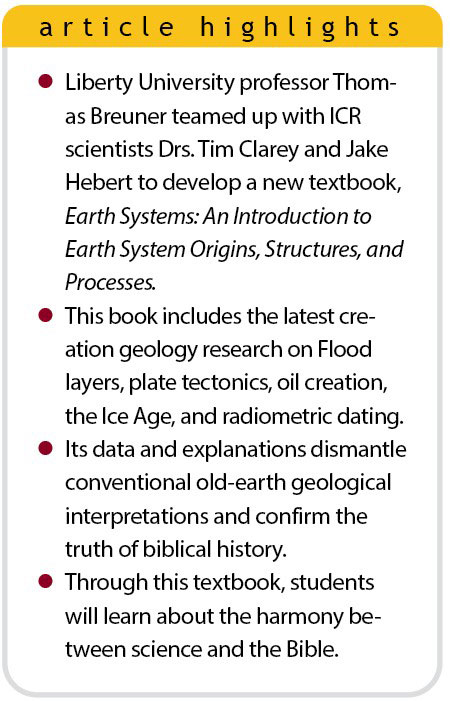
Like most Earth science introductory texts, Earth Systems covers the basics—geology, mineralogy, oceanography, meteorology, and climate. Unlike most such texts, however, it does not hesitate to point out difficulties confronting the old-earth interpretation, such as the Cambrian Explosion, incorrect ages obtained from radiometric dating techniques, original soft tissue found in dinosaur and other fossils, and the absence of convincing evidence for the conventional Ice Age theory. The book also unashamedly quotes Scripture in every chapter!
Earth Systems is the brainchild of Liberty University instructor and longtime creationist Thomas Breuner. He has a long relationship with ICR, having attended a class on coal stratigraphy taught by creation geologist Steve Austin at the ICR Graduate School in 1982. Tom requested that ICR be involved in this project, and ICR President Dr. Randy Guliuzza agreed. So Dr. Tim Clarey and I had the privilege of contributing to the writing of the book.
All three authors have past experience that helped prepare us for the task. Breuner has a master of science in geology and a master of arts in teaching. He was also a Fulbright exchange teacher to Hungary and the recipient of several awards for teaching excellence at Liberty University. Dr. Clarey earned a Ph.D. in geology, worked for over eight years as an exploration geologist, and taught geology classes at the college level for 17 years. My Ph.D. is in physics from the University of Texas at Dallas. Perhaps more importantly, I taught a college-level conceptual physics class for five years, which gave me considerable experience in explaining technical concepts in easy-to-understand ways.
Earth Systems is designed for nonscience majors, but it is sufficiently rigorous for college and even high school levels. Although equations are kept to a minimum, the book explains qualitatively, but in detail, the reasoning that uniformitarians use to reach their conclusions and why creationists dispute the assumptions underlying that reasoning. The book includes a thorough discussion of plate tectonics (including catastrophic plate tectonics), Flood geology, and the Ice Age.
In perusing the chapters written by my coauthors, I came across some information that I either didn’t know or had forgotten, so even longtime creationists may find Earth Systems beneficial. Copies are available for purchase at both ICR.org/store and the ICR Discovery Center gift shop.
References
- Bliss, R. D. 1978. A Comparison of Two Approaches to the Teaching of Origins of Living Things to High School Biology Students in Racine, Wisconsin. Ed.D. dissertation, University of Sarasota.
- Bliss, R. D. 1976. A Two-Model Approach to Origins: A Curriculum Imperative. Acts & Facts. 5 (6).
* Dr. Hebert is a research scientist at the Institute for Creation Research and earned his Ph.D. in physics from the University of Texas at Dallas.