A few years ago, scientists discovered a unique sensory organ in the jaw of a rorqual whale—the world's largest creature. Rorqual whales, which include the blue whale and fin whale, feed by ballooning out folds of tissue that bag gobs of krill from fertile ocean waters. Some of those researchers recently described the unique bungee-cord-like nerve construction that illustrates clever and intentional design.
In a 2012 Nature report, researchers portrayed the sensory organ as a necessary component among a long list of precisely formed body parts all required to make the rorqual whales' lunge feeding mechanism possible.1 These include the comb-like baleen to filter out food, expandable "ventral groove blubber" with cartilaginous support bars that open like a Chinese fan, a newly discovered sensory organ, a split jaw that is loosely connected to the skull, and vibrissae (long stiff hairs) along the chin to sense prey. The whale's sensory organ detects pressures that its lower jaws endure when taking on so much water in their mouths. Without this key sensor, the animal's jaw could rip apart.
Arctic and Antarctic oceans supply some of the best feeding areas for rorqual species. How do these enormous sea creatures keep from freezing as they engulf hundreds of gallons of cold ocean water? A countercurrent heat exchange arrangement of blood vessels throughout their enormous tongues protects their core body temperature. The Science authors who described this phenomenal design back in 1997 wrote, "All baleen whales possess countercurrent heat exchangers in their oral cavities, a physiological prerequisite allowing these endotherms to exploit the rich marine productivity of cold waters."2
What if all these whale feeding features were in place, but the creature had standard nerve packing? If this were the case, then when the whale's mouth ballooned and its tongue extended the nerve would break, severing the vital pressure signal from that special sensory organ.
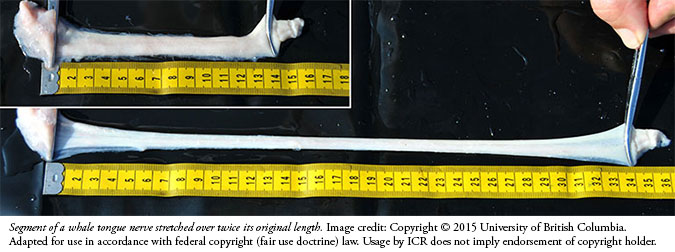
Fortunately, this does not happen. It looks like someone was looking out for whale well-being by providing a sheath within which these critical nerves can unfold and elastic tissues that retract the nerves. The journal Current Biology recently published a description of these newfound bungee-cord-like nerves, calling them "an essential component" of rorqual whales.3
Michael J. Benton, who is one of the world's foremost experts on the evolution of vertebrates, is a fellow of the Royal Society and studies at the University of Bristol. In his authoritative book Vertebrate Paleontology, he describes whale origins, saying, "Looking at the great blue whale, 30m [98 feet] long, or a fast-swimming dolphin, it is hard to imagine how they evolved from terrestrial mammal ancestors, and yet that is what happened."4
The reason this is so difficult to imagine is because it never really did happen. Natural causes have not and do not craft collections of interdependent, complicated mechanisms that coordinate vital body systems. These kinds of elegant mechanisms have to come into existence all at once, not bit-by-bit. The evidence indicates creation by design, not gradual evolution by happenstance.
References
- Pyenson, N. D. et al. 2012. Discovery of a sensory organ that coordinates lunge feeding in rorqual whales. Nature. 485 (7399): 498-501.
- Heyning, J. E., and J. G. Mead. 1997. Thermoregulation in the Mouths of Feeding Gray Whales. Science. 297 (5340): 1128-1140.
- Vogl, A. W. et al. 2015. Stretchy nerves are an essential component of the extreme feeding mechanism of rorqual whales. Current Biology. 25 (9): R360-R361.
- Benton, M. J. 2005. Vertebrate Paleontology. Malden, MA: Blackwell Science, 342.
Image credit: Copyright (C) 2015 University of British Columbia. Adapted for use in accordance with federal copyright (fair use doctrine) law. Usage by ICR does not imply endorsement of copyright holders.
*Mr. Thomas is Science Writer at the Institute for Creation Research.
Article posted on May 14, 2015.