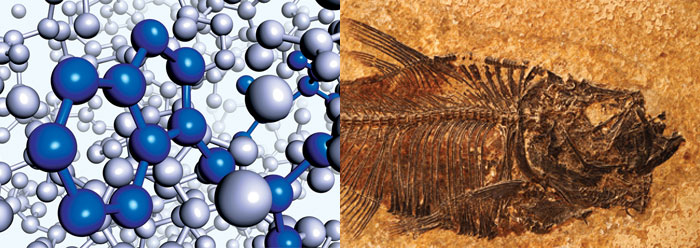
The design of living things has always been a huge problem for evolutionists. Even the simplest single-cell organism is unimaginably complex, with scores of highly sophisticated parts, all performing important functions and all mutually interdependent. The laws of statistics have convinced all who have bothered to calculate the odds that even something as basic as a protein molecule could never arise by chance, consisting as it does of a chain of hundreds of precisely arranged amino acids.
And such a protein molecule is trivial compared to any of the working parts of a cell. When it is recognized that all of these parts must be present and functioning at the start, it must be admitted that life is impossible without an Intelligent Designer. Actually, every living thing gives such strong evidence for design that only willfully ignoring the data (2 Peter 3:5) could lead one to assign such intricacy to chance and natural selection. Every living thing, from simple bacteria to people, possesses the marvelous DNA code, which contains a library full of precise information, and without which life is impossible.
Another fatal problem for evolution…which, if it occurred at all, occurred in the long-ago past…lies in the nature of the fossil record, which is the only physical record we have of life in the past. As is now being admitted by my evolutionary colleagues, the fossil record gives no clue that any basic type of animal has ever changed into another basic type of animal, for no undisputed chain of in-between forms has ever been discovered.
Each basic type is distinct in the modern world and in the fossil record, although there is much variation within these basic types. While gradual "Darwinian" evolution has always predicted that transitional forms would one day be found, the current rage in evolutionary circles is the concept of rapid evolution, or "punctuated equilibrium"…proposing that small isolated portions of a larger population evolved rapidly and left no fossils. But where is the evidence that they evolved at all?
Even though the gaps in the fossil record are found between each basic animal type, there are two huge gaps in particular that should be emphasized. The evolutionary distance between single-cell organisms and the vast array of multicellular, highly complex marine invertebrates precludes even rapid evolution. In the supposedly 600-million-year-old layers of rock designated as Cambrian (which contain the first appearance of varied multi-cell life), sponges, clams, trilobites, starfish, etc., are found without the required evolutionary ancestors.
The gap from marine invertebrates to the vertebrate fish is likewise immense. To make matters worse for the evolutionists, fish fossils are also found in Cambrian strata. If evolution is true, fish must have evolved from something, and invertebrates must also have evolved from something. Evolution has no ancestor to propose, but the evidence exactly fits the creation model, which insists that each animal type was created fully formed, with no evolutionary transition.
The evidence for creation is so strong, it is illogical to believe anything else. Only a religious commitment to atheism, or a desire for the approval of those atheists who call themselves scholars, could lead one down this path. The Bible says that those who deny creation are "without excuse" (Romans 1:20).
* Dr. Morris is President of the Institute for Creation Research.
Cite this article: Morris, J. 2011. The Biggest Problems for Evolution. Acts & Facts. 40 (4): 15.