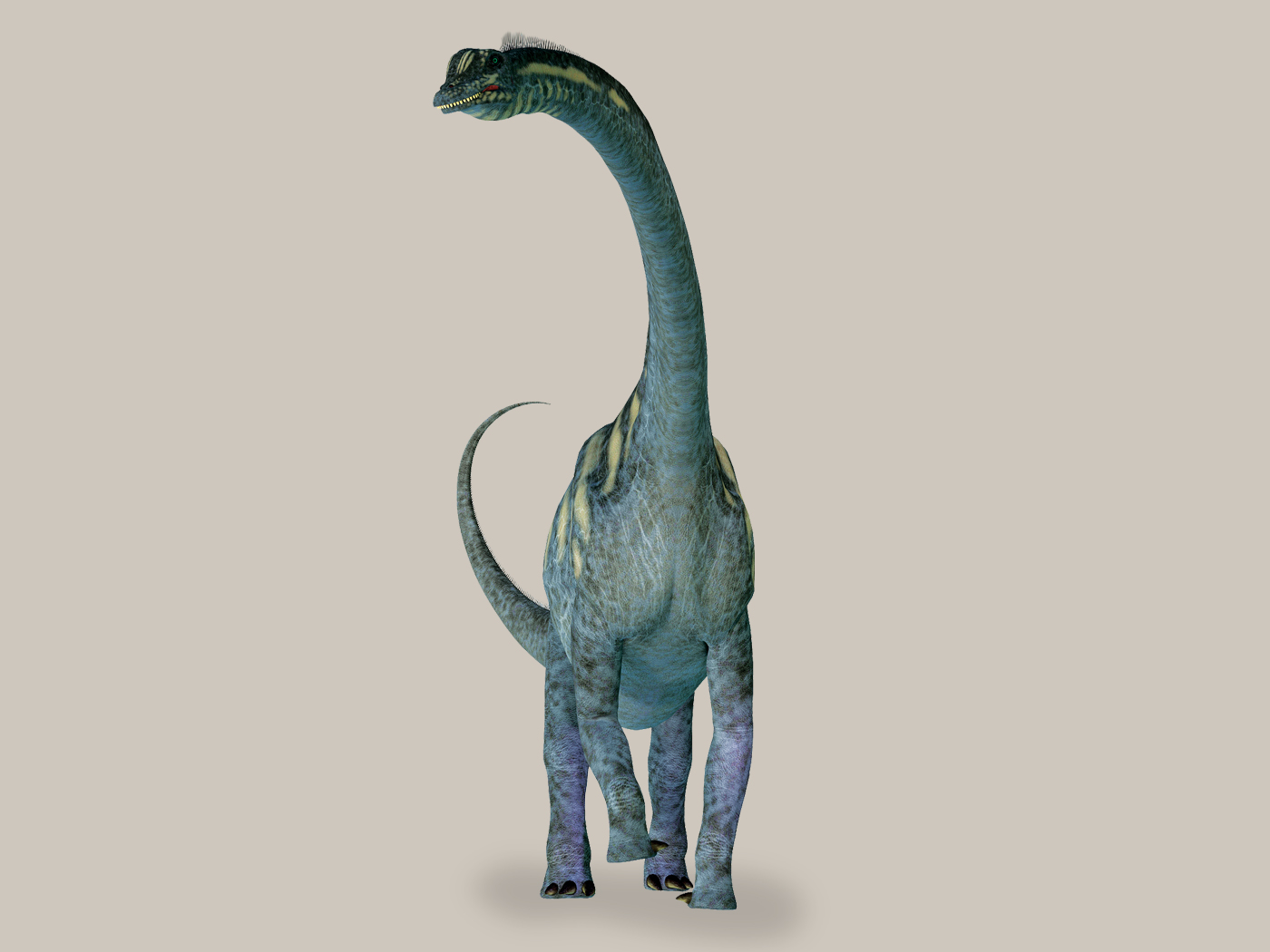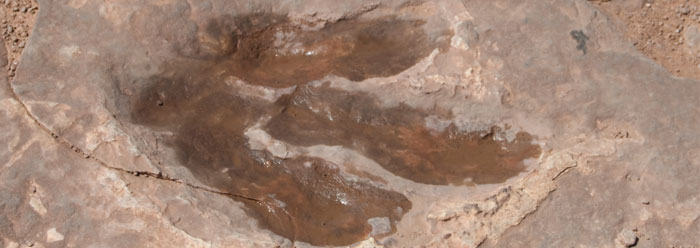
Dinosaur tracks and trackways are found in dozens of places worldwide. They are not particularly rare, but still unexpected. Stratigraphically, they are usually found in sediments thought to have been deposited midway through the great Flood of Noah's day, overlying sediments of marine origin. These layers contain a mixture of marine and terrestrial sediments, indicating that the Flood, initially an oceanic event, had begun to inundate more and more of the land, and bury land animals along with the marine.
There seems to be little way to predict where footprints will be found. However, individual tracks and even lengthy trails are usually found near a local stratigraphic "high," where animals fleeing the rising waters could find temporary sanctuary. Evidently some dinosaurs and other creatures avoided being drowned for several weeks into the Flood, and were able to leave their footprints in freshly deposited muds, which must then have been quickly covered to prevent erosion, allowing the host material enough time to harden into rock. These sediment layers were among the last to be deposited, and the tracks were left by some of the last animals still alive.
These easily eroded "ephemeral" markings are a good indicator that the sediments were never exposed on the surface for very long, subject to erosion, or on the sea floor where abundant oceanic life would obliterate them. Each layer is generally recognized to have resulted from a rapid, catastrophic event, and the evidence of little time passing between such events "ties the layers together" into a short, overall, time period (i.e., the Flood).
Recently I visited an unusual dinosaur print location, the roof of an underground coal mine in western Colorado. Remember coal is thought by uniformitarians to be metamorphosed peat which collected in a peat swamp. As the coal is mined away, the undersurface of the overlying (marine) shale is exposed, revealing in some locations dinosaur trails. These are not impressions, but the infilling of impressions which were originally made in the peat.
If peat formed in a swamp, it is reasonable that a dinosaur may have sloshed through it, leaving footprints, but is it reasonable to claim that such a swamp peat could have been submerged under the ocean to receive marine sediments (the shale), and yet undergo no erosion? No, it would be better to conclude major flooding which deposited virtually all the sedimentary layers in a short time.
*Dr. John D. Morris is the President of the Institute for Creation Research.
Cite this article: Morris, J. 2007. Where Are Dinosaur Tracks Found? Acts & Facts. 36 (6).