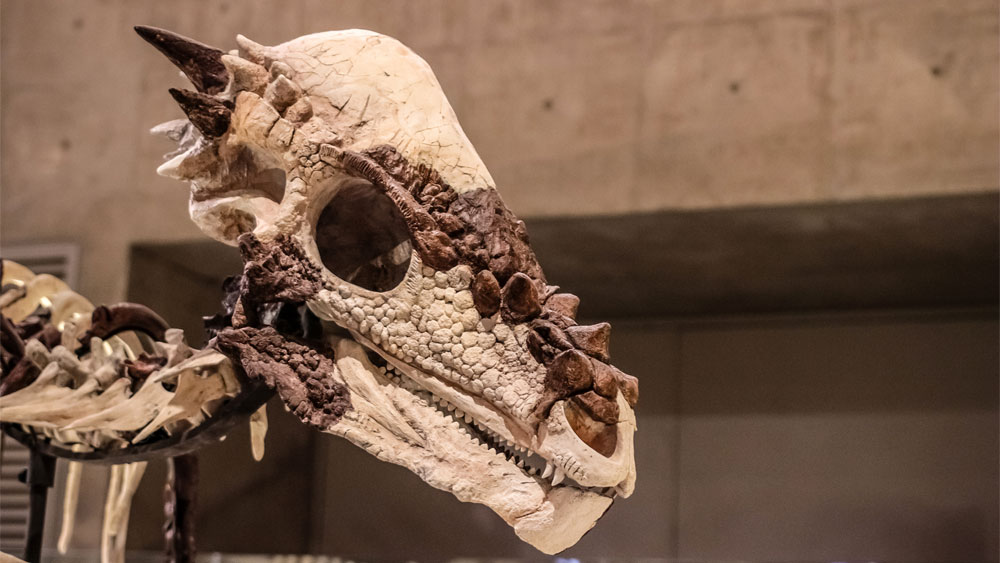
New species that are 100% dinosaur continue to be discovered by paleontologists with increasing frequency. One such recent discovery, described as “both the oldest and most complete skeleton of [the pachycephalosaur] group found to date,”1 has generated interest within the scientific community.
The specimen, named Zavacephale rinpoche, was found in Mongolia’s Gobi Desert and is dated to approximately “108 million years old [Early Cretaceous] pushing the group’s fossil record back by 15 million years.”1 Pachycephalosaurs, colloquially referred to as “bone heads” due to their distinctive thickened bone on the top of their heads,2 remain relatively rare and poorly understood. As Lindsay Zanno, associate research professor at North Carolina State University, stated, “Pachycephalosaurs are iconic dinosaurs, but they’re also rare and mysterious.”1
According to the study done in Nature, “The dome-headed pachycephalosaurians are among the most enigmatic dinosaurs.”3 Evolutionists from North Carolina State University suggest this juvenile specimen (Z. rinpoche) offers “a rare glimpse into the early evolution of these dome-headed dinosaurs.”1 But does it really? All indications are that it is simply a “teenaged”1 pachycephalosaur.
“Z. rinpoche fills in huge gaps in the pachycephalosaur timeline—both in terms of when they lived and how they grew, the researchers say.”1 When they allegedly lived and how they grew says nothing about their origin.
The Nature article states this fossil clarifies macroevolutionary trends in the assembly of the frontoparietal dome of Z. rinpoche.3 However, this is but a new species of pachycephalosaur exhibiting not macroevolution but variation within the pachycephalosaur kind,1 in this case, the development of the frontoparietal dome.
Another notable feature is this specimen’s exceptional preservation—including articulated limbs, gastroliths, and intact tendons—which suggests rapid burial in a high-energy depositional environment. Such preservation is consistent with catastrophic burial, potentially indicative of widespread flooding.
Tsogtbaatar Chinzorig from the Mongolian Academy of Sciences stated, “The newly recovered materials of Z. rinpoche, such as the hand elements, the stomach stones (gastroliths), and an articulated tail with covered tendons, reshape our understanding of the paleobiology, locomotion, and body plan of these ‘mysterious’ dinosaurs.”1 Everything, it would seem, except their origin.
Recent discoveries of new dinosaur species are ongoing, but they’re always dinosaurs. In October of 2025, Sci.News stated that a new species of hadrosaurid dinosaur was unearthed in San Juan County, New Mexico.4 Then, it was reported a new genus and species of abelisaurid theropod dinosaur was discovered by a team of paleontologists in South America.5
Even now in the twenty-first century, paleontologists are still at a loss as to the origin of the dinosaurs.6 As recently as 2024, five evolutionists stated, “Today, inspired by clues from fossils and footprints from a lost world, scientists continue to piece together the puzzle of how various dinosaur groups arose [e.g., pachycephalosaurs], behaved, and diversified.”7
In contrast, the creation model argues that all dinosaur kinds were created during the same period—specifically on Day 6 of the creation week—several thousand years ago. From this perspective, the lack of definitive transitional forms or ancestral precursors in the fossil record aligns with the expectation that dinosaur kinds appeared fully formed and distinct, as observed in the fossil record.
References
- Stunning Fossil from the Gobi Desert Rewrites Dinosaur History. North Carolina State University. Posted on sciencedaily.com September 20, 2025.
- Benton, M. 2024. Vertebrate Paleontology. Hoboken, NJ: Wiley, 322.
- Chinzorig, T. et al. A Domed Pachycephalosaur from the Early Cretaceous of Mongolia. Nature. Posted on nature.com September 17, 2025.
- de Lazaro, E. Paleontologists Identify New Species of Flat-Headed Herbivorous Dinosaur. Sci.News. Posted on sci.news October 6, 2025.
- New Species of Abelisaurid Dinosaur Discovered in Argentina. Sci.News. Posted on sci.news October 3, 2025.
- Sherwin, F. Dinosaurs, Always Dinosaurs. Creation Science Update. Posted on ICR.org November 13, 2017.
- Hickman, C. et al. 2024. Integrated Principles of Zoology. Columbus, OH: McGraw Hill, 590.
* Dr. Sherwin is a science news writer at the Institute for Creation Research. He earned an M.A. in invertebrate zoology from the University of Northern Colorado and received an honorary doctorate of science from Pensacola Christian College.