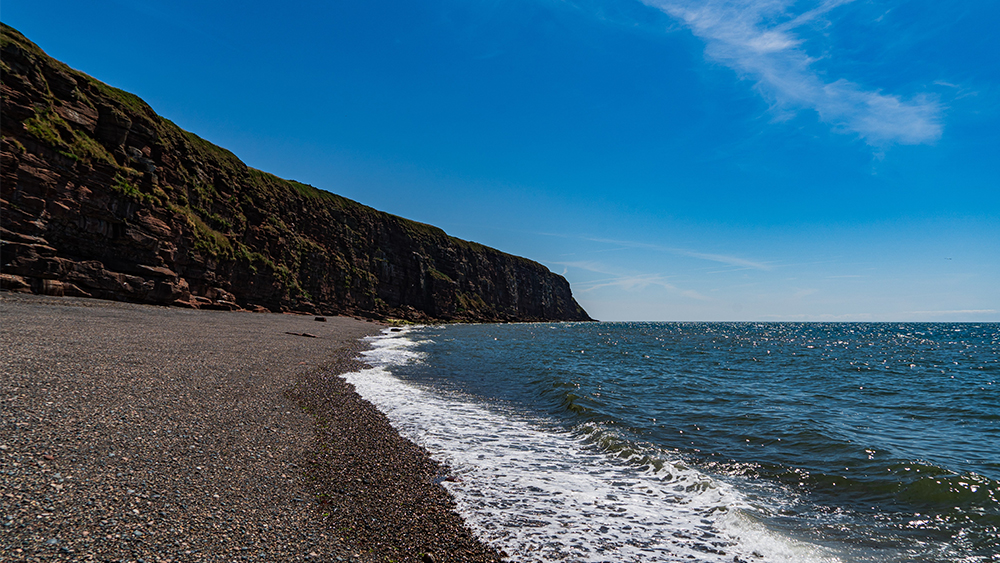
A recent study published in Geology found that sedimentary rock can form in as little as 35 years.1,2 Before this, conventional geologists thought these types of rocks took vast amounts of time to erode, consolidate, and lithify. What they discovered along the coast of Scotland caused them to quickly change their minds.
Senior author Amanda Owen of the University of Glasgow said,
For a couple of hundred years, we’ve understood the rock cycle as a natural process that takes thousands to millions of years. What’s remarkable here is that we’ve found these human-made materials being incorporated into natural systems and becoming lithifield [sic] — essentially turning into rock — over the course of decades instead.2
The team of scientists examined 13 sites along the western coast of the United Kingdom near the border of Scotland and England.1 Slag from steel and iron furnaces (which were in operation between 1856 and the 1950s) formed a 100-foot-high cliff along the coast.1 The cliff stretches 1.25 miles from north to south. High tide action and storm waves eroded part of the cliff, creating a near-planar foreshore (a cemented platform) between the cliff and the beach.1
The scientists found that the sedimentary rocks of the foreshore are composed of 83% slag that was eroded from the cliff and redeposited, essentially making conglomerate rock. Interestingly, the clasts (individual broken pieces of slag) are moderately rounded and moderately well-sorted by size. Furthermore, they discovered trough cross-bedding, indicating higher transport rates, and laminated beds that were tilted slightly toward the coast.1
Conventionally, the degree of rounding and sorting observed indicates transport and abrasion occurred over great distances. But these observations demonstrate that it can also happen in short distance transport.
Furthermore, they found that this clastic material was cemented into rock very quickly by water reacting with the chemistry of the slag in several different ways. In some locations, calcite cement was found to bind some of the clasts together. They explained, “Here, Ca and OH were leached from the slag, causing porewater to become hyperalkaline, therefore ingassing atmospheric CO2 and mineralizing calcite.”1
In other places, they found an iron cement called goethite holding the clasts together and noted that “goethite occurs in low-temperature, aerated, hydrous [water] settings, and often through hydrolysis [addition of water] of ferric iron, which is interpreted to be from oxidation of Fe-rich particles deposited in among the slag at Derwent Howe.”1
Other cements rich in manganese and magnesium leached from the slag also contributed to the cementing. The science team added, “Both typically form through low-temperature hydration of other Mn- and Mg-bearing phases, which are common in ferrous slag and are found in analogous hydrous [wet] ambient conditions in soils.”1
Essentially, the research documented a complete rock cycle, “with the production (source), erosion, transportation, deposition, and subsequent lithification of clastic material occurring at an unprecedented rate.”1
The discovery of two particular items essentially proved sedimentary rock can form in a matter of decades and not thousands of years or more, as most conventional geologists are taught. Coauthor of the paper John MacDonald, from the University of Glasgow, said, “We found both a King George V coin from 1934 and an aluminium can tab with a design that we realised couldn’t have been manufactured before 1989 embedded in the material.”2 These two items firmly establish that sedimentary rocks can form very quickly under the right conditions.
The authors concluded, “We demonstrate through observations from Derwent Howe that anthropogenic waste material can be deposited onto the landscape, subsequently reworked by coastal processes, and then relithified over decades.”1
While conventional geologists might be shocked by these findings, Flood geologists are not surprised. It justifies the fast processes we have been claiming all along. We’ve already found that sedimentary material can be deposited quickly.3 But now, we have observational evidence that these deposits can go through the entire rock cycle (erosion, sorting, deposition) and become fully lithified in a matter of a few decades, making deep time unnecessary.
The Genesis Flood left thousands of feet of sediment all over the globe.3 The cementing of this material into solid rock layers probably occurred quickly as well, and possibly even faster than what is observed today. The global Flood created the perfect conditions to create, transport, and cement sediment—likely doing so even while the floodwaters were still receding. Truly, sedimentary rock can form fast.
References
- Owen, A. et al. 2025. Evidence for a Rapid Anthropoclastic Rock Cycle. Geology. 53 (7): 581–586.
- Pare, S. Industrial Waste Is Turning into a New Type of Rock at ‘Unprecedented’ Speed, New Study Finds. Live Science. Posted at livescience.com June 17, 2025, accessed July 19, 2025.
- Clarey, T. 2020. Carved in Stone: Geological Evidence of the Worldwide Flood. Dallas TX: Institute for Creation Research.
* Dr. Clarey is the director of research at the Institute for Creation Research and earned his doctorate in geology from Western Michigan University.