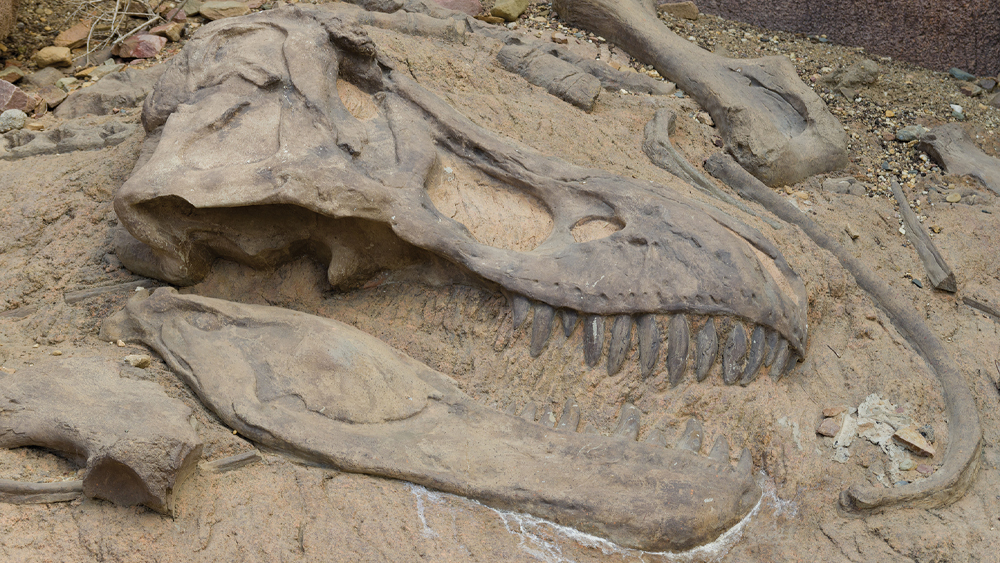
Paleontologists in Alberta, Canada, have recently unearthed “a mass grave on a monumental scale.”1 The BBC story speaks of
Thousands of dinosaurs [that] were buried here, killed in an instant on a day of utter devastation.
Now, a group of palaeontologists have come to Pipestone Creek - appropriately nicknamed the “River of Death” - to help solve a 72-million-year-old enigma: how did they die?1
The question and answer regarding the mass dinosaur death is found in the same sentence above. It was a massive flood (“river”) of death that killed them 4,500 years ago. Unfortunately, paleontologists will not accept this hypothesis and unnecessarily place the event many millions of years ago.2,3
In Michael Benton’s paleontology text in the section on dinosaur extinction, he lists “three current models to explain the KPg [Cretaceous-Paleogene or K-T extinction] event.”4 These are the impact hypothesis (i.e., the giant asteroid impact supposedly 66 million years ago5), the volcanic hypothesis, and the multiple causes hypothesis. In the multiple causes hypothesis he mentions “evidence of numerous killing agencies, including impact, marine regression [sea level drop], volcanic activity, and changes in climate.”4 Alas, the most obvious “agency” is not mentioned: a worldwide deluge.6
On page 383 (section 9.6) of Benton’s 5th edition (Vertebrate Paleontology, 2024) he states,
Over the years, hundreds of theories for the extinction of dinosaurs during the end-Cretaceous mass extinction (EKME) have been proposed (this event was formerly called the KT event, from Cretaceous-Tertiary).
As one can see, any explanation is valid—no matter how outrageous—except the most obvious: a global flood.7,8
A section of the BBC article has a most telling title: “A Sudden Devastating Event.”1 Morelle and Francis state,
“We believe that this was a herd on a seasonal migration that got tangled up in some catastrophic event that effectively wiped out, if not the entire herd, then a good proportion of it,” Prof [Emily] Bamforth says.
All the evidence suggests that this catastrophic event was a flash flood - perhaps a storm over the mountains that sent an unstoppable torrent of water towards the herd, ripping trees from their roots and shifting boulders.
Prof Bamforth says the Pachyrhinosaurus wouldn't have stood a chance. “These animals are not able to move very fast because of their sheer numbers, and they're very top heavy - and really not very good at swimming at all.”
Rocks found at the site show the swirls of sediment from the fast-flowing water churning everything up. It’s as if the destruction is frozen in time as a wave in the stone.1
To be fair, as one can see, they do mention a flood—a local flash flood.
One cannot help but be amazed that when viewing Pipestone Creek and other massive graveyards, the paleontological community is so blind that they are unwilling to consider the obvious Genesis Flood explanation for dinosaur fossils. This is a clear example of what is called confirmation bias—the propensity to interpret information or evidence in ways consistent with existing beliefs while rejecting others. Wearing such blinders has significantly influenced the interpretation of the fossil record for over a century and a half so that the worldwide sedimentary formations are only considered in a uniformitarian context. But as the late Henry Morris, the founder of ICR, stated in 1974, “dinosaur graveyards are found on every continent, all over the world. Again the uniformitarian is challenged to point to any such phenomena occurring anywhere in the world today.”9
Virtually every dinosaur fossil ever found is ensconced in sedimentary or (rarely) volcanic sediments, indicating a sudden and catastrophic deposition.10 This is particularly true with rich Cretaceous dinosaur beds (e.g., the Lance and Ferris Formations in Wyoming and the Hell Creek Formation in Montana).11 So why would paleontologists entertain bizarre extinction explanations such as slipped discs, sunspots, or magnetic reversals? Because if a scientist dismisses the global Flood out of hand, then anything goes when trying to explain the dinosaur demise. Anything.
The paleontologists are calling the Canadian mass grave the “River of Death,” but it should more accurately be called “The Flood of Death.”
References
- Morelle, R. and A. Francis. Solving the Mystery of a Dinosaur Mass Grave at the ‘River of Death.’ BBC. Posted on BBC.com 2025.
- Thomas, B. Published Reports of Original Soft Tissue Fossils. Posted on ICR.org.
- Thomas, B. Did Natural Gas Take Millions of Years to Form? Creation Science Update. Posted on ICR.org August 8, 2011.
- Benton, M. 2015. Vertebrate Paleontology. Hoboken, NJ: Wiley-Blackwell, 262.
- Clarey, T. 2017. Do the Data Support a Large Meteorite Impact at Chicxulub? Answers Research Journal. 10: 71–88.
- Clarey, T. 2017. South America Shows the Flood Progression. Acts & Facts. 46 (3): 9.
- Morris, J. 2014. Traditions of a Global Flood. Acts & Facts. 43 (11): 15.
- Clarey, T. Ichthyosaur Graveyard Explained by the Flood. Creation Science Update. Posted on ICR.org May 8, 2025.
- Morris, H. 1974. Scientific Creationism. Green Forest, AR: Master Books, 99.
- Clarey, T. 2015. Dinosaur Fossils in Late-Flood Rocks. Acts & Facts. 44 (2): 16.
- Clarey, T. 2015. The Hell Creek Formation: The Last Gasp of the Pre-Flood Dinosaurs. Creation Research Society Quarterly. 51: 286–298.
* Dr. Sherwin is a science news writer at the Institute for Creation Research. He earned an M.A. in invertebrate zoology from the University of Northern Colorado and received an honorary doctorate of science from Pensacola Christian College.