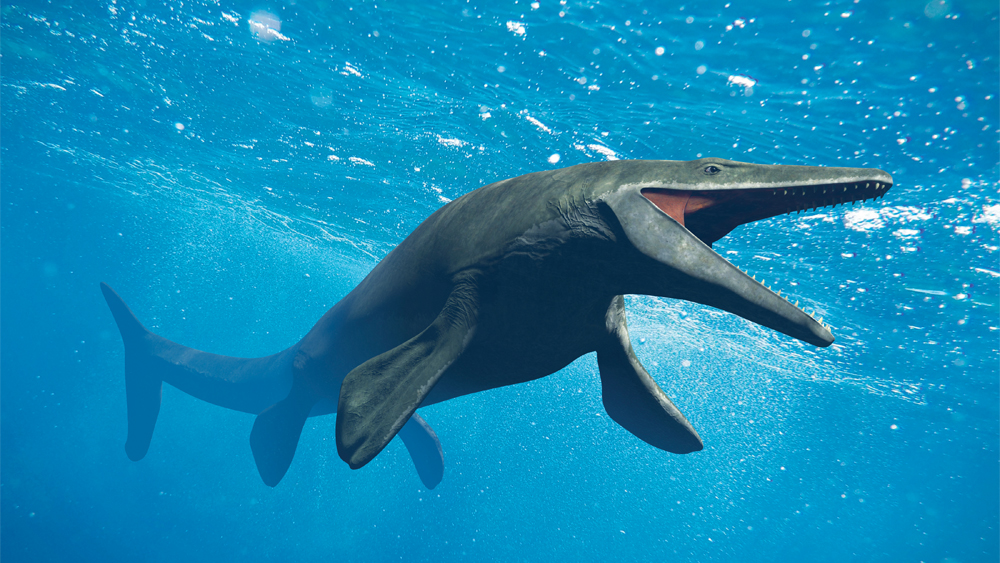
Mosasaurs (order Squamata) were massive marine lizards that were common in the pre-Flood oceans. Therefore, it is not surprising that their fossils have been found on every continent.
According to evolutionary theory, mosasaurs came from an unknown group of lizards that ventured into the sea about 100 million years ago. Additionally, evolution expects they were clumsy swimmers. But there is no evidence that these formidable creatures evolved from something else or that they moved inefficiently. On the contrary, according to ICR’s Brian Thomas,
An in-depth study of the world’s best-preserved mosasaur--which contains soft tissues such as skin, external scales, branching bronchial tubes, intestinal contents, decayed hemoglobin, and retinal soft tissues--demonstrated that the evolution-inspired weak-swimmer idea was all wrong. Instead, mosasaurs had all the necessary “adaptations” for a “fully aquatic existence.”
But there is no direct evidence that the “adaptations” described by the technical paper published in PLoS ONE were actually characteristics that had been “adapted,” either by altering some other feature or by inventing a new feature. Taking the fossilized structures at face value, the integrated features could simply have been created to function just as they appear. In fact, since there is no evidence to support any other story, the creation model fits best.1
Recently, “researchers may have discovered Mississippi’s largest ever mosasaur after pulling a Cretaceous-aged fossil out of a riverbed south of Starkville.”2 It was, of course, a huge 100% mosasaur, not an evolutionary ancestor. In addition, it was merely buried in sediments labeled as Cretaceous System rocks. It didn’t really live millions of years ago. The Cretaceous is simply one layer within the thick Flood rocks found all over the globe.
But paleontologist Michael Polcyn states mosasaurs are somehow an example of large-scale evolution.
Mosasaurs are a textbook example of macroevolution, the emergence of new and distinct groups of animals, above the level of species. Although they have been studied for centuries, new discoveries, novel research approaches, and the application of technology, are still teaching us about their relationships and behaviors, some of which continue to surprise us.3
In order to validate that mosasaurs evolved from terrestrial reptiles, fossils must be found that document their million-years history. According to the Utrecht University article, however, this has not been established, “Much less is known about their early evolutionary history, and how those major groups are related to one another, their origins, and the origin of mosasaurs as a whole [emphasis added].”3
The Utrecht University article didn’t list any transitional forms that would support large changes leading to mosasaurs. Instead, much was said about their feeding habits (including cannibalism), foraging, and the inferred alleged evolutionary relationships of mosasaurs. This is what non-evolutionists have been asking for: some clear evidence for the origin and evolution of this ferocious group, or any group of organisms for that matter. But “transitional” fossils showing clear step-by-step evolution of any type of organism simply do not exist!
Indeed, what is being unearthed devastates evolution’s long ages for these aquatic reptiles. Tissue inside a Cretaceous mosasaur humerus bone kept in the Royal Institute of Natural Sciences of Belgium revealed shocking results. Brian Thomas describes what the scientists discovered:
The investigators chemically removed the mineral matrix from the mosasaur bone, leaving behind the proteins and other biomolecules. Using scanning electron microscopy, they photographed what resembled actual protein fibers. This result was the same as that of a 2001 electron microscope study of mummified Tyrannosaurus rex bone.
Using transmission electron microscopy, the investigators found that the fibers looked like recent bone proteins. Since the concept of 70 million-year-old flesh sounds so fanciful, many evolutionists have suggested that biological material in fossils came from bacteria instead of being original tissue. Much of this study’s investigation, therefore, focused on testing whether or not that was the case with these soft tissues. But the long, stringy fibers that they photographed looked nothing like bacteria or bacterial colonies.4
Mosasaur fossils were found in sedimentary rock of a supposedly ancient sea called the Western or Cretaceous Interior Seaway. Evolutionists say it existed 100 million years ago, connecting the Gulf of America to the Arctic Ocean. However, ICR’s Tim Clarey stated,
Some of the fossils found in these same rocks [from the alleged Cretaceous Interior Seaway] give clues that refute the Cretaceous Interior Seaway story. They indicate a recent Flood extended across North America that transported deep sea creatures far inland in tsunami-like waves, burying mosasaurs and other marine creatures in a series of violent events. And the rocks provide no evidence that these fossils are millions of years old. To the contrary, preserved soft tissues found in a similar Kansas mosasaur contain partly decayed hemoglobin proteins still colored red. The fact that these proteins and pigment are still present strongly suggests these rocks are much younger than claimed by secular scientists and confirms a recent Flood as described in Genesis.5
The fossil record shows mosasaurs have always been mosasaurs. These and other terrestrial and marine creatures were buried in a series of violent events one could easily attribute to a massive flood. Proteins, pigment, and other biomolecules uncovered in mosasaur bone provide compelling evidence that these reptiles existed recently—as in thousands of years ago.
References
- Thomas, B. Contrary to Expectation, Extinct Sea Monsters Were Expert Swimmers. Creation Science Update. Posted on ICR.org August 24, 2010.
- Pester, P. Giant ‘Sea Dragon’ Fossil Could Be Largest Mosasaur Ever Discovered in Mississippi. Live Science. Posted on livescience.com April 24, 2025.
- New Insights into the Evolution and Paleoecology of Mosasaurs. Utrecht University. Posted on phys.org December 12, 2024.
- Thomas, B. Carbon Dating of ‘70 Million Year Old’ Mosasaur Soft Tissues Yields Surprising Results. Creation Science Update. Posted on ICR.org May 13, 2011.
- Clarey, T. Mosasaur Babies: Aren’t They Cute? Creation Science Update. Posted on ICR.org April 20, 2015.
* Dr. Sherwin is a science news writer at the Institute for Creation Research. He earned an M.A. in invertebrate zoology from the University of Northern Colorado and received an honorary doctorate of science from Pensacola Christian College.