Where did spiders (arachnids) come from? What was their origin? Clearly, the fossil record shows spiders have always been spiders1,2 along with other chelicerates (a subphylum of the arthropods).
The alleged evolution of the chelicerates (i.e., Arachnida) has recently become complex and problematic. According to Sharma and Gavish-Regev writing in the Annual Review of Entomology, the “longstanding hypotheses and textbook scenarios of chelicerate evolution, such as the monophyly [creatures sharing a single common ancestry rather than being a polyphyletic group] of Arachnida and a single colonization of land by the common ancestor of arachnids, have come into contention.”3 Agreed. The first problem is the common ancestor of arachnids has never been discovered. Creationists predict such a creature never will be found.
Dr. Gavish-Regev stated, “The idea that all arachnids share a single terrestrial ancestor has been widely accepted for decades, but the latest molecular evidence and a different interposition of some homologies points to a more complex scenario”4
Gajbhiye reported on Earth.com that whole-genome duplication (WGD or polyploidization5) might have played a role in arachnid evolution.
However, a new study presents a different picture, suggesting that this transition [of arachnids moving from water to land] happened multiple times rather than once. The research also highlights the role of whole-genome duplication in shaping key traits in spiders and scorpions, particularly silk production and venom synthesis.4
There are serious scientific problems with the alleged “ancient” duplication of the entire genome of an organism (WGD). Such an event in most animals would lead to genomic instability, disruptions in cellular metabolism and harmful effects on the organism’s overall viability.
Secondly, WGD in animals is largely a myth and has never been observed in real time in nature. Although some salamanders, frogs, and leeches are polyploids, there is no data to indicate in these cases that this was the result of some major genetic accident as opposed to a purposeful design plan. In other words, the invocation of WGD in spiders, which has never been observed in nature among any arthropod, is nothing more than wild evolutionary speculation.
The chief reason that evolutionists often invoke the WGD mantra is because some genes in the genome come in families with multiple copies of certain genes being present. The problem for WGD is how does this even happen? Do a few genes get duplicated in the WGD, but all the thousands of other genes become magically removed somehow? The most obvious conclusion is that gene families are a built-in adaptive feature where more of a certain type of gene product is produced for a specific process. In scientific terminology, this is called the gene dosage effect.
But what about genes magically emerging out of some repetitive region of the genome or a gene being possibly duplicated during meiosis (sperm and egg production)? Evolutionist Michael Denton stated, “The alternative notion of de novo gene origination [gene duplication] has been deemed very unlikely because of the seeming vast improbability of a functional gene sequence emerging from a random sequence.”6
Regardless of the evidence negating WGD, Sharma and Gavish-Regev stated, “The retention of ancient, duplicated genes across this lineage also offers fertile ground for investigating the role of gene duplication in chelicerate macroevolution.”3
To conclude, scientists now believe that arachnids came about by multiple whole-genome duplication events that magically occurred in the ancient evolutionary past. Gajbhiye stated, “These genetic changes may have played a crucial role in their evolutionary success [emphasis added].”4 However, the current living record among all kinds of spiders and other arthropod groups provides no evidence of WGD happening today. And the fossil record shows no basal spider ancestor. Instead, many different kinds of spiders show up suddenly with no transitional forms to indicate any evolution. The bottom line is that the Creator, the Lord Jesus Christ, puts design features like duplicate genes in the genome for a functional purpose.
References
- Sherwin, F. Spiders Have Always Been Spiders. Creation Science Update. Posted on ICR.org March 19, 2015.
- Sherwin, F. Delicate Spider Fossil Discovered. Creation Science Update. Posted on ICR.org February 21, 2019.
- Sharma, P. and E. Gavish-Regev. 2025. The Evolutionary Biology of Chelicerata. Annual Review of Entomology. 70 (1): 143–163.
- Gajbhiye, S. Rethinking Arachnid Evolution: The Surprising History of Spiders. Earth.com. Posted on earth.com February 20, 2025.
- Hahan, M. 2009. Distinguishing Among Evolutionary Models for the Maintenance of Gene Duplicates. Journal of Heredity. 100 (5): 605–617.
- Denton, M. 2016. Evolution: Still a Theory in Crisis. Seattle, WA: Discovery Institute Press, 141.
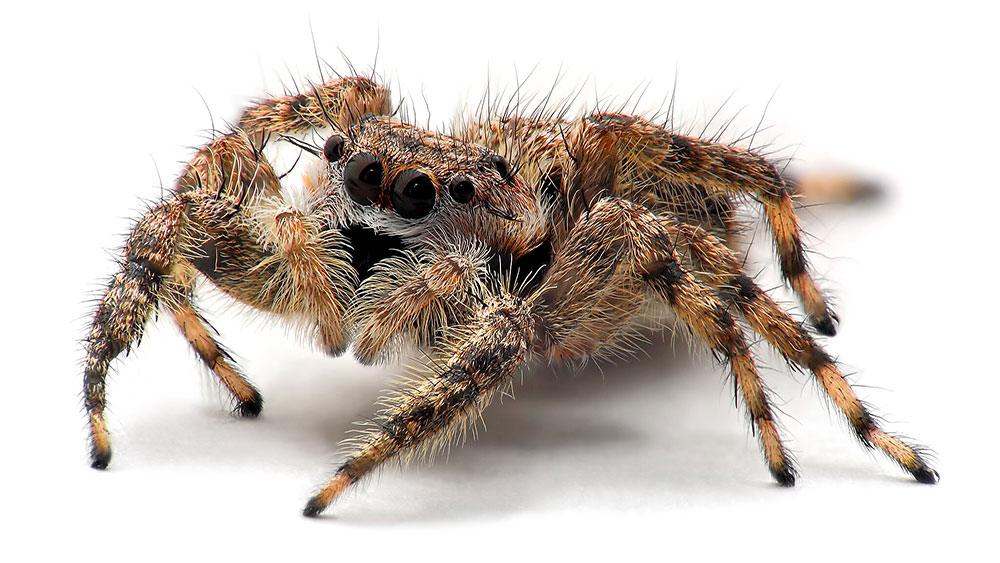
Stage image: Close up of a 9 millimeter-long female jumping spider (Platycryptus undatus)
Stage image credit: Kevincollins123, CC BY-SA 3.0, via Wikimedia Commons. Used in accordance with federal copyright (fair use doctrine) law. Usage by ICR does not imply endorsement of copyright holder.
* Dr. Sherwin is a news writer at the Institute for Creation Research. He earned an M.A. in invertebrate zoology from the University of Northern Colorado and received an honorary doctorate of science from Pensacola Christian College.