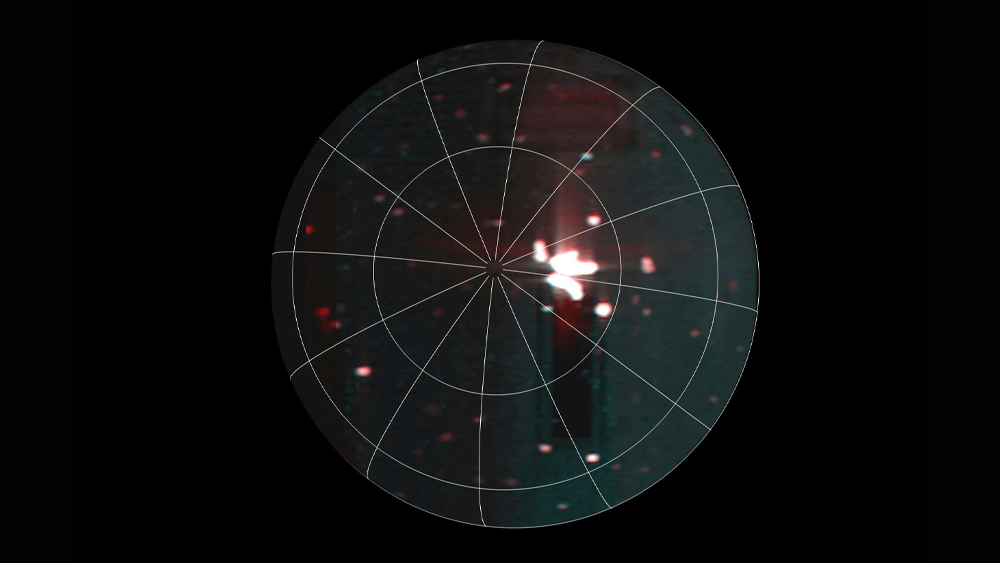
Jupiter’s moon Io is the most volcanically active body in our solar system, and NASA’s Juno spacecraft recently detected the largest volcanic event ever observed on that body.1 During a flyby on December 27, 2024, Juno detected the infrared radiation from a gargantuan volcanic hot spot larger than Lake Superior near Io’s south pole (see figure). The volcanism caused a subtle but noticeable change in the appearance of Io’s surface.
This is a reminder that Io’s prodigious heat output presents difficulties for those who believe in deep time.2,3 Io is a small moon, and small bodies lose heat to space fairly quickly. If Io is billions of years old, how could it retain the heat to drive this enormous volcanism for billions of years?
One option, heat generated by radioactive decay, has already been ruled out as a major contributor.4 A second option is that Io is still losing energy it had at the time it was formed. This second possibility is an option for biblical creationists, since little Io could still retain much of its original energy if it is only 6,000 years old. But if Io is billions of years old, this primordial heat should have leaked to space eons ago. A third option is tidal flexing, in which gravitational tugs from other bodies stretch and flex Io’s interior, warming it up. Old-age scientists generally argue that tidal flexing is the source of Io’s heat.
However, there are problems with this explanation. Theoretical calculations indicate that tidal flexing could only account for a fraction of Io’s heat output.5 Those earlier calculations only included gravitational tugs from Jupiter itself and ignored the effects of gravitational tugs from Jupiter’s other moons. Scientists have suggested that including those effects might generate sufficient tidal heating to explain Jupiter’s heat output.6
In any case, this intense volcanism could not have been going on for billions of years. Io’s volcanic activity is so intense that it would have turned Io’s crust and mantle inside out more than a hundred times in four billion years!7 This would likely have caused Io’s crust to be depleted of heavy elements like magnesium, like Earth’s continental crust, but this is not the case. Some planetary scientists thought Io’s crust could be rich in magnesium despite billions of years of volcanism if Io has both a subsurface crystal-rich magma ocean and a completely liquid core.3 Io’s core is thought to be liquid.8 However, despite previous claims of a magma ocean,9 a recent study seems to have shown that such a magma ocean is not present on Io.8,10
So the chemical composition of Io’s crust seems to demand that this intense volcanism began relatively recently. But in a billions-of-years-old solar system, it would seem a remarkable coincidence if Io’s intense volcanism just happened to start at about the time we humans developed sufficient technology to observe it. Of all the times in 4.6 billion years that Io could have started this prodigious volcanism, why start now? As noted in a 2013 article in the journal Nature,
The most active bodies out there [in the outer solar system] – Jupiter’s moon Io and Saturn’s moons Enceladus and Titan – may be putting on limited-run shows that humans are lucky to witness. Saturn’s brilliant rings, too, might have appeared relatively recently, and could grow dingy over time. Some such proposals make planetary researchers uncomfortable, because it is statistically unlikely that humans would catch any one object engaged in unusual activity – let alone several.5
Since 2013, evidence of a youthful solar system has only gotten stronger. Scientists have been forced to acknowledge that Saturn’s rings are indeed young,11 and belief in deep time continues to pose real problems for conventional scientists.3,12–14 This is to be expected since the Lord Jesus created our solar system—and the rest of the universe—just a few thousand years ago, as one would infer from a straightforward reading of Scripture.
References
- NASA. Juno Mission Spots Most Powerful Volcanic Activity on Io to Date. Phys.org. Posted on phys.org January 28, 2025, accessed February 6, 2025.
- Coppedge, D. F. 2007. Spewing Hot Rocks on Old Ideas. Acts & Facts. 36 (10): 15.
- Hebert, J. 2023. Jupiter’s Young Moons. Acts & Facts. 52 (5): 14–16.
- Thomas, N. 2022. A Comprehensive Investigation of the Galilean Moon, Io, by Tracing Mass and Energy Flows. Experimental Astronomy. 54: 791–807.
- McKee, M. 2013. Planetary Science: Caught in the Act. Nature. 493 (7434): 592–596.
- Mace, M. Jupiter’s Moons Could Be Warming Each Other. University of Arizona. Posted on news.arizona.edu September 10, 2020, accessed February 6, 2025.
- Spencer, W. 2020. The Volcanism and Age of Io. Journal of Creation. 34 (2): 117–123.
- Park, R. S. et al. 2024. Io’s Tidal Response Precludes a Shallow Magma Ocean. Nature. 638 (8049): 69–73.
- Thomas, B. Despite ‘Magma Ocean’ Discovery, Io’s Volcanic Heat Remains a Mystery. Creation Science Update. Posted on ICR.org May 23, 2011, accessed February 6, 2025.
- Nature Publishing Group. No Shallow Magma Ocean for Jupiter’s Moon Io, Research Suggests. Phys.org. Posted on phys.org December 12, 2024, accessed February 6, 2025.
- Coppedge, D. F. It’s Official: Saturn’s Rings Are Young. Creation Evolution Headlines. Posted on crev.info January 3, 2018, accessed February 6, 2025.
- Hebert, J. Saturn’s Moons Continue to Challenge Secular Theorists. Creation Science Update. Posted on ICR.org September 27, 2021, accessed February 6, 2025.
- Hebert, J. Reminder: Saturn’s Moon Titan Really Looks Young. Creation Science Update. Posted on ICR.org February 8, 2021, accessed February 6, 2025.
- Hebert, J. 2018. Our Young Solar System. Acts & Facts. 47 (9): 10–13.
Stage image: A massive hot spot near the south pole of Io
Stage image credit: Copyright © Public domain, NASA/JPL-Caltech/SwRI/ASI/INAF/JIRAM. Used in accordance with federal copyright (fair use doctrine) law. Usage by ICR does not imply endorsement of copyright holder.
* Dr. Jake Hebert is a research associate at the Institute for Creation Research and earned his Ph.D. in physics from the University of Texas at Dallas.