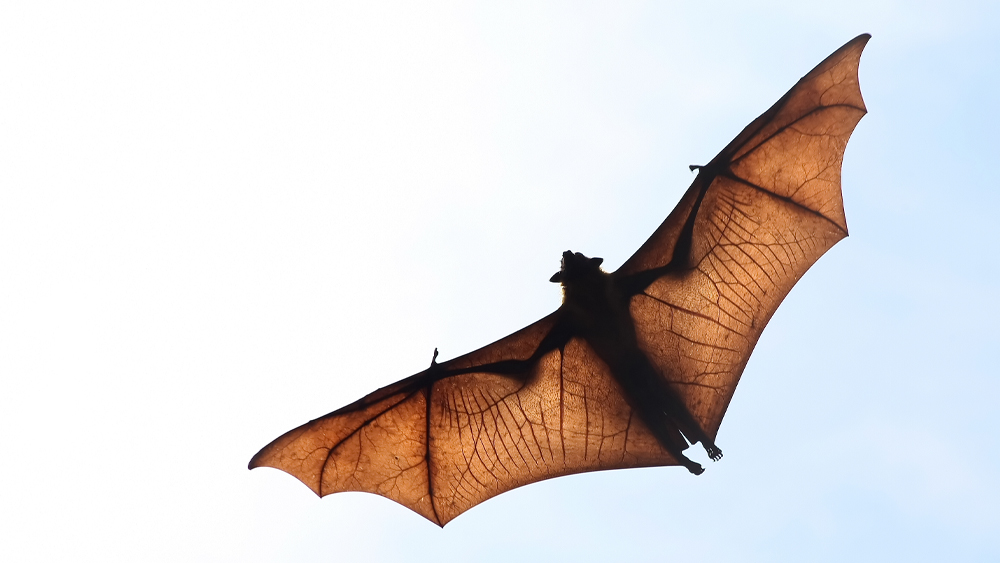
Animals designed to fly are classified into four groups: the extinct flying reptiles (pterosaurs), insects, mammals (bats), and birds. According to the creation model, bats and birds were created on Day 5 as bats and birds.
Recently, a science news article addressed the wings of the two groups in an article entitled, “A Comparison of Bat and Bird Wings Reveals Their Evolutionary Paths Are Vastly Different.”1 But bats clearly do not have an evolutionary path, nor do birds.
Genesis suggests that [birds] did not evolve at all. Since there are no bird transitional forms in the fossil record, since the most reliable written record of origins leaves no room for bird evolution, and since both the science of biophysics and inductive reasoning refute it, the time is overdue to issue a recall on the long-cherished naturalistic theory that theropod descendants developed into birds.2
However, evolutionists at Cornell University wrote in Nature Ecology and Evolution that convergent evolution of flight defined birds and bats.3 Convergent evolution is “the separate or independent origin of similar characters emerging on separate lines of descent after the point at which those lines diverged from their last common ancestor.”4
After studying the extremely complex wing anatomy of bats5 and birds, one can only agree with Heyduk et al. when they stated in Nature that “many highly convergent adaptations are also complex, which makes their repeated emergence surprising.”6 Surprising indeed. This is because convergent evolution is a conundrum that “doesn’t fit into the accepted evolutionary scheme.”7 ICR’s Dr. Randy Guliuzza stated,
Convergent evolution is the fabricated conjecture evolutionists invoke to explain very similar characteristics between creatures that could not have been inherited from a common ancestor and that evolutionists will never accept as having been produced by an intelligently designed internal programming that is specified for common purposes.8
In regard to the wing structure of these animals, a science writer with Phys.org asked, “Why aren’t there any flightless bats...or bats that spend their lives at sea, like the wandering albatross?”1
The possible answer, according to the Cornell researchers, is that “unlike birds, the evolution of bats’ wings and legs is tightly coupled, which may have prevented them from filling as many ecological niches as birds.”1 Using evolutionary theory, they thought bat legs and wings evolved like that of birds—allegedly evolving independently of one another. But it turned out the opposite was true, causing much surprise. They found that bat leg and wing proportions are united or combined, showing strong correlation. This is expected on the basis of creation. Bat appendages did not slowly evolve independently of one another because bats were created as bats thousands of years ago.
One-hundred percent of bat fossils appear abruptly in Eocene sediments (e.g., the Green River Formation).
The earliest known bats appear in the fossil record ≈50 million years ago, and they appear suddenly and already possessing the anatomical hallmarks of powered flight (including elongated third, fourth, and fifth forelimb digits). Thus, it seems to be likely that the earliest known fossil bats were already capable of powered flight.9
Orkney and his fellow researchers describe measurements in living bat species in an evolutionary context:
Here we present a phylogenetically representative and ecologically diverse collection of limb skeletal measurements from 111 extant bat species. We compare this dataset with a compendium of 149 bird species, known to exhibit modular evolution and anatomically regionalized skeletal adaptation.3
Limb skeletal measurements are objective, but the scientists’ interpretations (“modular evolution”) of the measurements can be quite subjective.10
Contrary to evolutionary theory, bats were created thousands of years ago with the morphological flexibility to move in and fill various ecosystems, which is described by continuous environmental tracking.11 Orkney et al. said as much when they stated,
Different regions of the bat limb skeleton adapt to accommodate variation in distinct ecological activities, with flight-style variety accommodated by adaptation of the distal wing, while the thumb and hindlimb play an important role facilitating adaptive responses to variation in roosting habits.3
Like all creatures in God’s creation, there are natural limits to biological change, and this applies to bats. Indeed, two authors were puzzled, stating in their evolution text, “Why species do not enlarge their ranges indefinitely, by incrementally adapting to conditions farther and farther away, is a major question in evolutionary biology.”12
God has created bats and birds with a genetic ability to undergo change only within their kind.
References
- Smith, E. A Comparison of Bat and Bird Wings Reveals Their Evolutionary Paths Are Vastly Different. Cornell University. Posted on phys.org November 1, 2024.
- Thomas, B. Fixed Bird Thigh Nixes Dino-to-bird Development. Creation Science Update. Posted on ICR.org June 22, 2009.
- Orkney, A. et al. 2024. Evolutionary Integration of Forelimb and Hindlimb Proportions within the Bat Wing Membrane Inhibits Ecological Adaptation. Nature Ecology & Evolution. 9 (1): 111–123.
- Meyer, S. 2013. Darwin’s Doubt. San Francisco, CA: HarperOne, 133.
- Sherwin, F. 2022. How Did the Bat Get Its Wings? Acts & Facts. 51 (7): 7.
- Heyduk, K. et al. 2019. The Genetics of Convergent Evolution: Insights from Plant Photosynthesis. Nature. 20: 485–493.
- Bethell, T. 2017. Darwin’s House of Cards. Seattle, WA: Discovery Institute, 115.
- Guliuzza, R. 2017. Major Evolutionary Blunders: Convergent Evolution Is a Seductive Intellectual Swindle. Acts & Facts. 46 (3): 17–19.
- Sears, K. E. et al. 2006. Development of Bat Flight: Morphologic and Molecular Evolution of Bat Wing Digits. Proceedings of the National Academy of Sciences. 103 (17): 6581–6586.
- Thomas, B. 2021. Archaeopteryx by the Numbers. Acts & Facts. 50 (5)
- Guliuzza, R. 2023. Continuous Environmental Tracking, An Engineering-Based Biological Model. Acts & Facts. 52 (6): 22–23.
- Futuyma, D. and M. Kirkpatrick. 2017. Evolution. Sunderland, MA: Sinauer Associates, 487.
* Dr. Sherwin is a news writer at the Institute for Creation Research. He earned an M.A. in invertebrate zoology from the University of Northern Colorado and received an honorary doctorate of science from Pensacola Christian College.