by Brian Thomas, Ph.D., and David Thomas*
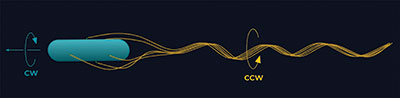
 The bacteria alive in our guts swim using tiny engines that power propellers called flagella (Figure 1). Each of several flagella—the number depends on the kind of bacteria—spins like a whipcord. These bacteria can even change the rotation direction of certain flagella to reposition themselves before heading in a new direction.
Now these are mighty miniscule motors! How well do they work? How are they controlled? New research has supplied stunning, unforeseen details that point more clearly than ever to a precision engineer to explain how these nanoscopic machines came into being.
Engine Parts
Bacterial flagella are made of tightly fitted parts, including bushings and gears. Though they vary in design between species, each motile or swimming bacterium has all the required engine parts (Figure 2). Key parts of flagella include:
1. Gear box: made of a large central gear with one or more smaller gears that surround it. A voltage (and chemical potential) across the bacteria’s cytoplasmic membrane powers these smaller gears, making them little electrochemical motors in themselves. The central gear is called the C-ring, and the smaller gears are usually called stator complexes. Stator is an electrical engineering term referring to the stationary part of an electric motor.
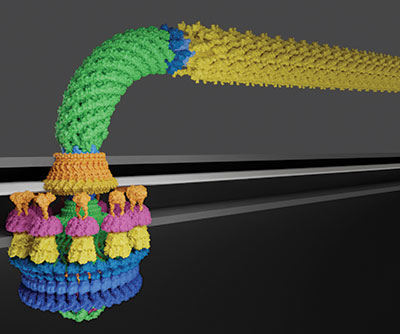
2. Structural scaffold: made of multiple rings, disks, and cage-like structures that stabilize the flagellar motors—especially the stator complexes. The design varies between species.
3. Central hub (typically called the MS-ring): connects the central gear to the driveshaft.
4. Driveshaft (sometimes called the rod): transmits torque (rotational force) from the central hub to a universal joint outside the cell.
5. Bushing: a type of bearing that creates a watertight seal around the driveshaft while stabilizing its rotation.
6. Universal joint (often called the hook because of its shape): changes the rotation axis of the flagella and transmits torque from the motor to the propeller filament.
7. Helical filament: a propeller.
8. Export gate and assembly motor (positioned inside the flagellar motors): sort out proteins and export them to the appropriate assembly sites at the required times to construct each flagellum.
9. Navigation system: While not part of bacterial flagella, this is crucial for bacteria to avoid harmful conditions and find food. Bacterial navigation systems integrate many components, including sensors that detect environmental conditions and algorithms to interpret sensory inputs and activate appropriate flagellar switches.
The Gear Box
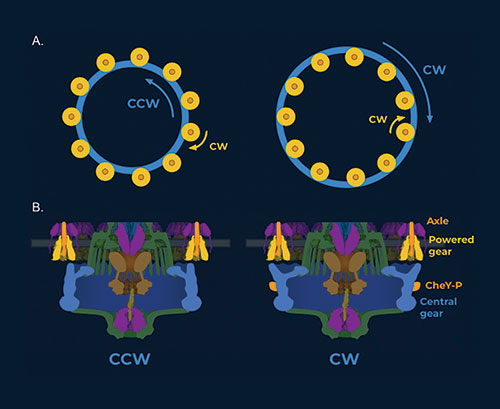
Keiichi Namba, a molecular engineer at Osaka University, said that the flagella gear box is “just like a two-cogwheel gear system.”3 Figure 3 shows 11 stator complexes in yellow, also called powered gears, per flagellum. They always rotate clockwise when viewed from outside the cell. In forward mode, the central gear (blue ring in Figure 3) lines up with the inner side of the ring of stator complexes. In this position, the central gear rotates the flagellum counterclockwise.
What about spinning in reverse? Signaling proteins from the navigation system bind to the outside of the central gear. This tilts the central gear outward to enlarge its diameter (Figure 3). The central gear then engages with the outer side of the stator complexes so that the central gear and the rest of the flagellum rotate clockwise (reverse). After a set amount of time, a component of the navigation system can then remove the reverse signal from the motor to switch the central gear back into forward.
How does the rotation of the smaller gears drive the rotation of the central gear? The central gear has a set of knobs. The stator complexes have five knobs each, shaped like gear teeth. Both sets of knobs precisely align. As far as we know, these gear teeth do not touch each other like man-made gears do. Instead, electrical charges at specific positions on the teeth exert force at a distance.
This is analogous to man-made contactless (nearly frictionless) gears with magnets in the teeth that push on one another. As one technical paper put it, “Highly conserved charged and neighboring residues [amino acids] of the A subunit [gear protein] interacts with the rotor, generating torque through a gear-like mechanism.”5 For a detailed discussion of other design features of the flagellum gearbox as well as the design features of other flagellum parts, see David Thomas’ upcoming review.6
How Did This Get Here?
Famous evolution defender J. B. S. Haldane once said that evolution by natural selection could never craft “various mechanisms, such as the wheel and magnet, which would be useless till fairly perfect.”7 If he was right, then evolution flounders on just one bacterial flagellum with its wheels and electrostatic gears.
Bacterial flagella are truly spectacular molecular machines. Their precise detail and sophistication require a Master Designer just like the God of the Bible.
References
- Berman, H. M. et al. 2000. The Protein Data Bank. Nucleic Acids Research. 28 (1): 235–242.
- Jumper, J. et al. 2021. Highly accurate protein structure prediction with AlphaFold. Nature. 596: 583–589; Varadi, M. et al. 2022. AlphaFold Protein Structure Database: massively expanding the structural coverage of protein-sequence space with high-accuracy models. Nucleic Acids Research. 50 (D1): D439–D444.
- Namba, K. 2020. A proposed gear mechanism for torque generation in the flagellar motor. Nature Structural and Molecular Biology. 27 (11): 1004–1006.
- Image sourced from Thomas, D. 2023. Fascinating new insights into the design of bacterial flagella. Creation Matters. 28 (1).
- Terashima, H. et al. 2022. Mutations in the stator protein PomA affect switching of rotational direction in bacterial flagellar motor. Scientific Reports. 12: 2979.
- Thomas, D. 2023. The Design of Bacterial Flagella: Part 1–Flagellar Design in Model Organisms. Journal of Creation. 37 (2): 83–95.
- Dewar, D., L. M. Davies, and J. B. S. Haldane. 1949. Is Evolution a Myth?: A Debate between Douglas Dewar, L. Merson Davies and J. B. S. Haldane. London: C. A. Watts/Paternoster Press, 90.
* Dr. Thomas is Research Scientist at the Institute for Creation Research and earned his Ph.D. in paleobiochemistry from the University of Liverpool. David Thomas is the pen name for an undergraduate student from Oceania studying biological sciences.