


A longtime advocate for creationism once asked me for an easy way to understand how a theory of biological design (TOBD) fits in the big picture of the evolution versus creation debate. I said that to zero in on the key issue he must use terms that precisely reflect the views—and that are easy to remember. The biology debate is really all about the clash between engineered biology and evolutionary biology.
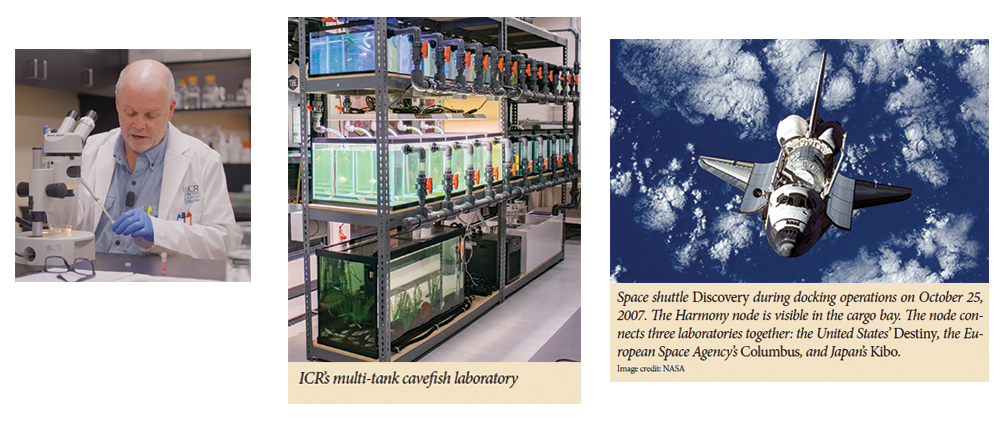
Living things, I told him, are exceedingly more than simply designed. A birdhouse and space shuttle are both designed. What intuitively leaves people in awe of a shuttle launch is that myriads of complicated parts operate together. It’s the engineering that stuns them as they quietly think, “What kinds of people thought all of this up and skillfully built it?” Like these man-made structures, creatures share corresponding characteristics of engineering (such as control systems, optimization, efficiency, robustness, modularity, etc.) that engineers work into space shuttles and other things. Creatures with corresponding engineered features are the primary general revelation that a creator with infinite wisdom, genius, and power exists.
So, as much as I value the terms “TOBD,” “design,” and even “creation,” the most accurate descriptor of living things, with little ambiguity that carries a powerful argument by itself, is engineered biology. This is what creationists and intelligent design advocates should be talking about.
Lessons from the Success of Flood Geology
 The questioner is thankful that he finally has a satisfying way to think about biology since ICR introduced a TOBD along with our continuous environmental tracking (CET) model of adaptation. But he now wants to know why this compelling creationist explanation for biology hasn’t been as successful in the broader creation-evolution debate as, say, the Flood geology model.
Was the Flood a real historical event? Creationists said yes. That fact became the foundation on which flood geology and its parallel interpretation were built.
The power of the Flood geology model is that it views as fundamentally flawed the uniformitarian idea that present geological processes are the key to understanding past ones. Flood geology deliberately avoids any harmony with other interpretations. Instead, it offers the substitute explanation that the biblical, global, catastrophic Flood is the key to understanding geological history. Longtime students of ICR’s teaching should readily understand where flood geology fits into the creation-evolution debate—it’s a superior explanation. Superior in what ways? It’s consistent with the Bible, and scientifically, there’s incredible agreement between the Flood model and field observations. Perhaps most importantly, however, it serves as a framework to shape how to think about geology.
Creationists should want that same type of clear, stand-alone explanation to powerfully shape the way we think about biology and guide our research.
Until the last 65 years, much of biology was an enigma, which allowed imaginative narratives to fill knowledge gaps. We also face sophisticated opposition. Creationists must correctly understand what truths evolutionary ideology is targeting in our position if we want our alternative models to be on target as accurate replacements to evolutionary theory.
Evolutionary Biology Consolidates Evolutionary Ideology
 At the pinnacle of the creation-evolution debate, creationists are facing something called evolutionary biology. When someone uses this term, it’s important to know that they could be referring to at least three related but distinct concepts. Thus, evolutionary biology can be:
1. A worldview.1 This worldview begins with a universal common ancestor that originated naturally and has diversified by the process of descent with modification into increasingly complex forms—which supposedly explains the origin of organisms and their “apparent” design.2
2. A theory of adaptive change. This theory hypothesizes that biological traits, and even behaviors, come about through random genetic mutations that are fractioned out through a deadly trial and error process that solves environmental challenges and eventually produces “fitter,” increasingly diverse organisms.3,4
3. A research methodology. Methodology is rooted in theory. In evolution, the fundamental assumption that there’s no purposeful intent in biology tightly controls what questions can be asked, dictates the experimental approach, frames how findings are interpreted, and shapes conclusions.
Creationists Didn’t Identify the Objective of Evolutionary Biology
Are creatures engineered? Creationists said yes. In this case, however, that fact didn’t stimulate creationists to integrate engineering principles (or causality) into explanations for operation.
Is this the main reason why creationists had not produced a creationist model for biology, as had been similarly done with flood geology to counter uniformitarianism?
Focusing on ICR’s history, until the TOBD, our responses to the above concepts of evolutionary biology have been limited and accommodative. We unequivocally rejected concept number one. We largely accepted number two but said it couldn’t accomplish all that Darwin claimed. To address number three, our research questions focused on random mutations or the probability limitations of good versus bad mutations.5 We offered a lighter version of evolutionary theory to explain adaptation, but that has never been a formidable response to evolutionary biology.
Why didn’t creationists develop a distinctive perspective for creationist biology? It’s because we didn’t fully grasp the objective of the evolutionary biology perspective. We failed to correctly perceive that words and phrases within evolutionary biology like natural, random, purposeless, blind, no regard to future needs, trial and error, unpredictable, etc., are intended to counter the basic engineered characteristic of purposefulness. The long-standing objective remains this: to destroy the view that creatures are engineered.
A distinct creationist perspective on biology would view creatures like any engineered entity, assume stochastic processes are themselves part of more broadly regulated systems, and approach research with the hypothesis that creatures look highly engineered because they are.
We failed to see that evolutionary biology is all about changing the public's view of God by changing how people view His creatures. If creatures are truly just natural products, never-ending works in progress with useless organs, and bad designs that were cobbled together by a death-driven process . . . then who needs or wants a creator god like that? You don’t need to attack God; Darwinism’s mutation-selection mechanism already does it.
A distinct creationist perspective on biology would predict finding finished organisms that are highly adaptable within parameters. For example, the space shuttle is highly adaptable. At the time of launch, systems are functionally complete, not works in progress. The ability to self-adjust to new conditions doesn’t indicate incompleteness, but rather, a highly complex state of completeness.
We failed to see the inherent mysticism of projecting selective (i.e., intelligent and volitional) abilities onto nature. We used “selection” as a causal explanation rather than looking to a creature’s innate abilities. These reinforced the evolutionist’s view of nature as exercising agency through the supposed creative force of selection. Conversely, we failed to credit the engineered problem-solving capabilities of biological systems.
 A distinct creationist perspective on biology would search for engineering principles and control systems that likely correspond in operation to those humans engineered. Explanations would use precise engineering causality. This approach neither omits system elements nor inserts mystical “selection events” between exposure and response.
We failed to work the Bible’s characterization of death as a curse and an enemy into our explanations. Instead, evolution’s death-driven story of survival of the fittest became our means of adaptation that we, accommodatively, linked to the Fall. We promoted selection as a “conservative” process. Meaning what? When children with genetic diseases die before their reproductive years, the population’s genome is “conserved” from more corruption.
Lastly, a distinct creationist perspective on biology recognizes that the main mechanisms used by creatures today to adaptively self-adjust are the originally engineered mechanisms existing since creation, not the Fall. They were initially engineered to enable creatures not to survive, but to continuously fill a very dynamic earth. Death-related adaptation since the Fall is expected to be the exception and not the rule.
Clearly, in order to introduce a perspective that directly counters—not accommodates—evolutionary biology, we must step up to a level higher than the TOBD.
Engineered Biology Is the Answer to Evolutionary Biology
“Engineered biology” is a term that encompasses multiple ideas, directly countering evolutionary biology. These ideas represent the apex perspectives of creation and evolution, yet they are polar opposites.6,7
Engineered biology can also refer to related but distinct concepts. It can serve as:
1. A descriptive term. Engineered biology accurately depicts the way biological systems operate.
2. A framework that shapes how to think about biology. Frameworks act like guardrails when developing either a high-level theory or a model to explain broad or limited phenomena. Engineered biology views the operation of an organism like any other engineered object, such as a space shuttle. It assumes engineered systems will explain all biological functions and, thus, expects to find purposeful operation from the molecular to ecosystem levels. Engineered biology sees organisms operating by 100% internal causes, through discoverable, innate control systems. These often regulate the expression (or modification) of specific traits that changes creatures’ potential to successfully solve challenges posed by internal or external environments.
 3. A research methodology. As I mentioned earlier, methodology is rooted in theory. This is where a TOBD fits in. Research progresses under the following assumptions: all systems can be reverse engineered, they operate by engineering principles, and the discovery of these principles is essential for accurate descriptions of biological phenomena. Studying human-engineered entities will aid in building models to explain biological systems performing similar functions (e.g., metabolism, adaptation, etc.). Recognizing that even different organisms can work in interactive communities, each organism must still be studied as a clear-cut entity with a definite boundary. Therefore, engineered biology should be understood as a distinctive way to practice biological research by developing hypotheses, interpreting findings, and analyzing systems to flesh out conclusions.
Coupling these concepts with the lessons learned from evolutionary biology above, the hierarchy of ICR’s biological research is:
1. Engineered biology. This is a broad approach to understanding biological functions that hypothesizes creatures are engineered, sees them operating with purposeful engineering via innate control systems, and frames explanations of operation like any other engineered entity.
2. Theory of biological design. Research questions and subsequent experimental setup are directed to discover engineering principles. The engineer’s non-mystical approach in describing causality is then used to produce precise explanations of biological operation.
3. Continuous environmental tracking model of biological adaptation. This is a model flowing from a TOBD that posits creatures track changing environments through numerous mechanisms, many with corresponding features to human tracking systems, to purposefully express traits targeted to solve specific challenges.
Thus, engineered biology is far more than identifying irreducible complexity, specified complexity, or just complexity in general.8 It represents a research hypothesis about biological operation. It mustn’t be confused with an inference about the best explanation for origins.
Engineered Biology: The Best Approach to Research Engineered Creatures
At ICR, we see that the evidence indicates engineered biology is far superior to any other approach. Conventional biologists would greatly benefit from employing engineered biology as their research framework, including ones who, for their own religious reasons, disbelieve in the Creator. The truth is, many of the assumptions or basic tenets of a TOBD have been used for decades in making biological, specifically medical, discoveries. Unfortunately, conventional biologists then gloss these findings in an evolutionary narrative to demonstrate their orthodox materialism and survive peer review.
ICR’s position is that when an institution consistently and successfully conducts biological research from an engineering perspective, engineered biology could become an identifying hallmark for that institute. When people think of organizations that practice and promote engineered biology, hopefully one of the first that comes to mind is ICR.
References
- A worldview is a context that shapes someone’s thinking about the biggest questions in life.
- Theistic evolutionists embrace the same scenario but usually add that God intervened—in scientifically undetectable ways—at life’s origin and through diversification events.
- Both atheistic and theistic selectionists usually include standing or created genetic variation.
- Coyne, J. A. 2009. Why Evolution Is True. New York, NY: Viking, 119.
- For ICR’s early position see Parker, G. 1980. Creation, Selection, and Variation. Acts & Facts. 9 (10). For ICR’s changed position see Guliuzza, R. J. 2023. Mutation-Selection: A Calamitous Creationist Concession. Acts & Facts. 52 (2): 4–7.
- Guliuzza, R. J. 2026. Making a TOBD Easy: A Conversation That Says It All. Acts & Facts. 55 (2): 4–7.
- Guliuzza, R. J. 2024. Why Biology Needs a Theory of Biological Design, Part 2. Acts & Facts. 53 (3): 4–7.
- For early treatment of the observation that some biological systems require all their key components to work so that if even one component is removed, the system loses its basic function (now popularly dubbed as irreducible complexity), see Parker, G. 1980. Creation, Selection, and Variation. Acts & Facts. 9 (10). See also Rue, H. M. 1984. Bomby the Bombardier Beetle. El Cajon, CA: Institute for Creation Research.
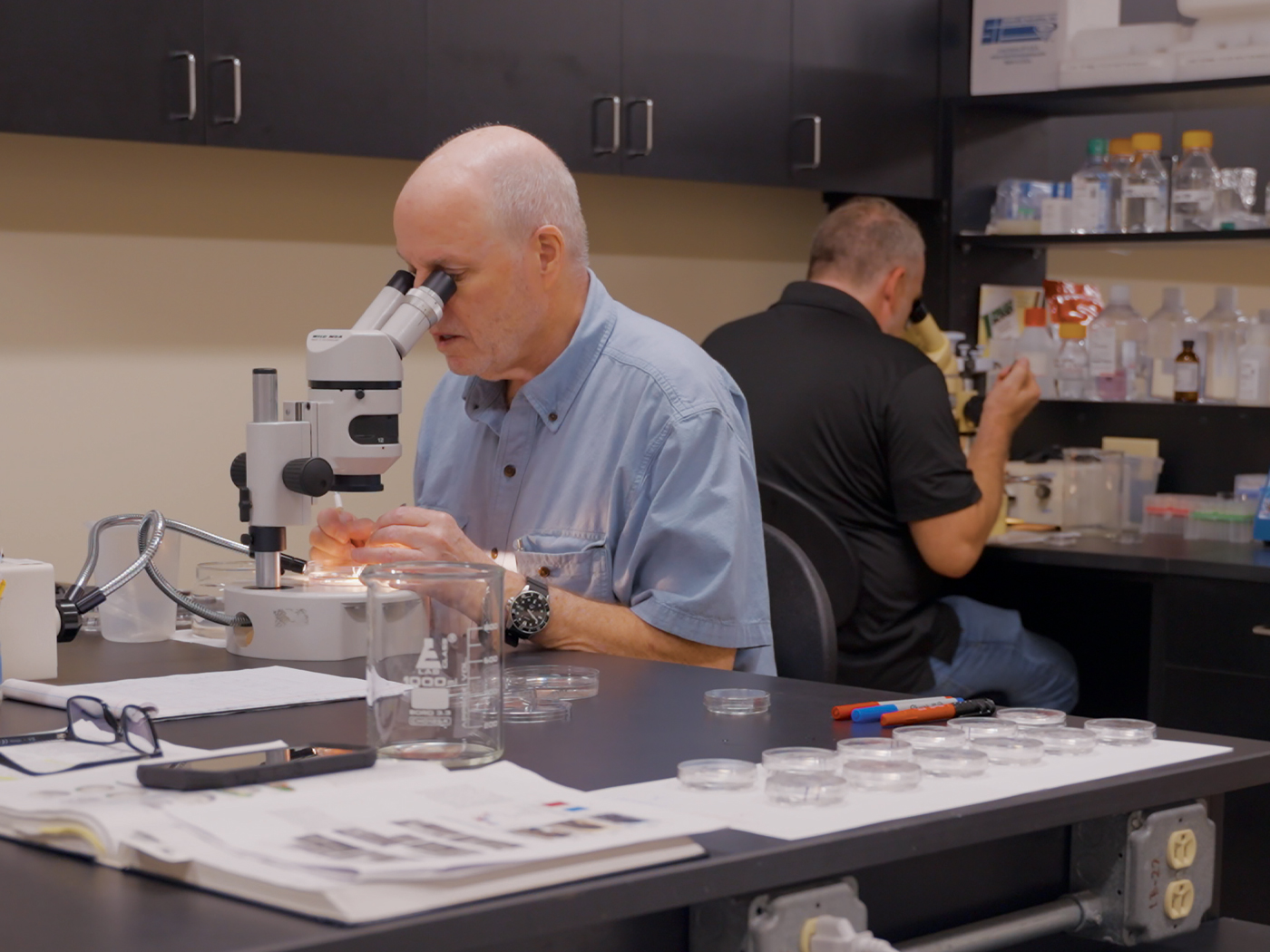
Stage image: Research scientist Dr. Michael Boyle and research assistant Michael Lane prepare cavefish samples
Dr. Guliuzza is the president of the Institute for Creation Research. He earned his doctor of medicine from the University of Minnesota, his master of public health from Harvard University, and received an honorary doctor of divinity from Southern California Seminary. He served in the U.S. Air Force as 28th Bomb Wing flight surgeon and chief of aerospace medicine. Dr. Guliuzza is also a registered professional engineer and holds a B.A. in theology from Moody Bible Institute.