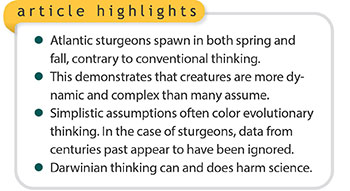
 Chesapeake Bay, the world’s largest bay, continually confuses evolutionists, but not so Atlantic sturgeons, who periodically spawn in that bay’s tributary rivers.1 Why? Erroneous assumptions about Atlantic sturgeon (Acipenser oxyrhynchus), compounded by the “latest therefore greatest” fallacy, are at least partly to blame.
Consider these Darwinism- promoting sentences recently posted on the Chesapeake Bay Program website:
The Atlantic sturgeon is a bony, ancient-looking fish that visits the Chesapeake Bay in spring to spawn in Virginia’s James and York rivers.…Sturgeons are prehistoric fish that have existed for more than 120 million years.2
The second sentence errs with evolutionist-imagined eons of surplus years, whereas the Bible reports sturgeons as originating on Day 5 of the creation week ~6,000 years ago (Genesis 1:20-22). Yet the innocent-looking first sentence is also false because it’s been well-documented, for enough years to justify notice, that sturgeons of Chesapeake Bay’s tributaries primarily spawn in fall, not in spring!1-4
It now appears that one reason adult fish [i.e., spawning Atlantic sturgeon] were overlooked [and assumed “extirpated”] is that biologists were looking at the wrong time.…Initially, the biologists concentrated their search in the spring.3
Why were these fish not seen? Sturgeons are large fish—sometimes 7 to 12 feet long and weighing 200 to 500 pounds—so they should not be difficult to see!2,3 However, in the 1990s, “most biologists” reported that only the James River had a small-yet-breeding springtime population of sturgeon. But during autumn, the James River has thousands! Also, nearby tributary Pamunkey River sports spawning populations, as well does tributary Marshyhope Creek.3
Professor Dave Secor, who once labeled Chesapeake’s sturgeons as “ghosts” of the past, now admits that these sturgeons now mostly spawn during autumn.
Although a bit embarrassed by being wrong, I am also delighted. Duped by sturgeon, I became their student rather than their authority.…Historically known to be springtime big-river spawners, fall spawning now seems to be the dominant behavior.4
Were sturgeons already spawning during autumn prior to the 1990s, or is this phenological pattern something new, e.g., a CET-based rapid self-adjustment?5
Also, what if Atlantic sturgeons can spawn during both springtime and autumn? Oversimplification errors, such as when evolutionists assume that “all” East Coast fish should limit their anadromous spawning (migrating from saltwater to fresh to spawn) runs to springtime, should be critically examined because God’s animal life cycles are never “simple” and not prone to one-size-fits-all explanations.1 Moreover, it helps to research all of the relevant data—don’t just “cherry-pick” the “latest” publications of “leading” scientists.1
Actually, historical records report Atlantic sturgeons spawning in the Chesapeake Bay watershed from March throughout September.3 Ignored in 2011, Dr. Matthew Balazik disputed the “Chesapeake sturgeons are extirpated” pessimism. Colonial-era records (e.g., in 1613) recorded sturgeons spawning in later September.3 Likewise, American Indians named August’s full moon “the sturgeon moon” due to its spawning phenology.3
But pre-Darwin science data are often ignored by evolutionists, who discount empirical observations and reports of not-so-modern observers, erroneously assuming that only “the latest [evolution-based] science” is worth trusting.1,4
Lesson takeaway: Not-so-modern data reported by reliable eyewitnesses should be weighed as relevant to avoid the “latest therefore greatest” fallacy.1,3,4
References
- Johnson, J. J. S. 2015. Anadromous Fish ‘that Swam with Dinosaurs’ Neither Extinct Nor Extirpated. Creation Research Society Quarterly. 51 (3): 207-208. Regarding scientific observations by not-so-modern scientists, see Johnson, J. J. S. 2014. Fishy Science. Acts & Facts. 43 (2): 17. Regarding God’s creatures never being “simple,” see Johnson, J. J. S. 2021. Eating Bugs Isn’t Always So Simple. Acts & Facts. 50 (10): 20.
- Atlantic Sturgeon (Acipenser oxyrhynchus). Chesapeake Bay Program. Posted on cheapeakebay.net, accessed January 5, 2022.
- Blankenship, K. 2014. Atlantic Sturgeon Back in the Chesapeake Bay, or Did They Ever Leave? Chesapeake Bay Journal. 24 (9): 1-18, quoting page 18, emphasis added. This article’s online version was updated July 14, 2020, with reports regarding Dr. Matthew Balazik’s empirical and historical research.
- Secor, D. 2021. Atlantic Sturgeon: Not the ‘Ghosts’ I Once Thought They Were. Chesapeake Bay Journal. 31 (9): 36. Regarding fish giving instruction, see Job 12:8. Regarding our need to carefully respect the past, see Proverbs 22:28.
- Regarding CET and adaptation triggers, see Guliuzza, R. J. 2018. Engineered Adaptability: Sensor Triggers Affirm Intelligently Designed Internalism. Acts & Facts. 47 (2): 17-19. Regarding rapid self-adjustments to changing environments, see also Johnson, J. J. S. 2020. Interrupting Business as Usual. Acts & Facts. 49 (3): 21.
* Dr. Johnson is Associate Professor of Apologetics and Chief Academic Officer at the Institute for Creation Research.