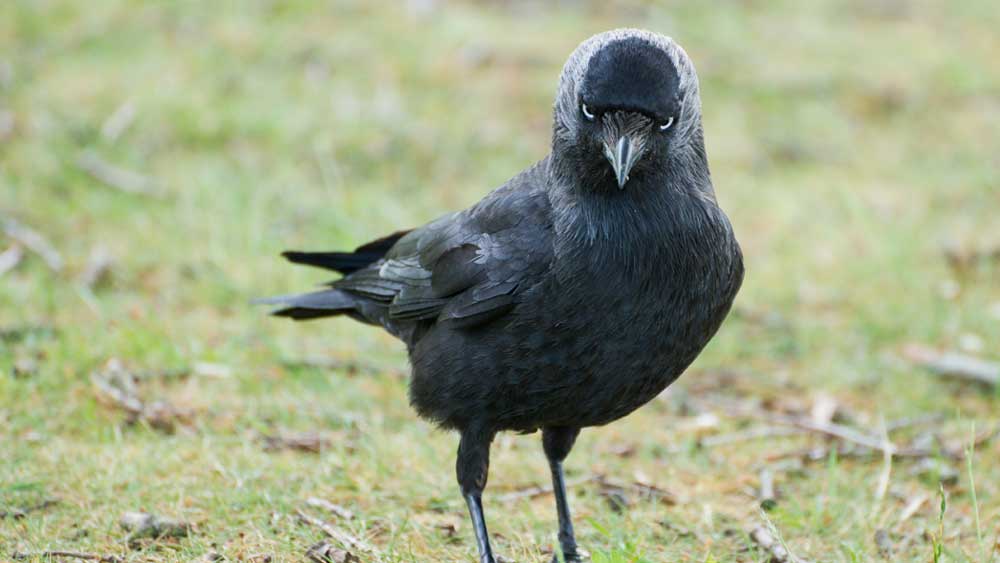
Consider Europe’s crow-like bird the jackdaw that can identify which humans are “safe” and which humans are “dangerous.”
Jackdaws can identify “dangerous” humans from listening to each other’s warning calls, scientists say. The highly social birds will also remember that person if they come near their nests again, according to researchers from the University of Exeter [in Devon, England].2
Recent research shows how these birds deal with danger.
Here, we tested whether wild jackdaws (Corvus monedula) use social learning to recognize dangerous people. Using a within-subjects design, we presented breeding jackdaws with an unfamiliar person near their nest, combined with conspecific alarm calls [warning that this human was dangerous]. Subjects that heard alarm calls showed a heightened fear response in subsequent encounters with the person compared to a control group, reducing their latency to return to the nest. This study provides important evidence that animals use social learning to assess the level of risk posed by individual humans.3
Specifically, the jackdaws were experimentally observed on how they reacted to jackdaw signals,3 giving information about approaching humans—namely, which humans were potential threats that needed to be quickly avoided.2
Audio recordings were played, to signal if a new human was “safe” or a threat.
In the study, a person unknown to the wild jackdaws approached their nest. At the same time scientists played a recording of a warning call (threatening) or “contact calls” (non-threatening). The next time jackdaws saw this same person, the birds that had previously heard the warning call were defensive and returned to their nests more than twice as quickly on average.2
In short, the experimental observations show that wild jackdaws can remember which humans are nice (or not) to them. This shows that wild jackdaws report this evaluative information among themselves.
Not only do the birds promptly take appropriate defensive actions, they recall later which humans they were warned to avoid.2,3
These birds don’t rely upon evolutionary “good luck” to avoid dangerous people. These jackdaws are given and utilize wisdom, with a little help from their friends.
God Himself made these communicative birds smart and mutually helpful.5
References
1. Johnson, J. J. S. 2020. Comparing Starling Murmurations to Social Distancing. Creation Science Update. Posted on ICR.org April 16, 2020, accessed April 30, 2020. See also Johnson, J. J. S. 2019. God Crafted Creatures to Communicate. Acts & Facts. 48 (11):21.
2. Lee, V. E., N. Régli, et al. 2019. Social Learning about Dangerous People by Wild Jackdaws. Royal Society Open Science. 6:191031.
3. Watson, P. 2019. Jackdaws can Identify ‘Dangerous’ Humans, Scientists Say. Independent. Posted on Independent.co.uk September 24, 2020, accessed April 30, 2020.
4. Remembering who is nice, or is not, is a trait not limited to corvid birds. Human children, even without direct help from adults, are especially quick to learn and likely to recall such experiences. Abernathy, A., and T. Abernathy. 1998. Bud and Me, the True Adventures of the Abernathy Boys. Irving, TX: Dove Creek Press, 40-41, 44-45, 66-68, 86. Likewise, even bumblebees recognize specific humans, with some memory as to who is a problem requiring some kind of defensive attention. Sherwin, F. Bee Brains Aren't Pea Brains. Creation Science Update. Posted on ICR.org July 11, 2019, accessed April 30, 2020. See also Ropes, M. 2000. Mary Jones and her Bible. Tain, Scotland: Christian Focus Publications, 134-137. Bees specifically recognized Mary Jones as harmless and never stung her.
5. Proverbs 30:24-28. Johnson, J. J. S. 2017. Clever Creatures: ‘Wise from Receiving Wisdom’. Acts & Facts. 46(3):21. See also Burke, M. 2016. Only Clever Observers Realize Just How Intelligent Fish Crows Are. Chesapeake Bay Journal. 26(8):39.
*Dr. Johnson is Associate Professor of Apologetics and Chief Academic Officer at the Institute for Creation Research.