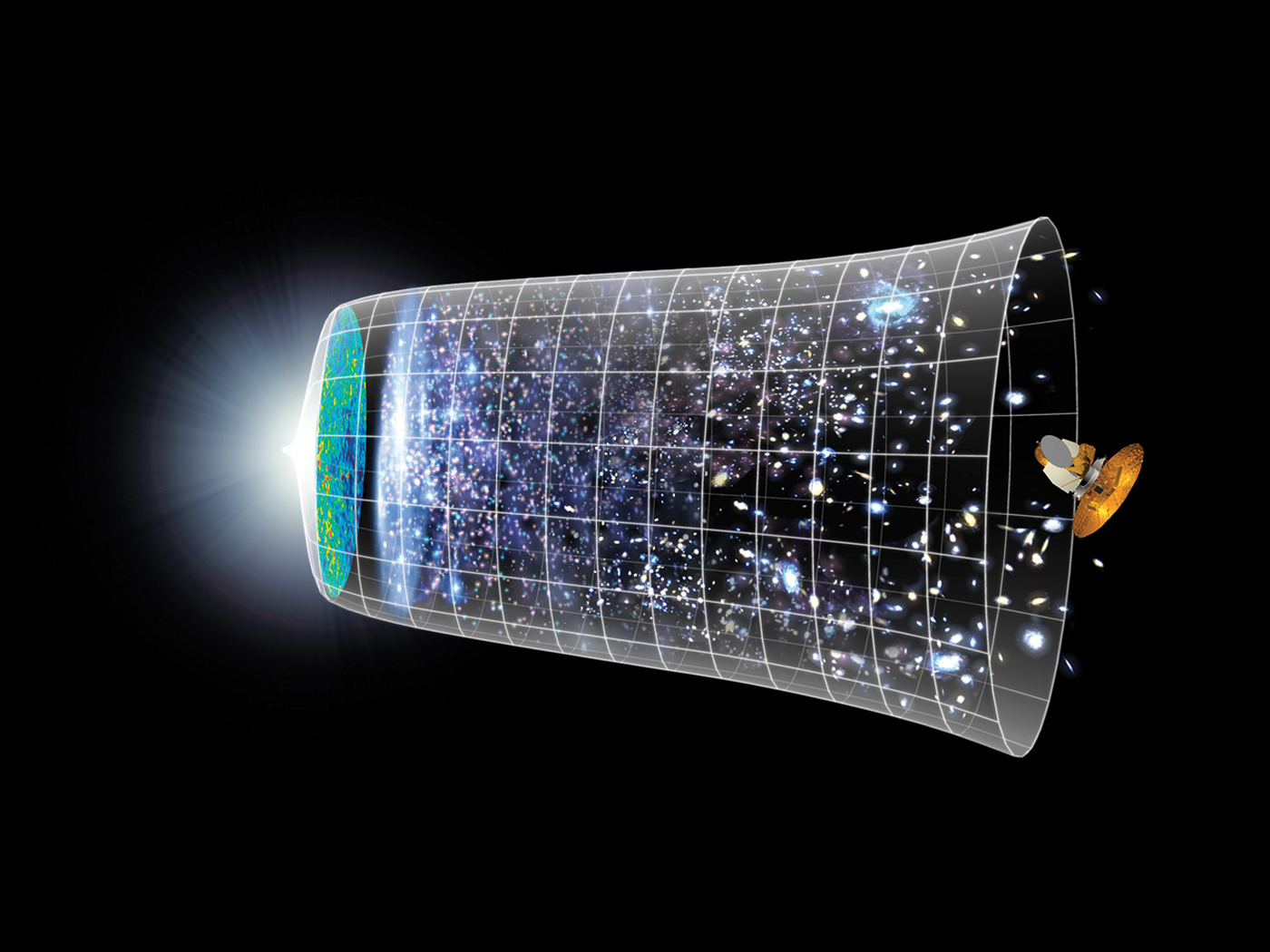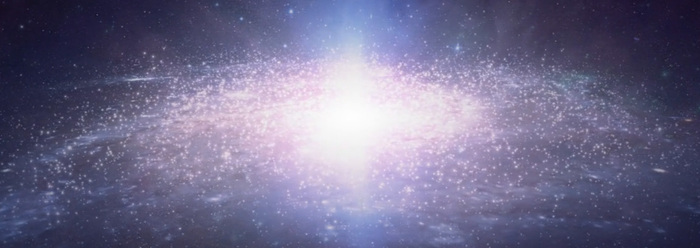
The Big Bang model for the origin of the universe certainly does not come from Scripture. No one could, and historically no one ever did, propose such an event as the starting point for creation simply by reading Genesis and the related passages. The most that could be said is that the Biblical account can be molded to conform to Big Bang ideas.
If we recognize the empirical nature of true science, that scientific models derive from observations of data in the present, then we recognize that the Big Bang idea of the unobserved past is not even good science. What we observe are points of light, each with certain unique luminosities, certain spectral bands, and other features like nebulous gas clouds. With the exception of an occasional explosive destruction of a star, these points of light are not seen to change or move with respect to one another. Their past may be theorized, but there well may be more than one legitimate view of history.
In Big Bang thinking, the spectral characteristics are interpreted as motion away from the viewer, the luminosity as age or stage of development, the gas clouds as stars not yet fully formed. But no star has been seen to form, and we certainly have not observed the Big Bang. In this view, all of these processes occur too slowly to be observed. Even after a million years, the location of the stars would remain the same, as far as we could tell.
It turns out that everything we think we know about the universe is really a mathematical model. To be fair, the Big Bang mathematical history does handle this array of data to the satisfaction of many working in the field (although many observations remain problematic). The question is, are there other mathematical models which work better? More importantly since Big Bang ideas conflict so obviously with the plain sense of Scripture (Earth created on Day One, the Sun and stars on Day Four, etc.), are there other mathematical models of history more compatible with Biblical history?
ICR adjunct professor Dr. Russell Humphreys has produced just such a model in his book, Starlight and Time. Is it right? I don't know—he doesn't know. His claim is only that his mathematical model is more Biblical and more scientific than the Big Bang mathematical model. Perhaps there are others even better which no one has thought of yet.
The Bible doesn't give the details, but it does say that all creation was "very good" (Genesis 1:31), perfect for God's purpose at the end of Day Six. Since the "lights in the firmament of the heaven (were) to divide the day from the night; and . . . be for signs, and for seasons, and for days, and years" (v. 14), they must have been visible on Earth at least by Day Six, and useful by man in keeping time. Since God was using creative processes during this creation period, processes which are not now observable, we can't know for sure how He did this; we can only speculate. At the least the universe must have been mature, able to accomplish its intended function. (This is not an appearance of age, but of maturity. In case we might mistake maturity for age, He told us when He created.)
Today, as we view the stars, our response should be one of praise to the Creator, giving Him (not a naturalistic mathematical model) the glory for its creation. And maybe someday, in eternity, He will give us the privilege of exploring the infinite universe, understanding it more fully and more completely, praising Him as Creator.
* Dr. John Morris is President of ICR.