




Was a Fossil "Fish-Hand" Discovered?
In order for the bizarre theory of evolution to be validated, evolutionists must show how inorganic non-life organized itself into carbon-based (organic) life. They also must show how major transitions in animals occurred, including how fish became the first tetrapods. This means fish fins would need to slowly turn into feet and legs.
Invasion of the Giant Lizards
We are already contending with the COVID-19 virus and the recent spate of murder hornets in the Pacific Northwest, but now sobering news coming out of Georgia sounds like a B-level horror movie.

An Ocean of Viruses
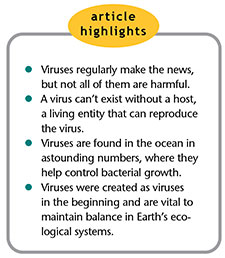 A virus is a very tiny structure that, in its simplest definition, is some nucleic acid (either DNA or RNA) packed inside a protein coat. Viruses can’t live on their own—they are designed to replicate inside living cells.

Avian Ventilation and Ventilators
During this time of the devastating COVID-19 pandemic, medical science is seeking a vaccine as well as drugs that will treat the symptoms. In the meantime, much has been reported on the ventilator, a lifesaving device that is used on the most serious cases.
Bats Have Always Been Bats
Bats have been in the news lately,1 but bats themselves are not new—they were created on Day 5 of Creation Week, along with other flying creatures.
Bats are a large and fascinating group of flying mammals. They include over 1,400 species. Not surprisingly, the fossil record shows bats have always been bats. They suddenly appear in a most un-Darwinian manner.
Pages
