Apparently, it's time to alter biology and anatomy textbooks again. There's much more to mitochondria than we ever thought. Researchers revealed that these tiny cellular power houses are highly organized to efficiently deliver ATP energy. They interconnect throughout muscle cells, forming a gigantic mitochondrial network. Researchers published this stunning discovery in Nature, calling it the "mitochondrial reticulum."1
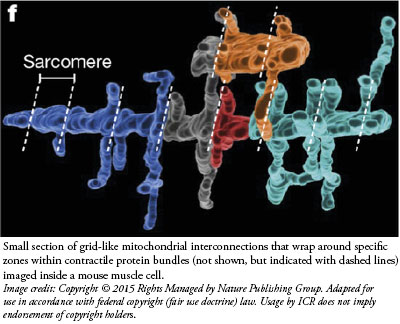 The interconnected mitochondrial net wraps around long, tubular, protein bundles that contract inside cells to make muscles move. This design efficiently delivers the right fuel to the right place at the right time and in the right quantity. But the scientists found more.
Areas of the mitochondrial net that lie next to blood capillaries "are optimized for generating the mitochondrial membrane voltage, while the interconnected mitochondria deep in the muscle are optimized for using the voltage to produce ATP," according to lead author Robert Balaban in a National Institutes for Health news release.2
Variable voltages maintained throughout the network fuel the mitochondrial machines that generate ATP. In other words, carbohydrate chemical energy enters the mitochondrial reticulum near the source, gets converted to electric energy which travels deep into the muscle cell, and that gets converted to ATP chemical energy right where muscle proteins need it the most. It's a brilliant manufacturing and distribution array "that resembles the wire grid that distributes power throughout a city."2
If real people designed and built power grids in cities, it stands to reason that a real Person made miniature mitochondrial power grids in muscle cells, which are even more complicated and more tightly regulated than human-engineered systems.
References
- Glancy, B. et al. 2015. Mitochondrial reticulum for cellular energy distribution in muscle. Nature. 523 (7562): 617-620.
- High-resolution 3D images reveal the muscle mitochondrial power grid. National Institutes for Health News. Posted on nig.gov July 30, 2015, accessed August 6, 2015.
*Mr. Thomas is Science Writer at the Institute for Creation Research.
Article posted on August 20, 2015.