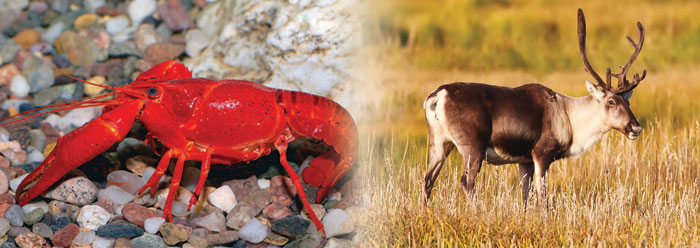
An unusual law has helped some creation science evidence to “go wild.”
Unsurprisingly (for Bible believers), mounting evidence increasingly shows that only the Genesis explanation of our world’s origin—and Earth’s present ecological equilibrium—makes sense. Animal ecology is purposefully balanced; it’s not a simple hodgepodge of evolutionary “accidents.”
We can thank Congress for much of what we now know about American wildlife, specifically, the Federal Aid in Wildlife Restoration [Pittman-Robertson] Act (P-R Act) in 1937.1 The P-R Act focuses financing of scientific research projects involving field studies of animals in their natural habitats. This approach improves upon stereotypical research done on experimental animals in laboratories because the facts learned in the field are usually more relevant for understanding how animals actually function.
But if biologists can conveniently research in climate-controlled laboratories, why spend money on ecologists’ in-the-wild field studies?
Crayfish in the Laboratory
Consider, for example, an experimental laboratory study of crayfish feeding habits that uses an aquarium in a temperature-controlled lab illuminated by artificial lighting. When biologists observe crayfish eating food supplied to them in such a laboratory setting, what are the biologists actually learning? Since crayfish prefer to forage in the dark or semi-dark, the experimental data largely constitute “artifacts” (outcomes biased by artificial conditions). The overly simplistic experimental results don’t teach us much that is both reliable and relevant about how crayfish behave naturally.
To learn how crayfish really live, we need to observe them in the wild, without them noticing that we are watching. Imagine how crayfish react to giant humans gawking at them as they eat! Hidden cameras in natural habitats can record candid behaviors, representative of real-world activities.
So, for learning ecology, there is no substitute for field study observations. And field studies, more than lab experiments, demonstrate the interactive complexity of the real world, with the resilient balancing dynamics that God programmed for it.2
Caribou in the Wild
Using P-R Act field study funding, what have we learned about caribou (Rangifer tarandus) and how they behave in the wild? Surveys using aerial photography inform us about a herd’s migration and calving patterns. Captured caribou are fitted with radio-transmitting collars and tracked by the latest space-satellite technology.3 Biologists previously thought that wolves were the only serious predator of Alaskan caribou. Not so. Brown bears often consume cervids, including many caribou. Likewise, in the wild, ectoparasitic mosquitos and endoparasitic brain worms plague them. Even golden eagles, which congregate hungrily near calving sites, prey on newborn caribou calves—a fact now beyond dispute due to modern monitoring technology.3
Caribou interact with other animals (wolves, bears, deerflies, mosquitos), plant life (willow, birch, aspen, tundra lichens), and their expansive geophysical environment, which varies according to seasonal migrations. How caribou populations survive, and thrive, is an ongoing, complex, and non-random balancing act.
God created caribou. God conserves their herds today. They interact with habitat neighbors and changing seasons. That caribou flourish in seasonal ranges exhibits God’s providential care for His creation—animals, plants, environment, and humans—even in this fallen world (Romans 8:21-22; John 1:3). If we are thoughtful observers, surely we are reverentially amazed.
This biogeographical drama of Rangifer tarandus herds—acted out in arctic tundra and boreal habitats—powerfully provides us with “clearly seen” proofs of God’s caring conservation of His own handiwork. Alaskan caribou are marvels in motion, created and conserved by the Lord Jesus Christ (Colossians 1:16-17; Romans 1:19-20).
References
- The Pittman-Robertson Act, as amended since 1937, is codified at 16 U.S.C. § 669, with implementing regulations (at 50 C.F.R. § 80.4). The P-R Act requires state fish and wildlife agencies to segregate (“lock-box”) and spend state hunting and fishing license fee revenues, for federally approved wildlife restoration/conservation programs. See, e.g., Sportsmen’s Wildlife Defense Fund v. U.S. Dep’t of Interior, 40 F.Supp.2d 1192, 1197-1199 (D. Colo. 1999).
- Johnson, J. J. S. 2015. Anadromous Fish “That Swam with Dinosaurs” Neither Extinct nor Extirpated. Creation Research Society Quarterly. 51 (3): 207-208.
- Kallmann, Harmon, chief ed. 1987. Restoring America’s Wildlife, 1937-1987: The First 50 Years of the Federal Aid in Wildlife Restoration (Pittman-Robertson) Act. Washington, D.C.: U.S. Department of the Interior, Fish and Wildlife Service, 190-207.
* Dr. Johnson is Associate Professor of Apologetics and Chief Academic Officer at the Institute for Creation Research.