In a recent analysis of how dozens of species propel their bodies through air and water, a collaborative team found not only ideal design but also common design.1
To successfully propel themselves through water or air, animals must possess structures that can produce thrust. Birds fly gracefully, and fish and whales glide through water with what appear to be unforced, easy motions. Wings and fins seem to fit these animals' environments so precisely that an observer could deduce these appendages are designed for efficient thrust in air and water, respectively.
An insightful new report from researchers representing Roger Williams University, Providence College, Indiana University-Bloomington, the Marine Biological Laboratory, California Institute of Technology, Harvard, and Texas A&M-Galveston applied engineering analyses to the complex ways animals move in a fluid environment. The team studied animal subjects from 59 diverse species and their findings were published in Nature Communications.1
Reverse engineering reveals ideal propulsion structure, shape, and performance
Using reverse engineering, the study authors discovered that vastly different creatures all propel themselves using the same basic mechanics.2 Contributing researcher Nathan Johnson of Texas A&M-Galveston commented to the Houston Chronicle on their surprising findings: "We found insects, birds, bats, whales, fish, dolphins, [and] even smaller molluscs are all using the same basic mechanics."3 Results showed that, "comparison of video sequences…for 59 animal species demonstrates clear, replicable patterns of spanwise propulsor bending during steady motion, which are similar over a broad range of animal sizes, fluid media and taxonomic groups."1
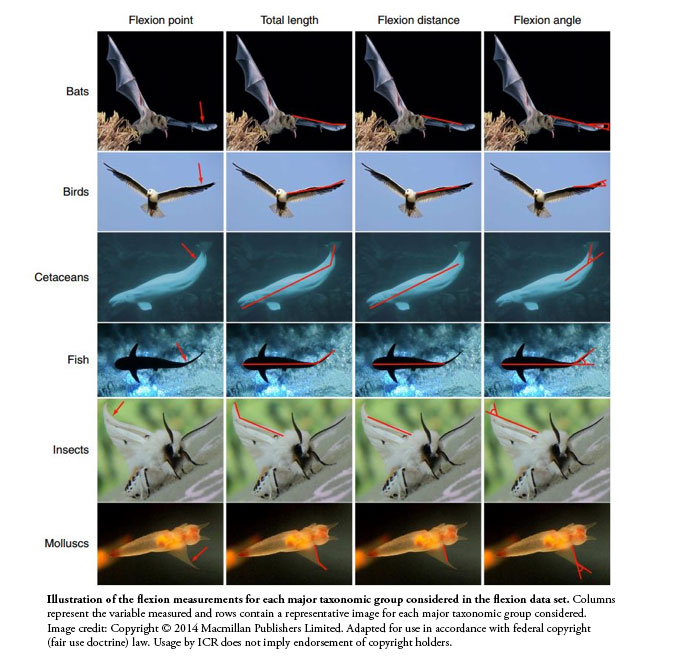
The team was able to extract exact measurements of the organisms' propulsion structures. Unlike the control surfaces of man-made wings and rudders, animal wings, fins, and flukes intentionally bend in a certain place as part of the propelling action during each phase of motion. The researchers' reverse engineering analysis surprisingly showed that, for all of the species studied, the wing, fin, or fluke would bend at essentially the same spot, which was at about two-thirds of the way out toward the tip.
Additional measurements found that the maximum degree of bend for the wings or fin tips was also very close for all species, averaging about 26 degrees. A plot of the bending distance versus the degree of flexion looked even more similar across all species. The incredibly comparable movement patterns of wings and fins in very dissimilar organisms is quite remarkable since these features are composed of diverse materials and constructed in some fundamentally different ways.
Further design analysis identified that the common point and degree of bending for these different organisms matched very energy-efficient thrust production. Fluid-dynamic tests revealed that the degree of bending in the design of these propelling structures greatly enhanced water or air circulation coming from the tips of the wings or fins (called "vortex circulation") that also enhanced thrust pressures. The study authors wrote, "Vortex circulation, thrust production and efficiency vary with flexibility, suggesting that the flexibility of animal propulsors may be tuned to maximize thrust production and efficiency by controlling vorticity associated with propulsor bending."1
Reverse engineering in this study stands out clearly, but in reality, the discovery of all biological function is essentially reverse engineering. If engineering analysis can clarify biological function, then why not try to use it to explain the origin of that function?
Explanations for ideal propulsion structure origins: mystical versus design-based
So how did a wide array of animal groups come to possess perfect flexibility in their wings and fins that optimizes their flying and swimming?
Johnson told the Houston Chronicle, "The best reason we can think that these similarities are there in nature is that they are the most energy efficient."3 Though they used design analysis to discover functions, the study authors apparently eliminated the possibility of a Designer as the cause of these similar, energy-efficient structures in diverse organisms. Was it because of evolutionary presuppositions?
Removing God as a cause leaves evolutionists in the position of explaining structures that are clearly intelligence-based without invoking an intelligent cause. Every time this occurs, they appeal to a magical, god-like agency somewhere in nature. The Houston Chronicle reported, "A magic formula of physics is propelling animals across the planet, from birds and sharks to jellyfish, according to a new discovery by researchers at Texas A&M Univeristy [sic]."3
In their Nature Communications report, the team pondered, "What factor(s) drive natural selection to converge on highly constrained bending kinematics across such a wide range of animal groups?"1 They speculated that natural selection was driven to converge on similar design by the quest for energy efficiency. This inevitably leads to affirming a substitute for the real Creator: The study "shows just how advanced Mother Nature's designs are compared to human engineering," wrote the Chronicle. "Scientists hope their findings will help technology catch up with millions of years of evolution."3
Invoking "magic" and "Mother Nature" irrationally departs from the clarity of engineering analysis by moving into areas outside of detection by human senses or instruments and beyond the realm of human understanding.
In contrast, as early as 1802, William Paley, a pioneer of design-based explanations, compared living things to human-engineered machines. He postulated that the origins of similar features in diverse creatures could be explained in the way man-made machine designs are copied and uniquely modified for similar uses.4
Dr. Henry Morris attributed design to an actual designer, writing, "In the organic realm, there are many similarities between different kinds of plants and animals….Creationists interpret similarities as evidence of common creative planning and design….Creationists explain them as structures designed by the Creator for specific purposes, so that when similar purposes were involved, similar structures were created."5
Paley's and Morris' explanations are consistent with the engineering analysis of the Nature Communications research group and link to everyday observations of the origin of design. These explanations also rightfully ascribe credit for the ideal and common design in creatures to their Creator.
References
- Lucas, K. N. et al. 2014. Bending rules for animal propulsion. Nature Communications. 5:3293.
- Reverse engineer. transitive verb. To disassemble and examine or analyze in detail (as a product or device) to discover the concepts involved in manufacture usually in order to produce something similar. Merriam-Webster. Posted on merriam-webster.com, accessed March 13, 2014.
- Alexander, H. A&M study finds magic formula of physics moves every kind of animal on earth. Houston Chronicle. Posted on chron.com February 20, 2014, accessed March 14, 2014.
- Paley, W. 1802. Natural Theology: or, Evidences of the Existence and Attributes of the Deity, Collected from the Appearances of Nature, 2nd ed. London: R. Faulder, chapter xii, 227-258.
- Morris, H. 1974. Scientific Creationism. San Diego, CA: Creation-Life Publishers, 69-70.
*Dr. Guliuzza is ICR's National Representative.
Article posted on March 14, 2014.