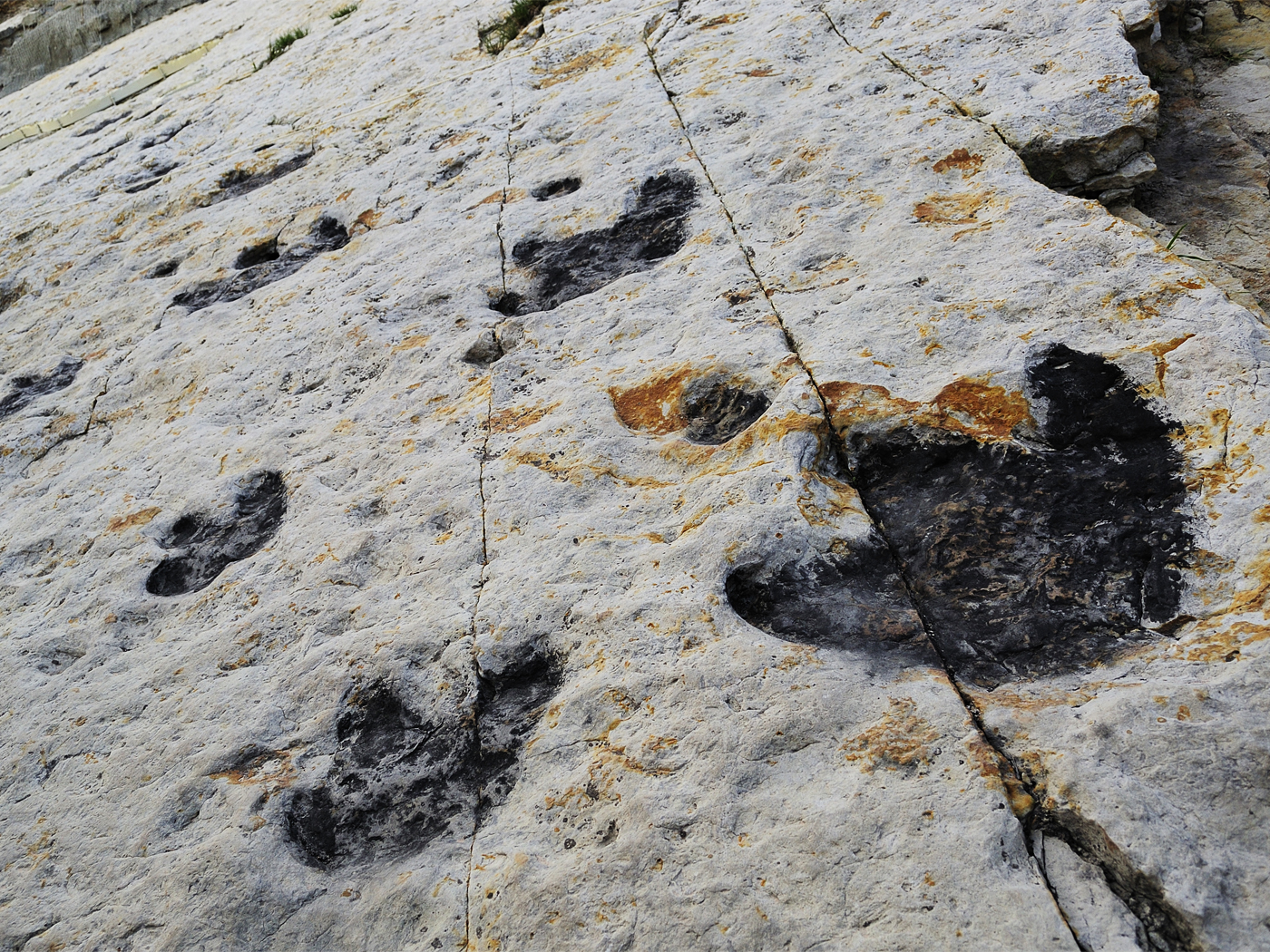
What's so fascinating about dinosaur tracks? Maybe it's because their many mysteries beg for solutions. For instance, because tracks in mud are so short-lived today, how did dinosaur tracks ever preserve in the first place? Newly described prints bolster biblical creation's explanation of dinosaur footprints.
Researchers working in China's Sichuan Province recently reported their discovery in the Chinese Science Bulletin.1 Their article documents several different types of dinosaur trackways, including two theropods (bipedal “lizard-hipped”), one sauropod (long-neck), and four ornithopods (duck-billed) all traveling in the same direction at about the same time.
The scientists determined at least one of the theropods was partly afloat as its feet swiped the underwater mud. Its fifty-foot trackway shows a number of tip-toe scratches and claw scrapings. A second theropod, walking in the same direction and on the same horizon as the first, was apparently wading in the water as it left more complete footprints. These scientists interpret the tracks were made as these dinosaurs crossed a river, possibly during a flood event.1
The study authors estimated both dinosaurs had hip heights of just under three feet—from sole to hip—but if they had similar leg height, why didn't they produce similar tracks? The evidence of both swimming and wading indicates rapid fluctuations in water depth.1 The first dinosaur was able to wade through the shallow water, while the second, same-sized dinosaur—apparently just moments later—had to swim as the water level rose quickly.
The parallel trackways of the sauropod and the ornithopods (all within several feet of one another) also indicate they had been wading through the water. The hip heights of these animals were higher than the two theropods, so they evidently had no need to swim.1
Creation scientists have suggested many animals swam to escape the Flood waters.2,3,4 These trackways in Sichuan confirm that water overwhelmed the dinosaurs and forced them to swim for their lives for as long as they could, clearly following the Flood events and timeline from the book of Genesis. This deluge created rapid fluctuations in water levels—its tsunami-like waves quickly covering the land surface, and then just as rapidly, draining off. In contrast to the Flood's grand-scale destruction and deposition, evolutionists call upon dinky, local river floods to explain these sites.
The consistent direction of the trackways also implies that all the dinosaurs were traveling in the same direction at the same time, trying to escape the approaching Flood water.
Researchers in Australia reported a similar situation occurred at a trackway site in Queensland, Australia.5 There, scientists found evidence of the same species of dinosaurs walking and wading, indicating similar rapid fluctuations in water depth.
The evidence for the Flood is found all over the world. Trackways of swimming dinosaurs on many continents confirm the global extent of the cataclysm. Dinosaur track formation clearly required abnormal and catastrophic circumstances. These desperate creatures ran, waded, and swam for as long as they could, but all succumbed to the overwhelming power of God's judgment as reported in Genesis.
References
- Xing L., M. Lockley, J. Zhang, et al. 2013. A new Early Cretaceous dinosaur track assemblage and the first definite non-avian theropod swim trackway from China. Chinese Science Bulletin. April. doi: 10.1007/s11434-013-5802-6.
- Morris, J. 2012. The Global Flood: Unlocking Earth's Geologic History. Dallas, TX: Institute for Creation Research; and Morris, J. and J. J. S. Johnson. 2012. The Draining Floodwaters: Geologic Evidence Reflects the Genesis Text. Acts & Facts. 41 (1): 12-13.
- Oard, M. J. 2011. Dinosaur Challenges and Mysteries. Atlanta, GA: Creation Book Publishers.
- Thomas, B. New Dinosaur Tracks Study Suggests Cataclysm. Creation Science Update. Posted on www.icr.org January 25, 2013, accessed March 1, 2013.
- Romilio, A., R. T. Tucker, and S. W. Salisbury. 2013. Reevaluation of the Lark Quarry dinosaur Tracksite (late Albian–Cenomanian Winton Formation, central-western Queensland, Australia): no longer a stampede? Journal of Vertebrate Paleontology. 33 (1): 102-120.
* Dr. Clarey is Research Associate at the Institute for Creation Research.
Article posted on April 26, 2013.