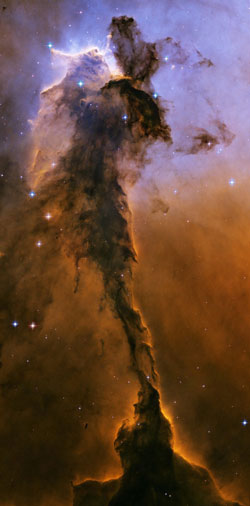
An international team of astronomers recently analyzed a specific frequency of light that hot gas clouds in outer space produce. Very hot stars, like blue stars, are thought to burn near or within these clouds, energizing the gas so that it can emit this characteristic light signature. Secular astronomers are also convinced that stars form inside these distant, turbulent, and gaseous zones.
The team, publishing in the Monthly Notices of the Royal Astronomical Society, surveyed the light from a wide range of redshifts.1 A higher redshift—when a characteristic light pattern appears shifted more toward the red end of the light spectrum—indicates a greater distance between the observer and the light source. So, they examined this light from near and far.
 Higher redshifts are also supposed to indicate that more time has elapsed since that light departed from the faraway glowing clouds. However, this assumes that light travels at the same speed in all directions—an assumption called the Einstein synchrony convention. No experiment has verified this assumption. Nobody has yet invented one that could.
The astronomers found more of these hot gases at higher redshifts. They interpreted that result to conclude that half of all stars formed naturally during a two-billion-year window of time that ended eight billion years ago. But these conclusions amount to mere speculation when considering how unproven the assumptions are that undergird them.
News describing this study fails to mention these assumptions. For example, the National Astronomical Observatory of Japan said in a press release, "Using the same method and techniques is a powerful way to look back in time to obtain fully comparable chunks of the Universe, which contain hundreds of star-forming galaxies."2 But do astronomers really peer "back in time," and do "star-forming galaxies" really exist?
No direct evidence supports either assertion, and some evidence refutes them. First, star formation has never been observed, even in the hot gas clouds in galaxies where it supposedly occurs. Stars could only form in theory through an unlikely nearby star explosion. And then that exploded star would need another earlier nearby star explosion. Clearly, the first star would never have formed.3 Plus, this process would have littered the universe with debris from countless star explosions. Instead, it is as clean as a whistle, which is a big problem for secular astronomers looking for missing supernova remnants.4
There is no good scientific reason to think that these distant glowing gas clouds are star nurseries. But calling them that is the only way to justify the existence of stars in a naturalistic worldview—one in which a universal Creator is universally ruled out of bounds. Scripture says that God made the stars all on one day and then completed that creative work. Based on this, one would not expect to find stars forming today. Star formation is an assumption, not an observation.
Second, the Monthly Notices authors assumed that high redshifts equaled billions of years. One could, with equal validity, assume that starlight travels instantaneously from its source to the viewer, as long as it travels at half the measured round-trip speed of light in the other direction.5 This way, starlight represents what is happening right now, albeit trillions of miles away.
But rejecting the Einstein synchrony convention—that light travels at the same rate both toward and away from the viewer—means that although stars are billions of light-years away, they are not necessarily billions of years old. Is there any observable evidence to suggest that distant stars or galaxies are younger than billions of years?
Yes. Ironically, the same blue stars that likely cause the gas cloud radiation that the international team of astronomers surveyed are just such evidence. Blue stars burn out so fast that they can barely last a million years. And blue stars are found throughout the universe—both near and far—showing that the whole universe is far younger than secular astronomers are willing to admit.
Spiral galaxies are also like cosmic egg-timers, still ticking away as though they are young.6 Because they are also distributed near and far throughout the universe, they refute the secular notion of billions of years of cosmic history.
Do stars form today? Not according to observational knowledge. Do astronomers see into the past through telescopes? Only if they assume that they do. And distant blue stars and spiral galaxies refute the claim that the universe is billions of years old.
The study authors claimed that star formation has dramatically slowed. But their observations are more consistent with Scripture, which teaches that star formation has totally stopped.
References
- Sobral, D. et al. 2012. A large Hα survey at z = 2:23; 1:47; 0:84 & 0:40: the 11 Gyr evolution of star-forming galaxies from HiZELS. Monthly Notices of the Royal Astronomical Society. Published online before print, November 7, 2012.
- Time-Traveling with One Method Illuminates the Evolution of Star Formation in the Universe. National Astronomical Observatory of Japan press release, November 5, 2012.
- Lisle, J. 2012. Blue Stars Confirm Recent Creation. Acts & Facts. 41 (9): 16.
- Thomas, B. Rare Supernova Recalls Missing Remnants Mystery. Creation Science Update. Posted on icr.org September 6, 2011, accessed November 15, 2012.
- Lisle, J. 2010. Anisotropic Synchrony Convention—A Solution to the Distant Starlight Problem. Answers Research Journal. 3 (1): 191-207.
- Thomas, B. Distant Galaxies Look Too Mature for Big Bang. Creation Science Update. Posted on icr.org November 30, 2011, accessed November 14, 2012.
Image credit: NASA
* Mr. Thomas is Science Writer at the Institute for Creation Research.
Article posted on November 20, 2012.