Christmas Island belongs to an idyllic group of islands in the northeast Indian Ocean. The animal biology (zoology) of this island is bountiful. Its vertebrates include birds and a very few mammals, and its invertebrates include14 species of land crabs and other arthropods such as the pesky and increasingly common yellow crazy ant. About two-thirds of this Scottie dog-shape island is a protected Australian national park.
When it comes to animals, Christmas Island has an abundance of birds! A wide variety of native and non-native birds of all sizes and shapes—including petrels, tropicbirds, cormorants, kingfishers, egrets, coots, terns, doves, falcons, stilts, sandpipers and many more—inhabit this naturalist’s wonderland. Christmas Island and the islands around it are important breeding places for many seabirds.
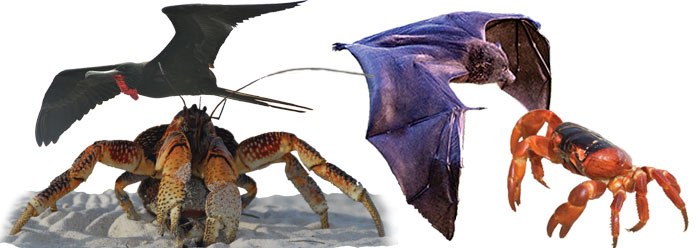
One of the more fascinating birds is the Christmas Island frigatebird—an aerial creature that prefers to get its meals on-the-wing by swooping down to the water or beach for a meal or even stealing food in-flight from a fellow bird. This beautiful bird is all-black with a white patch and has a characteristic forked tail. It is endemic to Christmas Island and does not swim or walk, but is content to majestically ride air currents and updrafts.
Most ornithologists agree that one of the most stunning birds in the world is the white-tailed tropicbird, unique to and ubiquitous on Christmas Island. It nests on the ground and has a golden tint to its otherwise white plumage. The characteristic silhouette of the golden bosunbird is seen on the flag of Christmas Island Territory.
Perhaps the most popular animal of these islands is the harmless 100 million-strong Christmas Island red crab (Gecarcoidea natalis). Online video clips of these legendary creatures show them risking their lives to migrate to the ocean and back again, with the males leading the way. They allow nothing to stop them as they march across roads and fields, through homes, and even over giggling school children. They spend most of their time hidden in the forest canopy, except during the rainy season when they head to the sea to spawn. At high tide, the females release eggs that immediately hatch as tiny larvae that grow and mature. Meanwhile, the adults climb up the Christmas Island cliffs and disappear into the forest until the next rainy season.
There are also huge, bluish robber crabs, or coconut crabs, that literally hang on the sides of trees or trash cans. They are a type of hermit crab and may be seen peeling the husks off coconuts or battling each other on the beach with their formidable claws. Coconut crabs are the largest land crabs on earth and span almost three feet across. These are smart invertebrates and have been seen dropping coconuts from a tree—and then dropping after them from over 12 feet high to eat the broken coconut. Sadly, their numbers are dwindling.
Christmas Island has had its share of animal extinction, from bats to rats. The islanders were once determined to retain five native mammals, but today only one is known to survive. The Christmas Island Pipistrelle, a four-gram microbat, is most likely extinct, although it numbered in the thousands just 20 years ago. Maclear's rat and the Bulldog rat have both become extinct, probably due to a blood-borne parasite. The same goes for the Christmas Island Musk-shrew that has been unseen since the mid-1980s. But in spite of the diminishing animal life, Christmas Island still provides a lush example of our Creator’s unique, diverse, and glorious creation.
* Mr. Sherwin is Research Associate, Senior Lecturer, and Science Writer at the Institute for Creation Research.
Cite this article: Sherwin, F. 2012. Christmas Island Zoology. Acts & Facts. 41 (12): 16.