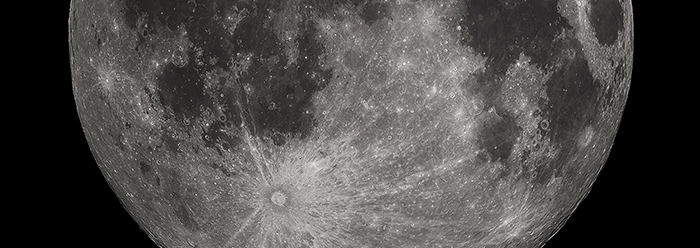
NASA recently released the most detailed images yet of the "far" side of the moon, or the side that faces away from earth.1 The Lunar Reconnaissance Orbiter took thousands of images that were assembled into a mosaic of the lunar surface. Both the moon's far and near sides contain craters, which may hold clues to its history.
The moon's craters have been the subject of many discussions. For example, researchers thought that the moon's cratering rate has been extraordinarily slow because of their belief that the solar system is billions of years old. If impacts caused craters at even a moderate rate, then during that many years the moon's surface should have been pulverized many times over, leaving the surface very heavily cratered. To them, the reason there are so few craters on the moon is that impacts have been relatively rare in the moon's history.
But two observations about craters and the impacts that caused them argue against a slow cratering rate and, hence, in favor of a young moon. First, "ghost craters" are found amidst lunar maria, which are dark, smooth areas. Maria resulted from lava that poured onto the surface from below after the crust was compromised by significant impacts. The ghost craters have been partly filled in by the lava, so that their rims are all that is visible today.
Significantly, "these craters existed in the impact basins before the lava came and partially filled them."2 Since the cooling time of lava would be rapid even on the moon, the time between the impact that spilled the lunar lava and the subsequent smaller impact that caused the ghost crater was short. This rapid succession of impact events means that the moon's cratering rate was fast, not slow.
Second, many, or even most, of the smaller craters on the moon and on the surfaces of other rocky bodies in the solar system were caused by secondary impacts.3, 4 These are made by ejecta that were propelled upward by a major hit and then crashed back onto the surface. This means that, given billions of years of impacts plus their secondary impacts, the moon should have been pulverized even more…perhaps orders of magnitude more than photos show.
The Lunar Reconnaissance Orbiter Camera discovered last year that the moon is not cold and dead, but geologically active, still forming scarps from thrust faulting, and young.5 Its new photographs show that the far side of the moon features lunar maria with ghost craters just like the near side does.6 The presence of ghost craters and the relatively low number of craters overall make the moon look young…closer to thousands, not billions, of years old.
References
- Photo Shows Far Side of Moon Like Never Before. Space.com. Posted on space.com March 21, 2011, accessed March 22, 2011.
- What You Aren't Being Told about Astronomy, Volume 1: Our Created Solar System. 2009. DVD. Directed by Spike Psarris. Creation Astronomy Media.
- Mars has many secondary craters strung out in rows that look "identical to lunar rays." See McEwen, A. S. et al. 2005. The rayed crater Zunil and interpretations of small impact craters on Mars. Icarus. 176 (2): 351-381.
- Venus has many secondary craters. See Korycansky, D. G. and K. J. Zahnle. 2004. Atmospheric impacts, fragmentation, and small craters on Venus. Icarus. 169 (2): 287-299.
- Watters, T. R. et al. 2010. Evidence of Recent Thrust Faulting on the Moon Revealed by the Lunar Reconnaissance Orbiter Camera. Science. 329 (5994): 936-940.
- The Far Side of the Moon -- And All the Way Around. NASA Lunar Reconnaissance Orbiter mission news. Posted on nasa.gov March 11, 2011, accessed March 22, 2011.
* Mr. Thomas is Science Writer at the Institute for Creation Research.
Article posted on April 11, 2011.