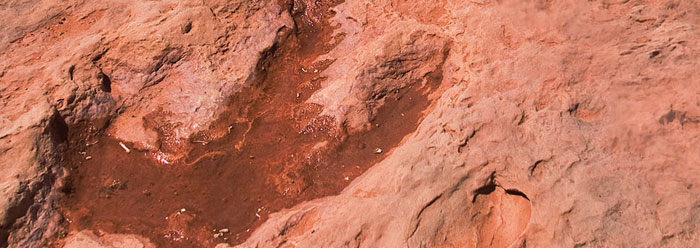
Dinosaur footprints are found in numerous locations around the world, on every continent. Typically they are found in strata that evolutionists identify as representing "dinosaur era" time, so their discovery isn't surprising to them. Creationists, however, insist that fossil-bearing strata were primarily deposited during the great Flood of Noah's day, and label the dinosaur fossils and footprint layers as coming from mid to late-flood episodes within that Flood.
A recent discovery of about 3,000 dinosaur tracks was announced from China. Here, tracks from creatures of several different species, sizes, lifestyles, and presumably habitats indicate they were all stampeding in the same direction. The researchers ask, "What were they all running from?" The carnivores couldn't have been pursuing the herbivores, because the footprints are intermingled. And what was chasing the carnivores? It's hard to reconstruct the event completely.
Perhaps the most notorious footprint-containing layer is the Glen Rose Limestone in central Texas, in the Paluxy River bed. Ever since the early 1900s, footprints of dinosaurs have been excavated here, along with elongated human-like footprints. To many, this proved humans and dinosaurs lived at the same time. For years while on the faculty of the nearby University of Oklahoma, I studied and documented these markings, and eventually wrote the definitive source book, Tracking Those Incredible Dinosaurs--and the People Who Knew Them, published by Master Books in 1980. Continued research led me to question the human interpretation of the human-like prints and, feeling the data were too ambiguous at that time to be certain, withdrew my book from circulation. Films for Christ withdrew their award-winning film Footprints in Stone from circulation at the same time. Research continues, and while I don't question the fact that humans and dinosaurs lived at the same time, I don't use the evidence from the Paluxy anymore. There is less problematic evidence for that conclusion.
But the question remains. How can fragile footprints made by any creature in mud survive the Flood's currents? Wouldn't the waves wash them away? Admittedly, the problems are serious, but they are much the same for evolutionists. How can easily eroded ephemeral markings survive for millions and millions of years? Investigation of the overlying and underlying strata provides a possible answer.
The Glen Rose Limestone in the Paluxy area measures scores of feet thick and contains multiple, rather thin layers of sandy limestone interspersed with layers of clay or sandstone. Prints are found in several of the layers. The layer immediately overlying the main print horizon consists of an unconsolidated clay made of fine, lightweight particles, which usually require slack water and unusual chemistry to be deposited. The limey muds were probably gravity-driven slurries cascading down shallow slopes. Evidently there were moments when the Flood's dynamic conditions alternated with somewhat calm times, and the water temporarily retreated. The twice-daily tides must still have acted, while pulsating tsunamis kept everything in turmoil. Temporary abatements allowed animals swimming for their lives to clamor over exposed mud flats, only to be overwhelmed when the waves returned. The prints were filled in by a less tumultuous layer, and thus protected while the sediments hardened into solid rock. All the print-making animals eventually died in the Flood, but they were not all dead at this stage.
Complete understanding of the Flood's complexity eludes us. The Flood processes were much more dynamic and complex than we have experienced or can fully comprehend. God promised such a thing would never happen again. Similarly, dinosaurs are extinct today, unavailable for observation and understanding. We must do our best, using Scripture as our guide.
* Dr. Morris is President of the Institute for Creation Research.
Cite this article: Morris, J. 2010. Tracking Those Incredible Dinosaurs. Acts & Facts. 39 (5): 15.