Most geologists are trained to think from a uniformitarian perspective—that "the present is the key to the past"—that present uniform processes operating throughout the past account for all present rock units. This concept considers coal to be the altered remains of plant material accumulated in a peat swamp. Let's look at modern peat swamps and the peat accumulating in their brackish waters and see if they would make a good coal.
Today's peat swamps sport extensive vegetation growing in shallow water or on saturated high ground. Nowhere can a laterally extensive flat surface be found. The decaying organic material collects in the stagnant, acidic water and takes on a rather "coffee grounds" texture with the wood and bark quite decayed, thoroughly penetrated by roots and animal burrows.
Let's compare this with a typical coal found in the geologic record. Although tectonics subsequent to deposition may have tilted or faulted the coal, modern coal seams usually show an extremely regular geometry. Often a knife-edge contact between the coal and the layers above and below can be seen. Most often the adjacent layers are shale or limestone, both "marine" deposits which necessitate a quite different environment of dep-osition from a terrestrial swamp. This involves repeated down warping and subsequent uplift in uniformitarian thinking.
The coal matrix is typically very fine grained, but surrounds abundant sheets of altered bark, recognizably different from the rest, giving coal a layered look. Seldom are roots present. Thin "clay partings" are almost always seen within the coal, often laterally extensive. They can be traced and correlated—some for miles. The seams are usually of rather constant thickness, and the now-flat bark sheets are consistent with the width and height of a tree. Although some variation does exist in all these parameters, everything about a coal seems different from a modern swamp peat, except it's high organic makeup.
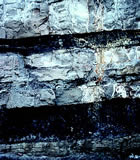 The accompanying photograph shows two coal seams visible in a road cut near Price, Utah. Observe the sharp contacts between the coal and the adjacent layers. If a swamp existed above sea level, but then was inundated by the sea to receive overlying marine sediments, then uplifted to become a swamp again, and the cycle repeated, one would think there would be some erosional channels or variation in peat thickness? How could they be so flat and of constant thickness, and how could there be such precise contacts above and below?
Modern-day peats do not seem to be of the same character as modern-day coals. Perhaps the creation model of decaying plant material collecting under a large floating mat during the Great Flood of Noah's day provides a better answer.
Cite this article: Morris, J. 2003. Did Modern Coal Seams Form in a Peat Swamp? Acts & Facts. 32 (8).