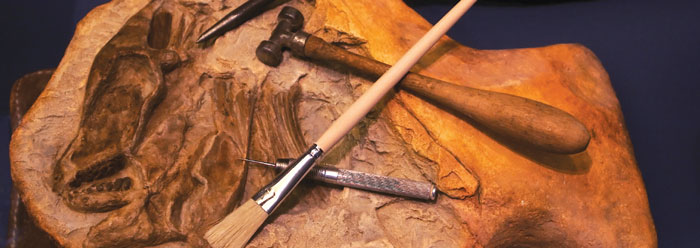
Fossils are typically found in sedimentary rock, almost all of which were originally deposited as sediments by moving water. Subsequent processes hardened them into sedimentary rock, as overlying pressure squeezed the water out and the grains were cemented together. Often plants and animals were trapped, being buried in the sediments. As the sediments hardened into sedimentary rock, the dead things hardened into fossils.
The vast majority of visible fossils are marine invertebrates, animals that live in the sea and have no backbone, mostly animals with a hard outer shell. This would include clams, coral, brachiopods, ammonites, and other animals familiar to us, as well as extinct animals like trilobites and crinoids. In some locations the deposits are dominated by fish fossils and more rarely insects.
Interestingly enough, while sedimentary rocks are found in most places, fossils are not so easy to find. Lots of sedimentary rocks contain no recognizable fossils at all, other than microscopic remains such as plankton, pollen, or spores. For instance, Grand Canyon, with thick sequences of sedimentary rock, contains surprisingly few fossils. This explains the excitement over the discovery of billions of two-foot long nautiloids in the Redwall Limestone by ICR's Steve Austin. "Fossils are where you find them" paleontologists say, and these fossils were found as creationists did their research from a creationist/flood perspective. They found what evolutionist/uniformitarian seekers missed.
The sedimentary rocks in which the fossils are found usually give evidence of rapid catastrophic deposition. The Grand Canyon nautiloids were trapped and buried by an extensive underwater gravity flow of mud covering what is now portions of several states, at least. Other Grand Canyon layers like the Bright Angel Shale and the Kaibab Limestone are equally widespread and are also thought to have resulted from catastrophic processes. They contain little more than fragments of fossils in a jumble of transported pieces.
One more thing. These catastrophically deposited marine fossils, entombed as they are in regionally extensive sedimentary rock, are all found on the continents! There are hardly any marine fossils found in the deep ocean basins.
The standard evolutionary view is that from time to time over the eons, a calm and placid sea covered what is now the continents. Over the millions of years of living and dying and coming and going the fossils were preserved as sediments slowly collected on the ocean bottom. But is there a better understanding? Let's summarize.
Marine fossils are found in rock layers which give testimony to dynamic water processes having deposited them. The layers themselves cover vast areas, sometimes on a continental or hemispherical scale. And they are prominently on today's continents.
Rather than demanding the conclusion of long ages of uniformity and evolution, the fossils speak of a time when the oceans fully destroyed the continents, employing catastrophic hydraulic and tectonic forces—a flood on a scale not witnessed today. Just such a flood was witnessed in yesteryear, however, and recorded for our edification in Genesis. It was the great Flood of Noah's day.