One of many problems in anthropology is how and why man's alleged ancestors decided to walk erect. Evolutionists see "the origin of bipedalism |as| central to understanding hominid evolution."1 Darwinism states humans began walking because forests supposedly dried up and they had to survive on the plains. But the details are unclear:
Fossil evidence demonstrates that by 4.1 million years ago, and perhaps earlier, hominids exhibited adaptations to bipedal walking. At present, however, the fossil record offers little information about the origin of bipedalism, and despite nearly a century of research on existing fossils and comparative anatomy, there is still no consensus concerning the mode of locomotion that preceded bipedalism.2
Three years later, an evolutionist from Duke University said, ". . . because of the paucity of the fossil record, the fragmentary nature of fossil remains, and the difficulty of inferring behavior from fossils, significant questions remain unanswered concerning the evolution of human bipedalism."3 This is not the case at all, of course. There are plenty of fossils.4 The problem is attempting to interpret them within the strange evolutionary paradigm.
The famous Laetoli footprints in East Africa, which appear to be quite human-like, continue to be a challenge for the evolutionary timeline of man. Specifically, an upright walking human could not have made these prints because they are too old. But evolutionist Russell Tuttle does not agree that A. afarensis (supposedly our ancestor) made these human-looking prints.5 He maintains an unknown hominid made them. Creationists suggest the unthinkable: modern man made these prints.
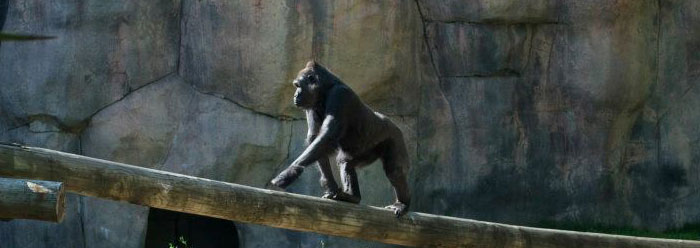
Recently, evolutionists were excited to discover that a Kurdish family in southern Turkey6 had a number of members that are palm walkers (gorillas and chimps knuckle walk). Finding humans with ape-like behavior certainly seems to be something that evolutionists were waiting for, although there is, according to the Times story, "fierce debate" among them. Creationists point to tragic "genetic faults" (mutations), as the culprit, that "their genes have triggered brain damage." The siblings have been determined to be severely mentally retarded possibly due to family inbreeding. This hardly sounds like evidence for human evolution.
While Darwinists continue to strongly disagree among themselves, "How and why natural selection favored the transition to bipedal posture and locomotion are likewise ongoing subjects of scholarly debate and conjecture"7 -- the model of our origin stands (so to speak) on Genesis 1:26-27.
References
- Stanford, C. B., 2006. Arboreal bipedalism in wild chimpanzees: Implications for the evolution of hominid posture and locomotion. American Journal of Physical Anthropology, 129:225.
- Richmond, B., and D. Strait, March 23, 2000. Evidence that humans evolved from a knuckle-walking ancestor. Nature, 404:382-385.
- Schmitt, D., 2003. Journal of Experimental Biology, 206:1437-1448.
- Solomon, E., L. Berg, and D. Martin, 2002. Biology, Brooks/Cole, p. 455.
- Tuttle, R., 1990. Pitted pattern of Laetoli Feet. Natural History, 99:64.
-
Lister, S., March 7, 2006. Walking on all fours with the ancestors. See: http://www.timesonline.co.uk/article/0,,
3-2072832,00.html - Stanford, C. B., op cit., p. 225.
* Frank Sherwin is a zoologist and seminar speaker for the Institute for Creation Research.
Cite this article: Sherwin, F. 2006. Walking the Walk. Acts & Facts. 35 (11).