What was the pitch that covered the Ark? Many have wondered what this could have been. Was it oil or some type of tree resin? A newly discovered Roman shipwreck has revived this debate. But this time, maybe it offers a resolution.
Numerous critics of young earth creationists argue that the pitch used to cover the Ark was a crude oil product. Evolutionary geologist David Montgomery goes so far as to claim oil and sedimentary rocks must have existed prior to the Flood, arguing, “A literal reading of the Bible requires that such rocks already existed at the time of the Flood because bitumen, the pitch or tar Noah used to caulk the ark (Genesis 6:14), comes from sedimentary rock.”1
Publishing in Frontiers in Materials, Armelle Charrie-Duhaut of the University of Strasbourg in France and colleagues studied a 2,200-year-old Roman shipwreck found off the coast of Croatia.2 Discovered in 2016 and excavated from 2017 to 2022, the recent report examined the waterproofing material that was painted on the exterior and interior of the hull.2 Ten samples were analyzed using spectroscopy and mass spectrometry to determine the organic makeup of the sealant.
Their results found that the adhesives were dominated by pine resins cooked to produce sticky tar, also called pitch. Molecular analysis also found a second substance in the sealant: wax esters indicative of beeswax. They noted, “Pitch tends to become brittle when cold, and adding wax improves the adhesive’s flexibility while further increasing its hydrophobic nature. This additive also reduces the adhesive’s viscosity [thickness] when hot, making it easier to apply.”2 They concluded, “This type of composition corresponds to the zopissa used by the Greek shipbuilders (Pliny the Elder, Natural History, XVI, 23).”2
The use of cooked pine resin (pitch) has been found on numerous ships dating back as far as 1120 BC in the Adriatic, Atlantic, and Mediterranean regions.2 Furthermore, the use of pine tar and other adhesives continued to be used by many Western European nations into the eighteenth century.2 So, it should be no surprise that the King James Version translators used this term in 1611 to translate the Hebrew word kopher, not to mean an oil product, but as a common wooden hull ship sealant of the time.
To be clear, as Dr. Henry M. Morris III pointed out, the Hebrew word used in Genesis 6:14, kopher, doesn’t literally translate as “pitch.” He stated, “The word is used 17 times in the Old Testament, and is translated “pitch” only in Genesis 6:14. Most of the time, kopher is translated with some term that represents money.”3 It seems that kopher was some sort of expensive sheathing or covering that was placed over the wood of the Ark. Dr. Morris added, “The kopher that sheathed or coated the Ark is not specified. . . . The idea that kopher was liquid is merely assumed. . . . Even if the material was a liquid coating, the development of resins or other non-petroleum coating materials has long been known to man.”4
But in the case of the Ark, the translators would have been familiar with tree resin tar. So, when the Bible refers to a wooden hull sealant like that on the Ark, they would have translated it into the common term of the day.
When and where did true crude oil, or bitumen, get used as a ship sealant? In the Middle East, where there are ample oil seeps. Conventional scientists have found evidence of the use of bitumen as a boat sealant as far back as 4500 to 3700 BC.2 Creation scientists realize these radiometric dates are not accurate. Instead, the usage of bitumen as a sealing mechanism likely dates back to the earliest centuries after the Flood when oil was beginning to seep from Flood rocks.
The first biblical reference to bitumen is around 100 to 340 years after the Flood, during the lifetime of Peleg (about 2250–2000 BC).5 In the Bible’s account of the Tower of Babel’s construction, we are told, “They had brick for stone, and they had asphalt for mortar” (Genesis 11:3). The Hebrew word for asphalt is chemar, sometimes translated as bitumen, cement, or slime. So here, unlike the use of the Hebrew word kopher (pitch), the Bible describes an oil tar or bitumen product, essentially a hydrocarbon.
Most likely, there was no oil before the Flood since the burial of marine plankton and algae during the Flood is the source material for crude oil.6 Without the rapid burial of these organics within Flood sediments, no oil would be formed in the past or today. We learn from this latest discovery that the “pitch” used by Noah was likely a product of cooked tree resins and not a crude oil product. And a similar sealant recipe has been used by humans for millennia since the time of Noah.
References
- Montgomery, D. R. 2012. The Rocks Don’t Lie: A Geologist Investigates Noah’s Flood. New York, NY: W. W. Norton & Company, 235.
- Charrie-Duhaut, A. et al. 2026. Adhesive Coatings in Naval Archaeology: Molecular and Palynological Investigations on Materials from the Roman Republican Wreck Ilovik–Paržine 1 (Croatia). Frontiers in Materials. 13.
- Morris, H. M. III. 2016. The Book of Beginnings: A Practical Guide to Understand and Teach Genesis, vol. 2. Dallas, TX: Institute for Creation Research, 30.
- Ibid, 32.
- Ibid, 134.
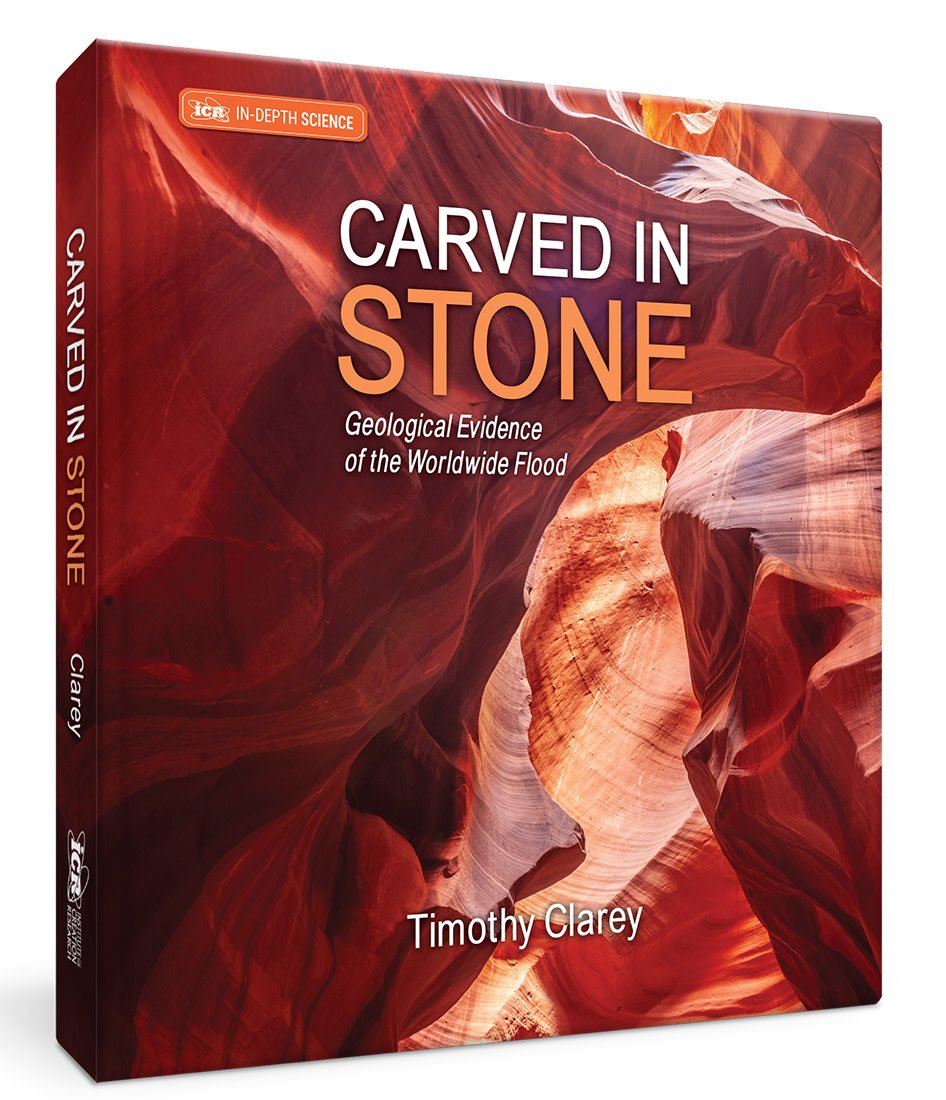
- Clarey, T. 2020. Carved in Stone: Geological Evidence of the Worldwide Flood. Dallas, TX: Institute for Creation Research, 418–431.
* Dr. Clarey is the director of research at the Institute for Creation Research and earned his doctorate in geology from Western Michigan University.