The book of Genesis tells us about a global flood that occurred about 4,500 years ago, an event that began with the bursting of the fountains of the great deep and a tremendous amount of rainfall (Genesis 7:11–12). This activity most likely caused rapid and widespread erosion across the surface of the earth. Do we actually see evidence of such erosion in the rock record? Yes!
For over 100 years, conventional science has struggled to explain the cause of the Great Unconformity (GUn).1 It is described as a globally extensive, near-planar surface of erosion that placed Cambrian sedimentary rocks on top of Precambrian crystalline rocks. Fossils of the Cambrian Explosion were also emplaced in some locations along the GUn, presenting yet another unsolved mystery for conventional science.2 Erosional surfaces where some of the rock record has been removed are known as unconformities. The GUn is the most extensive, enigmatic, and well known among all unconformities. In some places, many miles of erosion, or exhumation, may have carved the GUn.1
Until recently, conventional scientists have tried to explain this mysterious global erosion surface by claiming it was caused by “snowball Earth.”3 These researchers claimed that a massive episode of global glaciation eroded away as much as two to three vertical miles of rock between about 717 and 600 million years ago in three separate glaciations, creating the Great Unconformity surface.3 However, continental glaciers do not erode extensive, flat planar surfaces like the GUn.
Recently, another attempt to solve the GUn mystery was published in the Proceedings of the National Academy of Sciences, which cast more doubt on the snowball Earth theory.4 Led by Rong-Ruo Zhan of the department of geology, Northwest University, China, the team of scientists created “nearly continuous thermal histories . . . using a multimethod approach incorporating low-, medium-, and high-temperature thermochronology” at three locations in northern China.4
Essentially, they made cooling curves (thermal graphs) for the crust beneath the GUn. To do this, they assumed that higher temperatures resulted from deeper crustal depths and cooler temperatures resulted from shallower depths. In this way, they were able to calculate an exhumation record (amount of erosion) for the crust at each location. Then, they compared their results to previous studies for other continents.4
Their results did not support the snowball Earth for the origin of the GUn.4 Instead, they found that erosion began much earlier on the GUn surface, writing,
Unlike previously documented thermochronologic constraints on the origin of the GUn in the southern Rocky Mountains and Canadian Shield of Laurentia, evidence from multiple thermochronometers synthesized here strongly suggests that mechanisms driving most of the GUn denudation date from the late Paleoproterozoic, much earlier than the Cambrian Explosion of life or the onset of modern plate tectonics.4
The Paleoproterozoic, part of the upper Precambrian, is believed by conventional scientists to be about 1.6 to 2.5 billion years old. The Cambrian sediments on top of the GUn, on the other hand, are closer to 500 million years old (according to evolutionary dating methods).
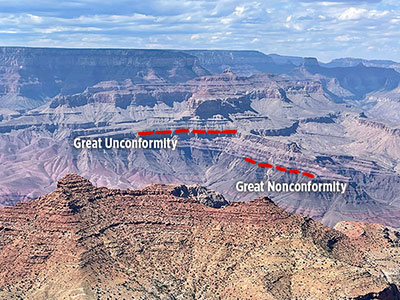
Obviously, ICR doesn’t accept these dates as accurate. But the results of this study do support an earlier beginning to the massive erosional event that likely marked the onset of the global Flood. This earlier erosional surface is known as the Great Nonconformity at Grand Canyon, possibly marking the beginning of the Flood.5 Note the planar nature of this nonconformity surface and the overlying GUn surface in Figure 1. Furthermore, this suggests that many Proterozoic (Precambrian) sediments may have also been part of the Genesis Flood.
Although the Cambrian Explosion, sitting atop the GUn, records the sudden appearance of the fossilized body plans of almost all animal phyla (buried by the Flood), these earlier Precambrian sediments below the GUn contain many microfossils, including those of multicellular creatures. However, they remain devoid of hard-shelled fossils (which appear later in the Cambrian). Regardless, these Precambrian sediments are found in limited locations on every continent, often resting on the crystalline crust like we find in Grand Canyon.6
This latest study still fails to provide conventional science with any type of consensus for the cause of the GUn. But it does indicate that an earlier episode of intense erosion occurred prior to its development, creating the Great Nonconformity. Then again, conventional scientists also struggle to explain the cause of this deeper erosional surface.
Although science continues to reveal new discoveries, conventional scientists are finding them more difficult to explain because they do not accept the Bible as real history. The best explanation for both of these global erosional surfaces is the great Flood, and the Great Nonconformity may mark the onset, as recorded in Genesis 7:11–12.
References
- Dinneen, J. Ancient Rocks Point to an Early Start for the Great Unconformity—The Biggest Gap in Earth’s Rock Record. Science. Posted on science.org on February 23, 2026, accessed February 27, 2026.
- Clarey, T. Cambrian Explosion Alive and Well. Creation Science Update. Posted on ICR.org January 14, 2021, accessed February 27, 2026.
- Keller, C. B. et al. 2018. Neoproterozoic Glacial Origin of the Great Unconformity. Proceedings of the National Academy of Sciences. 116 (4): 1136–1145.
- Zhan, R. et al. 2026. Tectonism Rather Than “Snowball Earth” Glaciation Is Responsible for the Great Unconformity. Proceedings of the National Academy of Sciences. 123 (9).
- A nonconformity is a type of unconformity (erosional surface) that has sedimentary rocks lying atop crystalline crustal rocks.
- Clarey, T. 2020. Carved in Stone: Geological Evidence of the Worldwide Flood. Dallas, TX: Institute for Creation Research.
Stage Image Credit: Tim Clarey
* Dr. Clarey is the director of research at the Institute for Creation Research and earned his doctorate in geology from Western Michigan University.