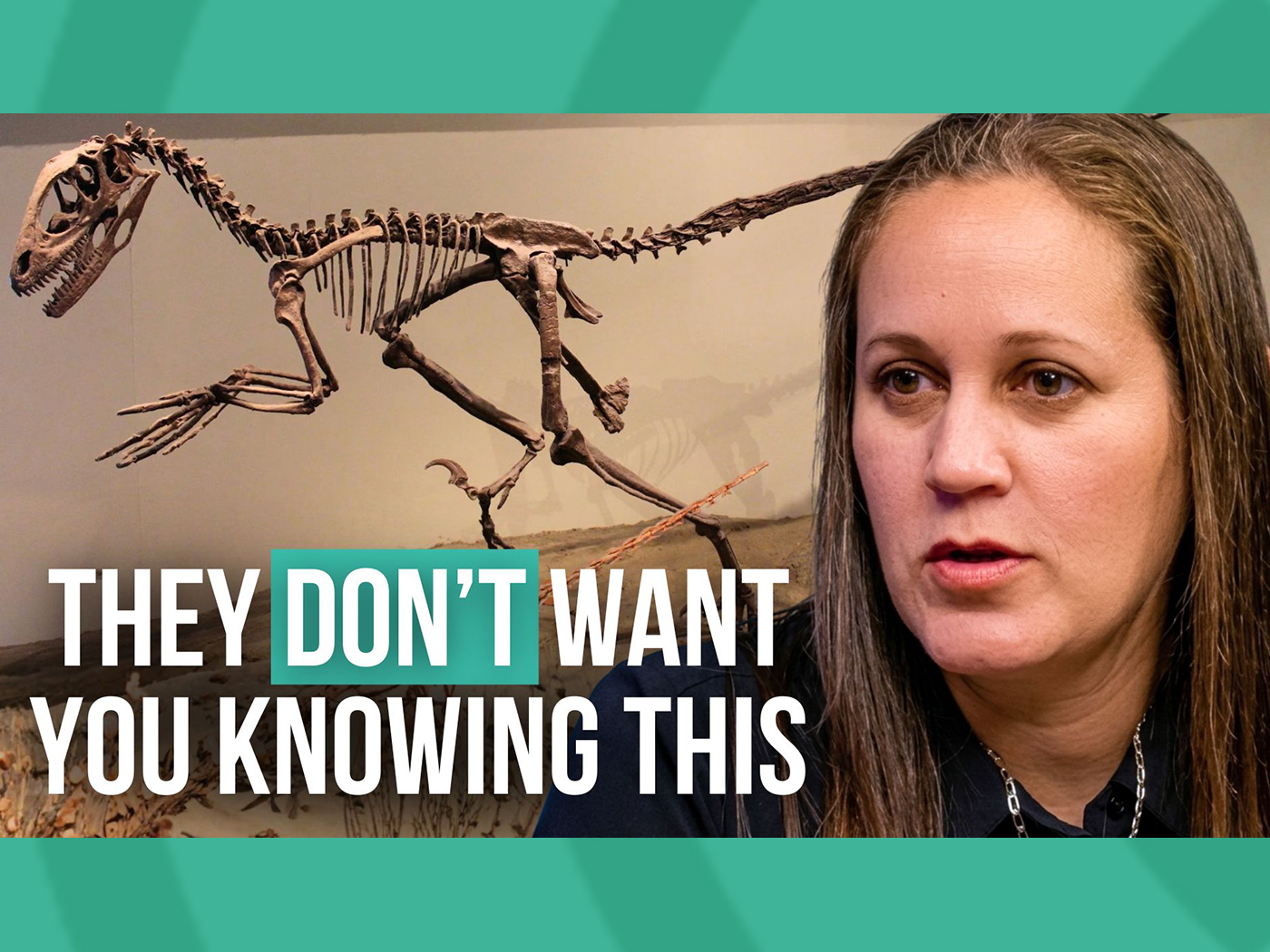
An open access 2026 PeerJ research paper claims that T. rex took 40 years to reach its full adult body size, in contrast to a much shorter previous estimate of 25 years.1–3 This study is arguably the most rigorous dinosaur growth study ever performed, and it was based on more data than any earlier T. rex analyses. Longevity studies in living animals consistently show that animals that take longer to attain their adult body sizes live longer than those that mature more quickly.4 This means T. rex’s prolonged growth interval could be indirect evidence for a very long lifespan.5
Nearly all the world’s fossils, including those of dinosaurs, are the remains of creatures that perished in the global Flood described in Genesis 6–8.6,7 The fifth chapter of Genesis matter-of-factly claims that people in the pre-Flood world routinely attained ages of 900 years, and there is no hint in Scripture that this remarkable longevity was in any way miraculous or supernatural. But if this pre-Flood longevity was natural, it’s reasonable to conclude that animals would have experienced very long lifespans, because almost any conceivable mechanism for this extreme longevity would likely have affected the animals, too. Was this longevity due to a more pristine human genome, with few genetic mistakes? When God created Adam and Eve, their genomes were perfect, and their immediate descendants likely only had a small number of genetic defects. And when God made the animals, there were no mistakes in their DNA, either. Was this longevity due to a more ideal environment? If so, the animals were living in that environment, too. Thus, it is difficult to avoid the conclusion that pre-Flood animals, like pre-Flood humans, had very long lifespans.
Surprisingly, previous dinosaur growth studies concluded that large dinosaurs reached adulthood very quickly. One study claimed that the giant Apatosaurus reached full adult body size in just 15 years!8 But there is good reason to doubt these earlier studies. First, larger, more massive animals generally have longer lifespans. Simply by virtue of their enormous body sizes, one would expect large dinosaurs to have longer lifespans than smaller animals. And because greater ages at maturity are so strongly associated with longer lifespans, one would expect large theropod and sauropod dinosaurs to take a long time to reach maturity. Thus, the claim that large dinosaurs matured very quickly was always counterintuitive.
Second, a 2013 paper by polymath Nathan Myhrvold of Intellectual Ventures9,10 was very critical of these earlier dinosaur growth studies: “Many previously published results in dinosaur growth studies were obtained using methods that deviate from accepted statistical practices or are irreproducible due to a lack of published data or methodology.”11 Of all the papers he surveyed, there were only two sauropod growth studies that Myhrvold did not criticize: a 2005 Alamosaurus growth study by Holly Woodward and a 2008 Apatosaurus growth study by Thomas Lehman and Holly Woodward.12,13 These two studies gave longer estimated growth times, as one would expect of large sauropods: 45 years for Alamosaurus and 70 years for Apatosaurus. Even so, Myhrvold cautioned that even these two results were somewhat uncertain, as even the largest sauropod in these studies was only 37% of its full adult body size.11
Woodward and Myhrvold have since collaborated with renowned paleontologist John (Jack) Horner to perform this reanalysis of T. rex growth times, and this PeerJ paper was the result.2 Consistent with the results of their two earlier studies, it now seems T. rex experienced delayed maturation, as well.
And it isn’t just large dinosaurs that may have been long-lived. There is abundant evidence, both direct and indirect, in the conventional scientific literature that many fossil creatures—including sharks,14 mollusks,15,16 birds,17 crocodylians,18 and mammals19,20—lived much longer than comparable animals today.
Bible-believing Christians should be very encouraged by these developments, since the scientific evidence continues to confirm the Bible’s description of even the very earliest chapters of Genesis.
References
- Harley, S. T. rex Grew Up Slowly: New Study Reveals ‘King of Dinosaurs’ Kept Growing until Age 40. Phys.org. Posted on phys.org January 14, 2026, accessed January 14, 2026.
- Woodward, H. N., N. P. Myhrvold, and J. R. Horner. 2026. Prolonged Growth and Extended Subadult Development in the Tyrannosaurus rex Species Complex Revealed by Expanded Histological Sampling and Statistical Modeling. PeerJ. 14: e20469.
- Erickson, G. M. et al. 2004. Gigantism and Comparative Life-History Parameters of Tyrannosaurid Dinosaurs. Nature. 430 (7001): 772–775.
- For some of these studies, see Hebert III, L. 2023. Allometric and Metabolic Scaling: Arguments for Design . . . and Clues to Explaining Pre-Flood Longevity? Proceedings of the International Conference on Creationism. 9, article 18.
- The authors of the paper were not completely sure that all the specimens they studied were T. rex fossils, but they all had body types very similar to T. rex. For this reason, the authors described the fossil collection as a “Tyrannosaurus rex species complex.”
- Morris, J. D. 1989. How Do the Dinosaurs Fit In? Acts & Facts. 18 (5).
- Clarey, T. 2017. Dinosaur Fossils Found in Marine Sediments . . . Again. Creation Science Update. Posted on ICR.org May 25, 2017, accessed January 20, 2026.
- Erickson, G. M., K. C. Rogers, and S. A. Yerby. 2001. Dinosaurian Growth Patterns and Rapid Avian Growth Rates. Nature. 412 (6845): 429–433.
- Intellectual Ventures. https://www.intellectualventures.com/.
- Myhrvold has been described as “the world’s most curious human.” YouTube: Bloomberg Originals. Posted on youtube.com May 19, 2022, accessed January 20, 2026.
- Myhrvold, N. P. 2013. Revisiting the Estimation of Dinosaur Growth Rates. PLOS ONE. 8 (12): e81917.
- Woodward, H. 2005. Bone Histology of the Sauropod Dinosaur Alamosaurus sanjuanensis from the Javelina Formation, Big Bend National Park, Texas. Master’s thesis. Texas Tech University: Lubbock, TX.
- Lehman, T. M. and H. Woodward. 2008. Modeling Growth Rates for Sauropod Dinosaurs. Paleobiology. 34 (2): 264–281.
- Hebert, J. 2024. Fossil Sharks Show Signs of Greater Past Longevity. Acts & Facts. 53 (5): 20.
- Hebert, J. 2024. Oysters and Pre-Flood Longevity. Acts & Facts. 53 (5): 19.
- Yika, B. Ancient Squid-Like Creature with Paperclip-Shaped Shell May Have Lived for Hundreds of Years. Phys.org. Posted on phys.org November 5, 2020, accessed January 14, 2026.
- Hebert, J. 2026. Did Fossil Birds Live Longer Than Today’s Birds? Acts & Facts. 55 (1): 20.
- Hebert, J. 2025. Croc Fossils Hint at Extreme Longevity. Acts & Facts. 54 (2): 18.
- Hebert, J. Methuselah-Like Longevity in Pre-Flood Mammals. Creation Science Update. Posted on ICR.org October 7, 2024, accessed January 14, 2026.
- Hebert, J. 2024. Late Pleistocene Body Size Reduction: Evidence of a Post-Flood Decline in Longevity? Journal of Creation. 38 (1): 60–66.
* Dr. Hebert is a research scientist at the Institute for Creation Research and earned his Ph.D. in physics from the University of Texas at Dallas.