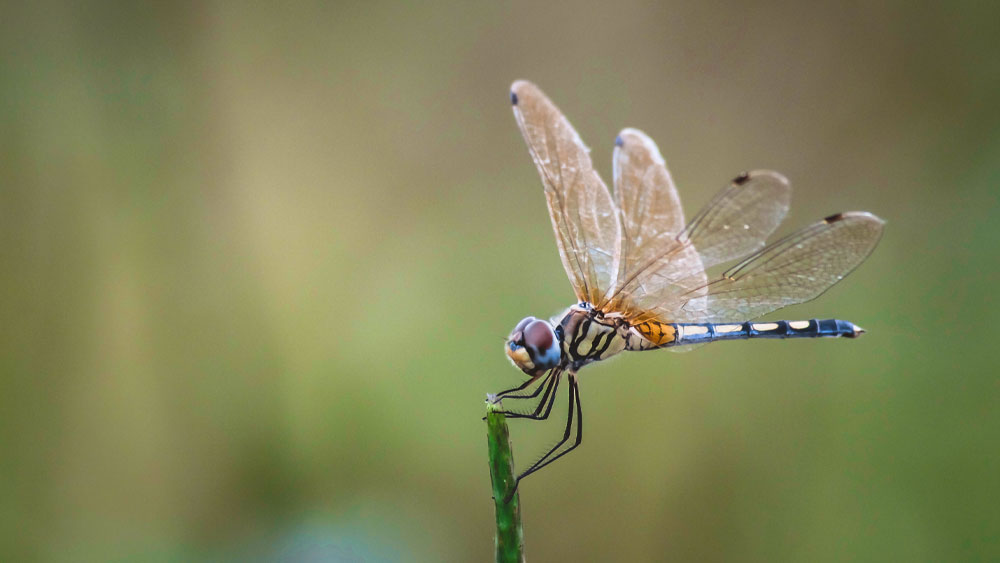
In 2023, an undergraduate student from McGill University discovered a new dragonfly species in Alberta, Canada. In fact, “This is the first ever dinosaur-aged dragonfly found in Canada,” said paleontologist Andre Mueller of McGill University.1 Paleontologists are claiming it’s a missing link.
Sci.News reported this find, stating it supposedly fills a huge gap in dragonfly evolution: “Named Cordualadensa acorni, this new species from Alberta’s Dinosaur Provincial Park represents the only Mesozoic dragonfly for Canada and fills a major 30-million-year gap in the evolutionary history of dragonflies.”1
Three researchers writing in the Canadian Journal of Earth Sciences also claim this dragonfly is a missing link . . . from dragonflies to dragonflies: “This discovery provides a missing link in the evolutionary transition from the early Cretaceous Cavilabiata [a clade of dragonflies] to extant families and introduces one of the few dragonflies known from the late Cretaceous fossil record.”2
Although it was placed in a new family—the Cordualadensidae—it remains a new species that is 100% dragonfly, as predicted by the creation model.
Anatomically, C. acorni is designed like extant dragonflies. Professor Hans Larsson stated, “The wing anatomy tells us this species was adapted for gliding — a trait associated with migratory dragonflies today and possibly a key to their success [emphasis added].”1 Of course. Both living and fossilized dragonflies have the same basic structure and show no indication of real evolution, just variation.
Insects such as the dragonfly were incredibly diverse and complex from the beginning.3 They have been designed by God with the ability to undergo limited change in their basic body plan as they move in and fill ecological niches.4
Looking at the class Insecta, entomologists find no evolutionary transition,5 including the supposed evolutionary history of dragonflies. C. acorni was simply a dragonfly that got caught up and buried in Genesis floodwaters about 4,500 years ago. ICR’s Dr. Brian Thomas states,
If most fossils were deposited in just one year by the worldwide Flood of Noah, then the geologic “periods” are not separated by millions of years. Instead, they represent different biomes. In other words, some swamp-dwelling dragonfly habitats were inundated prior to the more terrestrial habitats that contained the dinosaurs, conifers, birds, and mammals that are found together as fossils. But since they show catastrophe and are broad in extent, both the rock layers containing dragonfly fossils and those with dinosaurs appear to have been deposited as phases within the overall Flood year.6
Insects, including dragonflies, have always been insects from the beginning.
References
- De Lazaro, E. 75-Million-Year-Old Dragonfly Species Found. Sci.News. Posted on sci.news August 18, 2025.
- Mueller, A., A. Demers-Potvin, and H. Larsson. 2025. New Family of Fossil Dragonfly (Odonata, Cavilabiata) from the Late Cretaceous (Campanian) Dinosaur Park Formation, Alberta, Canada. Canadian Journal of Earth Sciences. 62 (8): 1373–1381.
- Sherwin, F. Aerial Engineering and Physics of the Dragonfly. Creation Science Update. Posted on ICR.org May 26, 2022.
- Guliuzza, R. and P. Gaskill. Continuous Environmental Tracking: An Engineering Framework to Understand Adaptation and Diversification. Proceedings of the International Conference on Creationism. 8, article 11: 158–184.
- Sherwin, F. Leaf and Stick Insect Variation. Creation Science Update. Posted on ICR.org January 23, 2025.
- Thomas, B. Did Dragonflies Really Predate Dinosaurs? Creation Science Update. Posted on ICR.org October 20, 2011.
* Dr. Sherwin is a science news writer at the Institute for Creation Research. He earned an M.A. in invertebrate zoology from the University of Northern Colorado and received an honorary doctorate of science from Pensacola Christian College.