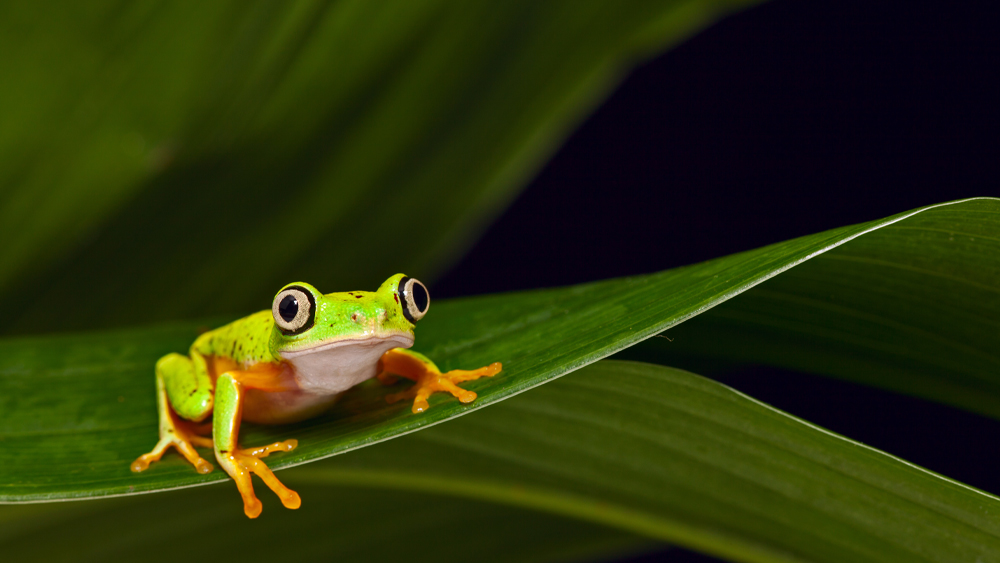
In the 1990s, Australian paleontologists discovered fossil frog bones during a dig in Murgon, Queensland.1 This new species of frog—Litoria tylerantiqua—was subjectively dated to be 55 million years old.
Previously, evolutionists had dated the earliest Australian tree frogs from the Oligocene and the Early Miocene, at half that age. But “the discovery of Litoria tylerantiqua suggests that Australian treefrogs (pelodryadids) were present in Australia by the Early Eocene, when the continent was still connected to Antarctica and South America as the last remnants of the supercontinent Gondwana.”1
But creationists state with clarity that these frog fossils were from Genesis Flood deposits about 4,500 years ago and are merely descendants of the original frog kind that was created during the creation week 6,000 years ago. 2 In contrast, authors of a recent Journal of Vertebrate Paleontology article regarding L. tylerantiqua stated, “The origins and evolution of Australian frogs are poorly understood.”3
De Lazaro stated,
Litoria tylerantiqua joins the only other Murgon frog, the ground-dwelling Platyplectrum casca (previously described as Lechriodus casca), as the oldest frogs known from Australia.
Both have living relatives in Australia and New Guinea demonstrating remarkable resilience over time.1
They certainly would be a remarkably resilient species if they had avoided extinction for all those many millions of years, but this would not necessarily be the case if they’re actually dated to only 4,500 years.
Dr. Roy Farman was quoted as saying, “Despite their delicate nature, frogs have been surprisingly successful at surviving several mass extinction events since their origins about 250 million years ago, including the mass extinction 66 million years ago that took out the non-flying dinosaurs [emphasis added].”1
So even though frogs are delicate and require particular environmental conditions, they have supposedly survived for “250 million years,” which includes several mass extinction events. Moreover, according to Dr. Farman, the recent spread of a particular fungus and rapid climate change is worse than all that and “may be among the worst challenges frogs have had to face”—triggered by human activities, of course.1 One wonders if during those 250 million years there were any chytrid fungal outbreaks or rapid climate change. Evidently not; the delicate frogs are still here.
Farman et al. stated, “All known Australian fossil frogs identifiable to genus or species have proven to be most closely related to extant congeners.”3 In other words, living Australian frogs are very much like fossil Australian frogs. The group to which frogs belong are called the Lissamphibians, which five evolutionists said “likely arose during the late Carboniferous period and later diversified probably by the early Triassic period [emphasis added].”4 Furthermore, evolutionist Kardong stated,
The fossil record preserves no intermediate common ancestor that definitely connects [amphibians] with either the lepospondyls or the labyrinthodonts. When frogs first appeared in the Triassic and salamanders in the Upper Jurassic, they were essentially modern in their skeletal design, already exhibiting the highly [advanced] salutatory (jumping) locomotor system.5
To conclude, there is no indication frogs evolved from a non-frog ancestor and survived over the course of millions of years.6 This is not surprising from a young-earth creation viewpoint. Frogs have always been frogs since their creation, whether they are found in Australia, North America, South America, Asia, Africa, Europe, or even Antarctica.7
References
- De Lazaro, E. 55-Million-Year-Old Tree Frog Fossil Unearthed in Australia. Sci.News Posted on sci.news June 20, 2025.
- Clarey, T. Copulation Didn’t Kill the Frogs, the Flood Did. Creation Science Update. Posted on ICR.org July 28, 2022.
- Farman, R. et al. 2025. Early Eocene Pelodryadid from the Tingamarra Local Fauna, Murgon, Southeastern Queensland, Australia, and a New Fossil Calibration for Molecular Phylogenies of Frogs. Journal of Vertebrate Paleontology. Article e2477815.
- Hickman, C., et al. 2024. Zoology. New York: McGraw-Hill, 558.
- Kardong, K. 2012. Vertebrates. New York: McGraw-Hill, 107.
- Thomas, B. Did Noah Recognize Different Frog Species? Creation Science Update. Posted on ICR.org January 21, 2013.
- Johnson, J. Frog Fossils Found in Antarctica! Creation Science Update. Posted on ICR.org May 6, 2020.
* Dr. Sherwin is a science news writer at the Institute for Creation Research. He earned an M.A. in invertebrate zoology from the University of Northern Colorado and received an honorary doctorate of science from Pensacola Christian College.