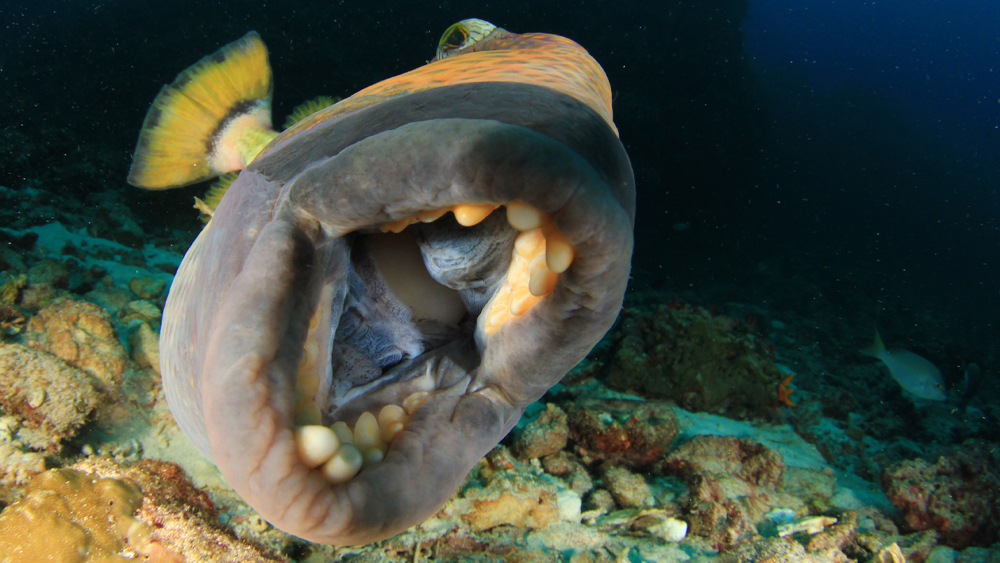
One of the mysteries of evolution (there are so many) is the origin of teeth.
The past few years have witnessed a remarkable flurry of research on the origin or origins of vertebrate teeth. While this work is progressing, the details of when, where, why, and how teeth first appeared still elude consensus. Indeed, there is not even agreement on the fundamentals, such as how we define a tooth.1
Fifteen years later, despite this “remarkable flurry of research on the origin or origins of vertebrate teeth,”1 evolutionists (including Neil Shubin of Tiktaalik2 fame) still have no progress to report, stating in Nature, “The origin of vertebrate teeth has been a long-standing problem in palaeontology.”3
Evolutionists speculate, though, that vertebrate teeth evolved from vertebrate skin appendages called odontodes. Cooper et al. claimed the vertebrate skin “appendages evolved over 450 million years ago.” It was an unobserved event and at an unknown place.
Vertebrate skin appendages are incredibly diverse. This diversity, which includes structures such as scales, feathers, and hair, likely evolved from a shared anatomical placode, suggesting broad conservation of the early development of these organs. Some of the earliest known skin appendages are dentine and enamel-rich tooth-like structures, collectively known as odontodes. These appendages evolved over 450 million years ago. Elasmobranchs (sharks, skates, and rays) have retained these ancient skin appendages in the form of both dermal denticles (scales) and oral teeth.4 (Emphasis added)
Odontodes are hard structures found in all vertebrate jaws. They are designed with a pulpy interior surrounded by dentine and covered with enamel or a mineralized substance. And as the quote says, odontodes are considered to be the evolutionary precursors to teeth.
Evolutionists believe the odontodes-to-teeth process began with sensory tissue. ScienceDaily reported recent work by University of Chicago scientists that “shows that dentine, the inner layer of teeth that transmits sensory information to nerves inside the pulp [rather than dentin, the hard, calcified tissue—the main portion of teeth], first evolved as sensory tissue in the armored exoskeletons of ancient fish.”5 However, one may just as easily say instead that dentine is found as sensory tissue in the armored exoskeletons of pre-Flood fish.
Science writer Benedicte, writing in ScienceAlert, offered some theories for odontodes’ function, which would hopefully give clarity to evolutionists for why they would have evolved: “There are several theories for why these odontodes first appeared, including that they protected against predators, helped with movement through the water or stored minerals.”6 Creationists would say odontodes do carry out, to some degree, all three of these functions. But they were created to do so, and they are designed for the exterior of certain vertebrates, such as sharks, that have dermal odontodes. They are not dermal teeth.
But the researchers continue to theorize, per their evolutionary philosophy, that denticles (odontodes) found on the surface of catfish and elasmobranchs (rays, sharks) went on to become teeth through deep evolutionary time.
There are two [evolutionary] schools of thought about how these structures [denticles or odontodes] eventually became teeth. One, the “inside-out” hypothesis, says that teeth arose first, and were later adapted for exoskeletons. This paper would support the second, “outside-in” hypothesis, that says sensitive structures developed first on exoskeletons, and at some point, animals utilized the same genetic toolkit to produce sensitive teeth as well.5
What was the origin of the sophisticated genetic toolkit and of dentine? “Although dentine seems to be a vertebrate apomorphy [derived trait or specialized character], its origins remain controversial owing to its variability, lack of a sufficient comparative dataset, and challenges identifying it in fossil forms.”3
The University of Chicago article stated,
Sharks, skates, and catfish also have tooth-like structures called denticles that make their skin feel like sandpaper. When Haridy studied the tissues of her catfish, she saw that the denticles were connected to nerves, just like a tooth would be. She said the similarities to teeth, the ancient odontodes of armored fish, and the sensilla of arthropods was striking.5
But in the very next paragraph she said, “they’re all making this mineralized layer that caps their soft tissue and helps them sense the environment.”5 So denticles help these creatures sense their environment7 and, despite evolutionists’ claims, have nothing to do with the origin of teeth. Indeed, according to the fossil record, elasmobranchs have always been elasmobranchs, complete with dermal denticles that have remained dermal denticles.8,9
To conclude, it’s an unscientific stretch to say our “sensitive teeth may exist so ancient fish could avoid danger [emphasis added],”6 and it is equally irrational to state, “sharks, stingrays and catfish are covered in microscopic teeth.”6 No, they’re covered in denticles (odontodes).
Fish have always been fish and were designed by the Lord Jesus with structures like odontodes so they can sense and track their surroundings.7 This allows protection against predators, help with movement through the water, and storage of minerals. Teeth did not evolve but were created in the beginning.
References
- Ungar, P. 2010. Mammal Teeth. Baltimore, MD: Johns Hopkins University Press, 73.
- Sherwin, F. Banner Fossil for Evolution Is Demoted. Creation Science Update. Posted on ICR.org January 27, 2010.
- Haridy, Y. et al. 2025. The Origin of Vertebrate Teeth and Evolution of Sensory Exoskeletons. Nature. 642 (8066): 119–124.
- Cooper, R. et al. 2023. Teeth Outside the Mouth: The Evolution and Development of Shark Denticles. Evolution and Development. 25 (1): 55–72.
- Toothache from Eating Something Cold? Blame These Ancient Fish. University of Chicago. Posted on sciencedaily.com May 21, 2025.
- Rey, B. Your Sensitive Teeth May Exist so Ancient Fish Could Avoid Danger. ScienceAlert. Posted on sciencealert.com May 22, 2025.
- Guliuzza, R. and P. Gaskill. 2018. Continuous Environmental Tracking: An Engineering Framework to Understand Adaptation and Diversification. Proceedings of the International Conference on Creationism. 8: article 11, 158–184.
- Sherwin, F. 2009. Sharks Remain Sharks. Acts & Facts. 38 (8): 16.
- Sherwin, F. and J. P. Tomkins. New Shark Species Is Still a Shark. Creation Science Update. Posted on ICR.org January 17, 2019.
* Dr. Sherwin is a science news writer at the Institute for Creation Research. He earned an M.A. in invertebrate zoology from the University of Northern Colorado and received an honorary doctorate of science from Pensacola Christian College.