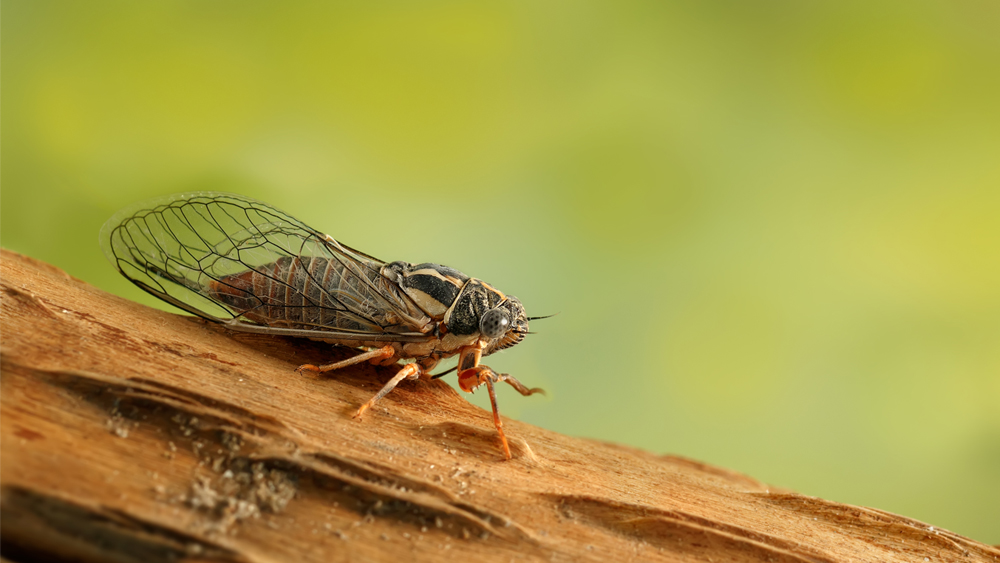
Cicadas are an unusual-looking insect belonging to the order Hemiptera (the true bugs, including bed bugs and aphids). If you live in the eastern United States or in the Midwest, you have undoubtedly heard their long raucous calls on summer days. They produce their characteristic sound via unique structures called tymbals.
Large numbers of these insects that have spent most of their lives as underground nymphs emerge every 13 or 17 years. Once above ground, they eat veggies, fruits, and shrubs. And as they grow, cicadas molt, leaving their ghostly shell attached to a plant or building.
Like all insect groups, evolutionists do not know where these exceptional creatures came from. They appear suddenly in the fossil record as fully-formed cicadas.
Recently, a species of fossil-singing cicadas was uncovered in the Messel Pit, an oil shale open-cast mine in the German state of Hesse. According to evolutionary scientists, “Eoplatypleura messelensis [the new cicada] lived in Europe approximately 47 million years ago (Eocene epoch).”1
Jiang et al. stated that, “Platypleurini is a highly remarkable group within the Cicadidae.”2 This is certainly true. The tribe Platypleurini is composed of 240 described species of cicada with E. messelensis being the latest addition. The authors stated this new species “will serve as a fossil calibration point for future molecular phylogenetic studies and [will provide] new insights into the origins and dispersal patterns of Platypleurini.”2
Described by evolutionary scientists as a new genus and species, E. messelensis “not only represents one of the earliest known fossil crown-group Cicadidae from the Eurasian continent but also the oldest confirmed record of the subfamily Cicadinae worldwide to date.”2
But it’s still simply a fossil cicada. In fact, the claimed 47-million-year-old fossil looks very similar to modern cicadas. And it appears to have been suddenly and catastrophically buried—by the Flood—with the clearly veined wings spread wide.
Because the body structures of the European fossils were so well preserved, scientists were able to assign the ancient insect to a modern tribe of cicadas called Platypleurini, “which is today primarily distributed in tropical and subtropical regions of sub-Saharan Africa and Asia, but is absent from Europe,” [Dr. Hui] Jiang said.3
To be sure, evolutionists can only say cicadas originated in a “wide range of time”—but as cicadas.2 Scientists are unsure of their precise origin.
Molecular evidence, based on estimated origin times for various Hemipteran groups, suggests that Cicadidae originated between 160 Ma and 40 Ma. A key factor contributing to this wide range of time of origin is the limited selection of modern taxa, scarce use of dated fossils, and issues with the taxonomic classification of fossils. The precise origination times of Cicadidae currently are inconclusive.2
Like all insects,4 there is no record of the Cicadidae evolving from an alleged evolutionary ancestor. Instead, all cicadas were created by the Lord Jesus during the creation week.
And God made the beast of the earth according to its kind, cattle according to its kind, and everything that creeps on the earth according to its kind. And God saw that it was good.5
References
- de Lazaro, E. New Species of Fossil Singing Cicada Found in Germany. Sci.News. Posted on sci.news May 9, 2025.
- Jiang, H. et al. 2025. Sounds from the Eocene: The First Singing Cicada from the Messel Pit, Germany. Scientific Reports. 15, article 12826.
- Weisberger, M. 47 Million-Year-Old Bug Is the Oldest Singing Cicada Fossil from Europe. ABC17News. Posted on abc17news.com May 13, 2025.
- Sherwin, F. Fossil Leaf Miners. Creation Science Update. Posted on ICR.org December 11, 2023.
- Genesis 1:25.
* Dr. Sherwin is a science news writer at the Institute for Creation Research. He earned an M.A. in invertebrate zoology from the University of Northern Colorado and received an honorary doctorate of science from Pensacola Christian College.