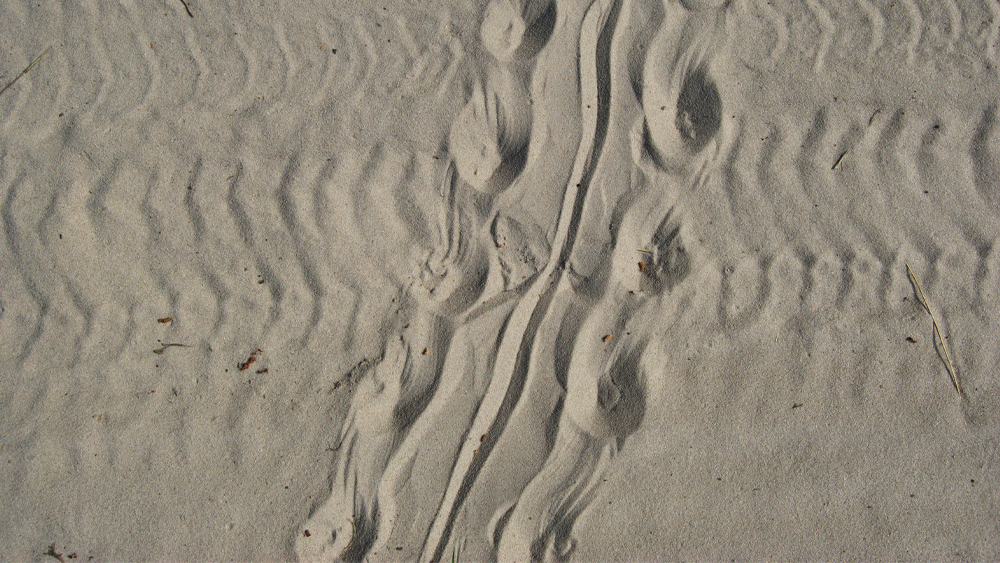
Reptiles belong to a group of animals called amniotes that also include birds and mammals. A new Australian fossil discovery of a clawed amniote demonstrates these animals appeared much earlier than predicted by evolution theory. The introductory paragraph from the evolutionary website Earth.com says it all: “The origin of reptiles on Earth has been pushed back by an astonishing 40 million years. Fossilized tracks unearthed in Australia provide compelling evidence that reptile-like animals existed far earlier than previously thought.”1
Writing for Earth.com, Eric Ralls explains why this discovery is significant: “The tracks, found in the Mansfield district of northern Victoria, indicate that amniotes – a group that includes reptiles – were present in the Carboniferous period [Mississippian], much earlier than established records in the Northern Hemisphere.”1
Long et al. described the discovery in the science magazine Nature.
A track-bearing slab from the Snowy Plains Formation of Victoria, Taungurung Country, securely dated to the early Tournaisian [Lower Mississippian System], shows footprints from a crown-group amniote with clawed feet, most probably a primitive sauropsid [amniotes, like reptiles]. This pushes back the likely origin of crown-group amniotes by at least 35–40 million years.2 (Emphasis added)
The Associated Press reported, “The animal was around 2 ½ feet long (80 cm) and its feet has long fingers and claws, which are visible in newly discovered fossil footprints.”3 And evolutionary paleontologist Per Ahlberg was quoted describing the details of this slab: “The fossil footprints record a series of events in one day, Ahlberg said. One reptile scampered across the ground before a light rain fell. Some raindrop dimples partially obscured its trackways. Then two more reptiles ran by in the opposite direction before the ground hardened and was covered in sediment.”3
But how were these tracks preserved? Tracks made today disappear quickly. So, these must have been buried quickly. And it’s amazing this track-bearing slab withstood all forms of erosion and volcanic/tectonic activity for those supposed many million years. ICR’s Brian Thomas described how these footprints and other imprints point to the Flood in Genesis.
These and many other rock features around the globe that geologists call “ephemeral markings”—which include raindrop indentations, lizard tracks, and delicate ripple marks from flowing water—are consistent with the worldwide Flood of Noah as described in Genesis. The sheer energy inherent in such a massive catastrophe could have provided a reasonable cause for the distribution of such large masses of limestone and other sedimentary rocks, all within the year of the Flood.4
Clearly, this discovery in Australia has turned the philosophy of animal evolution upside down.5 Ralls stated, “This finding challenges long-held assumptions about the evolution of tetrapods, the group that includes amphibians, reptiles, birds, and mammals.”1 This is because “the discovery suggests that after the first animals emerged from the ocean around 400 million years ago, they evolved the ability to live exclusively on land much faster than previously assumed.”3
Non-evolutionists ask how, when, and where these first animals evolved such an ability. The late evolutionary paleontologist Jennifer Clack wrote, “The question of where tetrapods evolved is even more difficult to answer than that of when [emphasis added].”6
In addition to this most unsettling earlier appearance of amniotes, evolutionists have no idea what they evolved from.
Amphibians and amniotes [e.g., reptiles] must have had a common ancestor at some stage among the early tetrapods that was related equally to both but strictly belonged to neither. … Although this common ancestor will probably always remain hypothetical, it would lie at the node [of the hypothetical evolutionary tree] where the lineages of amphibians and amniotes join.7
As nice as it would be for evolutionists to find one, evolutionist Ann Campbell Burke questions if there will ever be a convincing series of fossils documenting evolutionary relationships in the amniotes. “An unshakable phylogeny of amniotes, should such a thing be possible, would provide greater context to our understanding of vertebrate evolution [emphasis added].”8
Not surprisingly, there is no evolutionary progression. “The 350 million year old fossils show characteristics similar to modern monitor lizards.”3 Could this simply be because lizards have always been lizards?
Indeed, in 2024 Hickman et al. said, “evolutionary relationships of early tetrapod groups remain controversial.”9 Now this recent finding in Australia has only compounded the problem.
“The implications of this discovery for the early evolution of tetrapods are profound,” says Professor Long.
“All stem-tetrapod and stem-amniote lineages must have originated during the Devonian period [below the Mississippian]—but tetrapod evolution proceeded much faster, and the Devonian tetrapod record is much less complete than we have believed.”10
To conclude, “the story of reptile evolution may undergo even more dramatic revisions” as evolutionists are now increasingly cautious and uncertain about their supposed evolution.1
The discovery of clawed tracks from the early Carboniferous has profound implications for the timeline of tetrapod evolution. It suggests that the tetrapod crown-group node must be located deep within the Devonian, not the Carboniferous as previously thought.
The findings also reveal that tetrapod evolution was a more rapid and complex process than previously recognized. The appearance of clawed amniotes in both Gondwana and Euramerica indicates that these groups may have evolved in parallel across different regions.1
Claiming the same animals evolved in different places at the same time is difficult to explain in terms of evolutionary theory. It’s supposed to be a random process. The attempted shoe-horning of tetrapods (e.g., reptiles) or any other group of animals into an evolutionary paradigm will never be successful.
Amniotes have always been amniotes since their creation thousands of years ago, in the beginning, just as the Lord Jesus told us in Genesis.
References
- Ralls, E. Animal Evolution Theory Turned Upside Down by New Fossil Discovery. Earth.com. Posted on earth.com in 2025.
- Long, J. et al. Earliest Amniote Tracks Recalibrate the Timeline of Tetrapod Evolution. Nature. Posted on nature.com May 14, 2025.
- Ancient Reptile Footprints Upend Theories about When Animals Evolved to Live on Land. The Associated Press. Posted on nbcnews.com May 14, 2025.
- Thomas, B. Pterosaur Tracks Show Traces of the Great Flood. Creation Science Update. Posted on ICR.org March 14, 2019.
- Sherwin, F. 2021. Vertebrate Origins on the Ropes...Again. Acts & Facts. 50 (5): 14.
- Clack, J. 2012. Gaining Ground. Bloomington, IN: Indiana University Press, 128.
- Ibid, 88–89.
- Burke, A. 2015. Origin of the Turtle Body Plan. In Great Transformations in Vertebrate Evolution. K. Dial, ed. Chicago, IL: University of Chicago Press, 86.
- Hickman, C. et al. 2024. Integrated Principles of Zoology. New York, NY: McGraw Hill, 557.
- Fossil Tracks Show Reptiles Appeared on Earth Up to 40 Million Years Earlier. Flinders University. Posted on sciencedaily.com May 14, 2025.
* Dr. Sherwin is a science news writer at the Institute for Creation Research. He earned an M.A. in invertebrate zoology from the University of Northern Colorado and received an honorary doctorate of science from Pensacola Christian College.