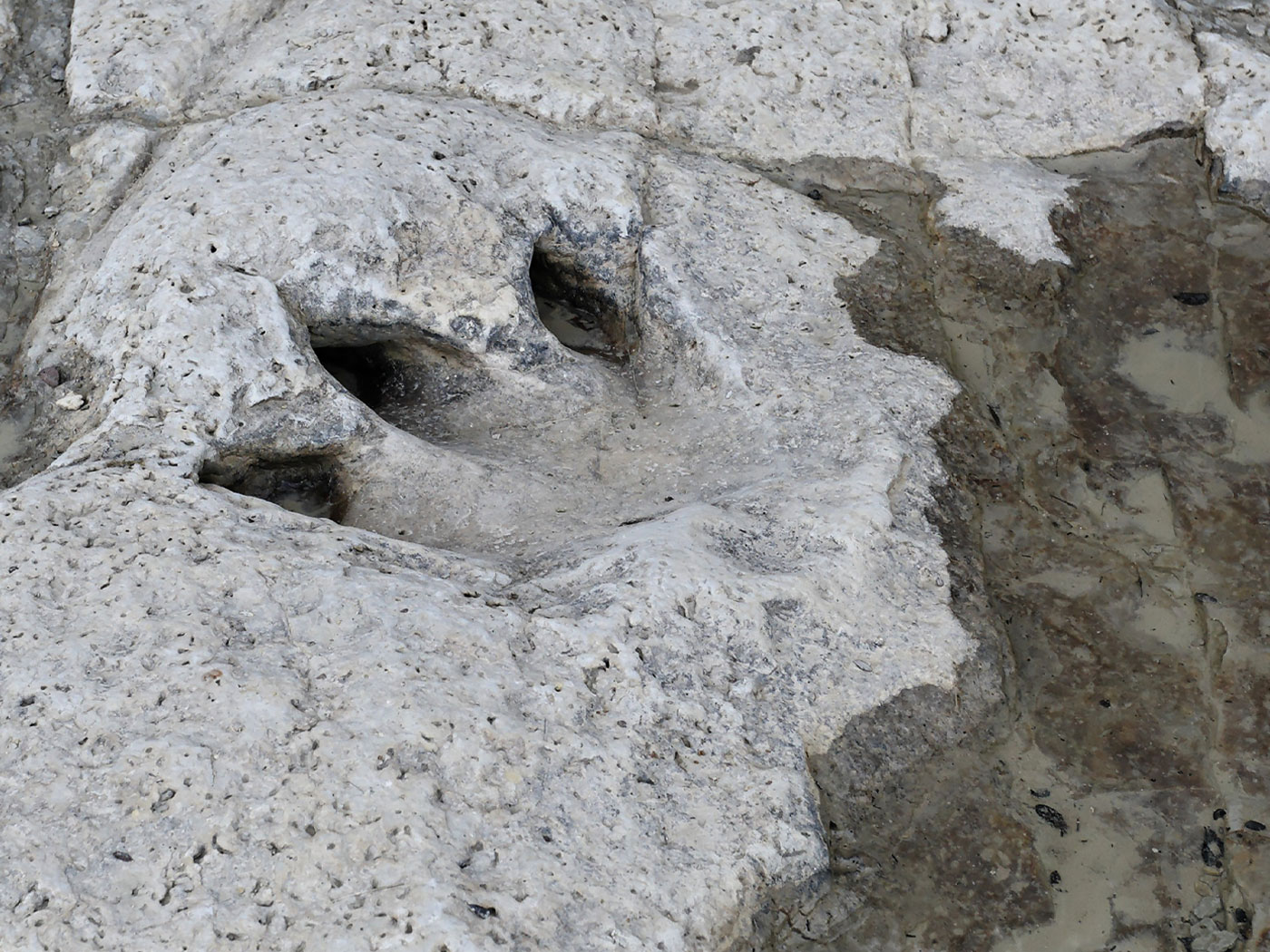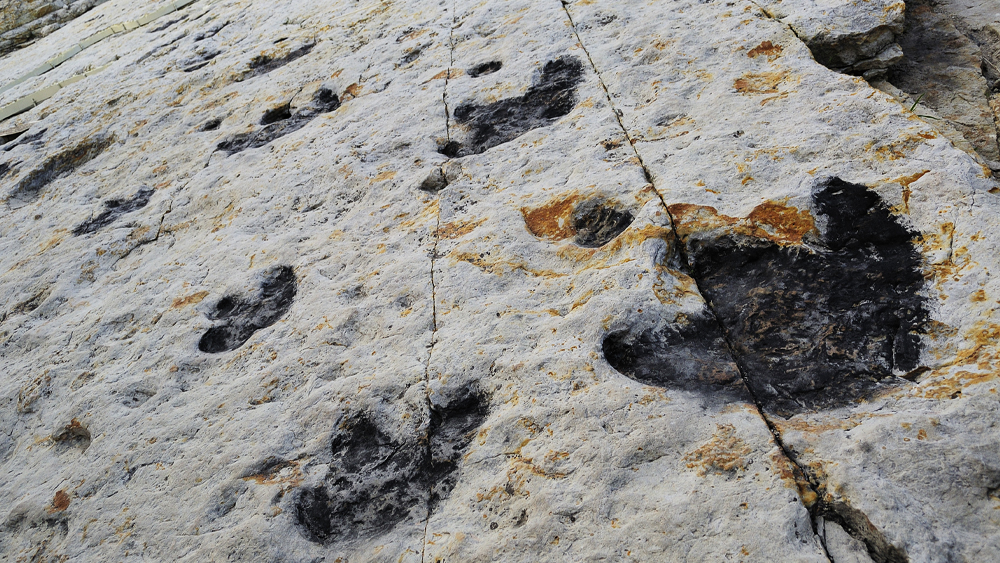
Dinosaur trackways1 are once again making the news. Australia is the setting of a remarkable series of dinosaur tracks attributed to ornithischian dinosaurs (one of two orders of dinosaurs).
Four scientists reported in Historical Biology, “One surface contains a single print, a second a trackway with two tracks, and the third features at least 13 trackways and numerous isolated prints representing one of the most densely concentrated dinosaur track surfaces in Australia” with the tracks being formed “in subaqueous, moderate-to-high energy conditions.”2 Dr. Anthony Romilio also said, “The [200-million-year-old] footprints are from 47 individual dinosaurs which passed across a patch of wet, white clay, possibly walking along or crossing a waterway.”2
The scientists described in geological detail these water deposits that one could easily visualize as being formed by the Flood 4,500 years ago: “The Precipice Sandstone is composed of fine to very coarse-grained pebbly cross-bedded sandstone interbedded with thin mudstone layers, consistent with deposits of a high-energy braided river system.”2
And speaking of river systems, ICR’s Dr. Tim Clarey reported research of well-preserved dinosaur tracks from China’s Sichuan Province.
The scientists determined at least one of the [bipedal “lizard-hipped”] theropods was partly afloat as its feet swiped the underwater mud. Its fifty-foot trackway shows a number of tip-toe scratches and claw scrapings. A second theropod, walking in the same direction and on the same horizon as the first, was apparently wading in the water as it left more complete footprints. These scientists interpret the tracks were made as these dinosaurs crossed a river, possibly during a flood event.3
Discovering dinosaur trackways like these is always exciting for creationists because they not only can be interpreted as part of a flood deposit, but they are also often well preserved and virtually erosion-free as one might expect from a recent catastrophic flood.4
Conversely, long-age, evolutionary explanations for track formations leave much to be desired. The late ICR President, John Morris, said that he
visited an unusual dinosaur print location, the roof of an underground coal mine in western Colorado. Remember coal is thought by uniformitarians to be metamorphosed peat which collected in a peat swamp. As the coal is mined away, the undersurface of the overlying (marine) shale is exposed, revealing in some locations dinosaur trails. These are not impressions, but the infilling of impressions which were originally made in the peat.
If peat formed in a swamp, it is reasonable that a dinosaur may have sloshed through it, leaving footprints, but is it reasonable to claim that such a swamp peat could have been submerged under the ocean to receive marine sediments (the shale), and yet undergo no erosion? No, it would be better to conclude major flooding which deposited virtually all the sedimentary layers in a short time.5
Dallas has its own dinosaur tracks, as revealed by the heavy rains in 2015.
What preserved these dinosaur tracks at Lake Grapevine [N Texas]? Secular explanations leave plenty of room for doubt. They tell tales of dinosaurs wading across placid ancient shorelines surrounding a vast and shallow inland sea. If those conditions somehow preserved footprints back then, why do the same conditions erase footprints today?
Also, the same basic types of dinosaurs left footprints hundreds of miles away. Patches of rock with dinosaur trackways occur elsewhere in North Texas, Oklahoma, Colorado, Wyoming, and all the way to Alberta, Canada—a string that some have called the “dinosaur freeway.”
Most of the billions of known dinosaur prints came from adult dinosaurs, another unsolved puzzle for secular science. Where are all the toddler and teenage tracks? Rocks—including many limestones in North America—seem to preserve almost exclusively adult footprints.
A recent research project at ICR has produced new maps that piece together data from hundreds of detailed geologic sites exposed as outcrops or through well and drill cores. They reveal an intriguing solution to these mysterious dilemmas.6
The “66 fossilised footprints left in the Callide Basin in Central Queensland”7 are clear evidence of dinosaur activity down under. They were made perhaps during the high-water stage of the Flood as it was approaching its peak level on Days 100–120.
References
- Morris, J. 2010. Tracking Those Incredible Dinosaurs. Acts & Facts. 39 (5): 15.
- Romilio et al. Dinosaur Footprints from the Lower Jurassic (Hettangian–Sinemurian) Precipice Sandstone of the Callide Basin, Queensland, Australia. Historical Biology. Posted on tandfonline.com March 10, 2025.
- Clarey, T. Dinosaurs Swimming out of Necessity. Creation Science Update. Posted on ICR.org April 26, 2013.
- Sherwin, F. Dino Trackway Leads Straight to a Young Earth. Creation Science Update. Posted on ICR.org February 3, 2025.
- Morris, J. 2007. Where Are Dinosaur Tracks Found? Acts & Facts. 36 (6).
- Thomas, B. and T. Clarey. Dinosaur Footprints in Dallas. Creation Science Update. Posted on ICR.org September 10, 2015. See also Sotelo, G. Dinosaur Tracks Uncovered in Texas. Gizmodo. Posted on gizmodo.com August 22, 2022.
- Dozens of 3-Toed Dinosaurs Leave Their Mark in Australia. University of Queensland. Posted on sciencedaily.com March 13, 2025.
* Dr. Sherwin is a news writer at the Institute for Creation Research. He earned an M.A. in invertebrate zoology from the University of Northern Colorado and received an honorary doctorate of science from Pensacola Christian College.