Astronomers have inferred the presence of a fourth exoplanet in the Kepler-51 star system.1,2 They made the discovery when the third exoplanet in the system passed in front of its host star two hours sooner than their models predicted. The astronomers were able to account for this error by the existence of a fourth, previously unknown exoplanet. However, the most interesting aspect of this story for biblical creationists is that the three previously known exoplanets are called “super-puff” planets because they have extremely low densities. These low-density exoplanets challenge evolutionary models of planet formation, and they may also challenge the dogma of “billions of years.”
Jessica Libby-Roberts, the first coauthor of the paper, explained the enigma of these super-puff planets:
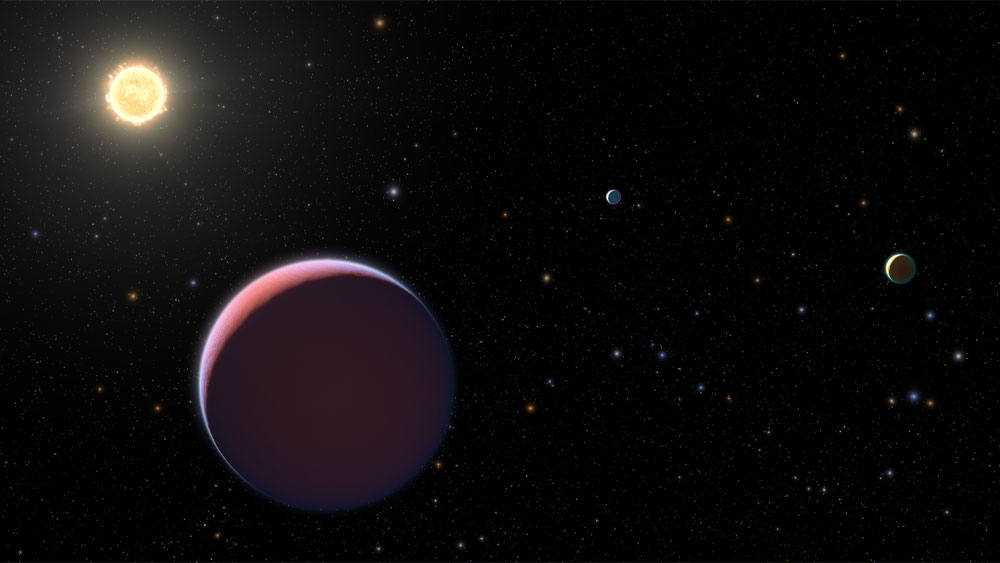
Super puff planets are very unusual in that they have very low masses and low density....The three previously known planets that orbit the star Kepler-51 are about the size of Saturn but only a few times the mass of Earth, resulting in a density like cotton candy. We think they have tiny cores and huge atmospheres of hydrogen and helium, but how these strange worlds formed and how their atmospheres haven’t been blown away by the intense radiation of their young star has remained a mystery.1 [emphasis added]
Super-puff planets should not exist according to theoretical models, yet the Kepler satellite detected six of them by 2019.3 Another super-puff gas giant exoplanet also challenges uniformitarian theories, since the mass of its core is less than the theories predicted.4 Moreover, it is difficult to see how these super-puff planets could survive for long ages.
Given a super-puff’s low density, its atmosphere should be tenuous at best; without strong surface gravity to contain it, the atmosphere should get boiled off by the planet’s host star within perhaps 1,000 years. The super-puffs we see are much older than this, and yet they still retain their extended atmospheres.3
Since uniformitarian astronomers have trouble explaining the existence of super-puffs, they have suggested that observational errors are causing the super-puffs to seem less dense than they really are. If exoplanets detected by the transit method, as were the first three Kepler-51 planets, have large rings, the rings could cause astronomers to overestimate the planet’s size and underestimate its density. However, this explanation does not work in every case.5
Another proposed explanation is that the exoplanets are slowly losing their atmospheres, and the outflowing gas carries very small dust grains to high altitudes. The dust aloft would make the inferred planet radius seem larger and its density lower than they really are.6 This scenario may explain why the transmission spectra of two of the Kepler-51 planets do not show spectral lines. Spectral lines can be “washed out” by dust grains high in the atmosphere.3,7 This mechanism requires continuous gas outflow since such dust grains would not remain aloft in a static atmosphere for long. A minimum gas outflow mass of 0.1 billionths of Earth’s mass per year would be needed for this mechanism to work for the first Kepler-51 planet, Kepler 51b. However, because mainstream astronomers think the Kepler system is 500 million to a billion years old, the outflow rate could not exceed a billionth of an Earth mass per year because a greater outflow rate than this would have completely removed its super-puff atmosphere in that time.6
Of course, there is another possible explanation. What if these super-puff planets are just thousands of years old, not millions? In that case, the dust outflow explanation might not be necessary, especially if the original created sizes of these exoplanets were considerably larger than they are today. On the other hand, the “dust outflow” explanation is attractive since it also explains the flat transmission spectra of two of the Kepler-51 exoplanets. But even then, there could still be a problem for “deep time.” What if the Kepler 51b outflow rate should later be measured and shown to be greater than a billionth of an Earth mass per year? In that case, Kepler 51b should no longer exist if it formed around a billion years ago, but it could still exist if is just thousands of years old.
Super-puff exoplanets, like many other exoplanets, pose severe difficulties for evolutionary planet formation theories.8,9,10 And like some other exoplanets, these “super-puffs” might also be a problem for deep time.11,12,13 This should not be surprising since Scripture testifies that the Lord Jesus created the universe recently, just thousands of years ago.14,15
References
- Webb Observations Discover New Planet in Kepler-51 ‘Super-Puff’ System. Pennsylvania State University. Posted on phys.org December 3, 2024, accessed December 9, 2024.
- Masuda, K. et al. 2024. A Fourth Planet in the Kepler-51 System Revealed by Transit Timing Variations. The Astronomical Journal. 168: 294.
- Kohler, S. Inflating a Super-Puff Planet. American Astronomical Association NOVA. Posted on aasnova.org March 4, 2019, accessed December 9, 2024.
- Lewis, S. “Super Puff” Exoplanet Is as Big as Jupiter but 10 Times Lighter, Confusing Astronomers. CBS News. Posted on cbsnews.com January 19, 2021, accessed December 9, 2024.
- Piro, A. L. and S. Vissapragada. 2020. Exploring Whether Super-Puffs Can Be Explained as Ringed Exoplanets. The Astronomical Journal. 159 (131).
- Wang, L. and F. Dai. 2019. Dusty Outflows in Planetary Atmospheres: Understanding “Super-Puffs” and Transmission Spectra of Sub-Neptunes. The Astrophysical Journal Letters. 873: L1.
- Libby-Roberts, J. et al. 2020. The Featureless Transmission Spectra of Two Super-puff Planets. The Astronomical Journal. 159 (57): 1–20.
- Thomas, B. Planet Formation Theory Collides with Backward-Orbiting Planets. Creation Science Update. Posted on ICR.org April 27, 2010, accessed December 13, 2024.
- Hebert, J. Nebular Hypothesis Doesn’t Hold Together. Creation Science Update. Posted on ICR.org October 18, 2018, accessed December 13, 2024.
- Hebert, J. Exoplanet Too Large for Its Star. Creation Science Update. Posted on ICR.org January 15, 2024, accessed December 13, 2024.
- Hebert, J. New Exoplanet’s Year is Just 16 Hours. Creation Science Update. Posted on ICR.org December 13, 2021, accessed December 13, 2024.
- Hebert, J. “Hot Jupiter” on the Verge of Destruction. Creation Science Update. Posted on ICR.org March 19, 2020, accessed December 13, 2024.
- Hebert, J. Hot Neptune Atmosphere “Shouldn’t Exist.” Creation Science Update. Posted on ICR.org November 5, 2020, accessed December 13, 2024.
- Genesis 1, Psalm 19:1–2, Colossians 1:13–18.
- Johnson, J. J. S. 2008. How Young Is the Earth? Applying Simple Math to Data Provided in Genesis. Acts & Facts. 37 (10): 4.
Stage image: Illustration of Sun-like star Kepler 51
Stage image credit: Copyright © Public domain, NASA, ESA, and L. Hustak, J. Olmsted, D. Player and F. Summers (STScI). Used in accordance with federal copyright (fair use doctrine) law. Usage by ICR does not imply endorsement of copyright holder.
* Dr. Jake Hebert is a research associate at the Institute for Creation Research and earned his Ph.D. in physics from the University of Texas at Dallas.