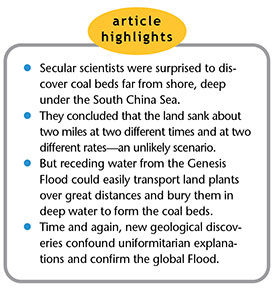
 Recent geological discoveries are defying standard uniformitarian explanations. First there was the massive Whopper Sand found in the deep water of the Gulf of Mexico.1 Then there was the dinosaur bone washed 70 miles offshore and buried 1.5 miles deep.2 And now researchers have come across another startling discovery—coal beds hidden far beneath the South China Sea.3
Geologist Peter Lunt reviewed recent oil well drilling data in an area in the South China Sea known as North Luconia, about 175 miles off the coast of Borneo.3 The oil wells were drilled in over 3,000 feet of water and yet penetrated a thick section of bedded coals at the bottom. Coal deposits form when land plants are buried between sedimentary layers, but no land is near these particular deposits. So, how did these coals form in such deep water so far offshore?
Lunt claims these coals were not transported to the deep water but were buried where the plants grew. He believes the coal was only found in such deep water because the land sank nearly two miles.
He tried to explain:
Coal-bearing Late Oligocene beds are known in several wells in North Luconia, but now in water depths of more than 1000 m [about 3,300 feet], with these coals typically 3 km [1.9 miles] or more below modern sea level. These wells therefore indicate 3 km or more of basement [crustal] subsidence since the Late Oligocene.3
Lunt also found that the coal-bearing sediments are as much as 5,000 feet thick, adding the second mile to the mystery. He added:
Geohistory analysis of the G10-1 well shows that the Oligocene section [containing coal beds] drilled there is both thick and rapidly deposited. The facies [perceived environment] is remarkably consistent over the 2100 m [1.3 miles] of section, with facies…suggesting coastal to very shallow marine throughout.3
Lunt explained that the lack of variation within the coal-rich Oligocene section and across an area greater than 10,000 square km (3,861 square miles) was simply because these thick coal beds sank at exactly the same rate as the coal was accumulating to keep the surface near sea level.3 To maintain such a balance for a mile-thick section would be a very tricky prospect indeed.
Lunt also found that a thick deep-water Miocene section was deposited directly on top of the coal beds. This implies that the land surface had to instantly drop about a mile from one deposit to the next. Lunt discovered that the Mulu-1 well “is quite exceptional in the extremity of events it shows,” adding more coincidences to the story.3
In total, he proposes over two miles of subsidence to place the coals so deep below the ocean surface—one mile for the Oligocene coal beds and then a second mile to accommodate the deep-water Miocene rocks deposited on top. This second act of subsidence had to be nearly instantaneous to change from a “coastal” to a “deep-water” environment across the Oligocene-Miocene boundary. This is highly improbable in itself.
Speculations about rapid “yo-yo” movements of the crust are common in uniformitarian explanations because it’s the only way to maintain their worldview. In reality, these Oligocene coal beds are better explained by the tremendous water runoff that occurred toward the end of the global Flood.4 This interpretation doesn’t require any extreme up-and-down movement. The energy of the receding phase of the Flood could easily transport land plants 175 miles or more out to the deep sea, just like it did the Whopper Sand, and then rapidly bury them in marine sediments. We can add coal beds in deep water of the South China Sea to the ever-growing list of evidence for the global Flood.
References
- Clarey, T. A Whopper Mystery for Nearly 20 Years. Creation Science Update. Posted on ICR.org April 22, 2020, accessed June 5, 2020.
- Clarey, T. and J. J. S. Johnson. 2019. Deep-Sea Dinosaur Fossil Buries Evolution. Acts & Facts. 48 (8): 10-13.
- Lunt, P. 2019. A new view of integrating stratigraphic and tectonic analysis in South China Sea and north Borneo basins. Journal of Asian Earth Sciences. 177: 220-239.
- Clarey, T. 2020. Carved in Stone. Dallas, TX: Institute for Creation Research.
* Dr. Clarey is Research Associate at the Institute for Creation Research and earned his Ph.D. in geology from Western Michigan University.
.jpg)