 This past summer, a colleague and I went to a secular science conference seeking critique from our non-creationist colleagues over what amounts to creation research. Their reactions surprised us.
Creation science done well should be defensible to any reasonable scientist. That was our goal during the international event where, for the better part of a week, almost 7,000 scientists interacted with one another. We went in expecting some shock from our evidence for recent creation, but only two out of dozens so much as raised their eyebrows. Most who read our findings just rubbed their chins. Afterward we thought of four reasons why our secular colleagues stayed so serene—and a few reasons why we would do it all again.
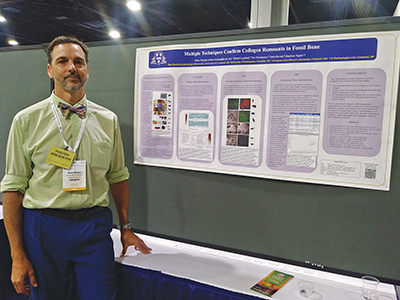
My recently completed Ph.D. research extended into the project I laid out for this conference on a three-foot-long poster. I used two independent techniques to detect and identify collagen protein from the same set of bones on which I used a new technique to visualize that collagen. The two independent techniques confirmed the new technique’s revelation of collagen remnants in very old bone. However, one of those independent techniques involved collagen extraction for radiocarbon dating—a standard procedure for archaeology. I showed a successful collagen extract from dinosaur bone (not archaeological, but much older fossil material). The poster showed collagen and radiocarbon results for medieval, Ice Age, and dinosaur bones.
 Neither radiocarbon nor collagen lasts even one million years. My research thus showed two clock-like processes that indicate a young age in the specimens. So why didn’t secular scientists call us quacks?
First, this conference featured new technologies. Attendees had their minds trained on repeatable processes (part of the scientific method) and innovations—not on non-repeatable phenomena like the timing of buried bones.
Second, I worded the results to appeal to secular minds. Rather than trying to swing a sledgehammer against the entire juggernaut of evolution, we simply let our data do the talking. This meant that our fellow scientists would have to mull over our results, consider what they imply, and make their own conclusions.
This leads to our third reason for serene reactions. Most attendees zipped from one poster to the next without spending the time to let the data interact with their core beliefs. That interaction might happen later.
The fourth reason has to do with expectations. Secular scientists expect virtually all their colleagues to march in step with Darwin. Those who pigeonhole Darwin-doubters as religious ignoramuses never expect to see them at a science conference, let alone presenting data that damage Darwinian deep time. We often fail to notice what we don’t expect to see, even if it’s right in front of us.1
We plan to keep presenting good science in secular conferences and journals. If our research direction is off-base or if we misinterpreted our results, then secular experts might help us steer straight. We also hope our results will plant seeds of doubt in their faith in evolutionary time. In nurturing new friendships and open dialogue, those seeds of doubt could grow toward reconsideration of the Bible as God’s Word and of the Lord Jesus as Creator and Savior.
Reference
- Jesus mentioned this in John 3:11-12. Jesus’ own disciples didn’t expect their Lord to rise from the grave, so they thought Jesus was not actually in front of them—only a ghost—until they saw Him swallow food and heard Him reason with them.
* Dr. Thomas is Research Associate at the Institute for Creation Research and earned his Ph.D. in paleobiochemistry from the University of Liverpool.
.jpg)