Can a single fossil showcase the immense power of the global Flood? One such revelatory fossil may have been found recently in Myanmar encased in beautiful, golden Cretaceous amber.1 And secular scientists are scrambling to come up with an adequate explanation for its existence.
Tingting Yu, from the Nanjing Institute of Geology and Palaeontology in China, and colleagues published their baffling discovery in the journal PNAS.1
Ammonites are common fossils in marine rocks, especially in the Cretaceous layers. But this particular specimen was found in the famous amber (fossil-tree resin) mines of Myanmar (formerly Burma) that has yielded many spectacular land fossils such as countless insects, a juvenile bird,2 bird wings,3 and even complete reptiles.4
How could an ocean-dwelling mollusk get trapped in tree resin and become a fossil? Even more surprising is that it was found mixed with a host of land animals and other marine critters.1 This environmental mixing is just what one would expect in a global Flood, with tsunami-like waves carrying sea creatures far inland, mixing and burying them with land creatures, and resulting in rocks filled with animals from diverse locations.5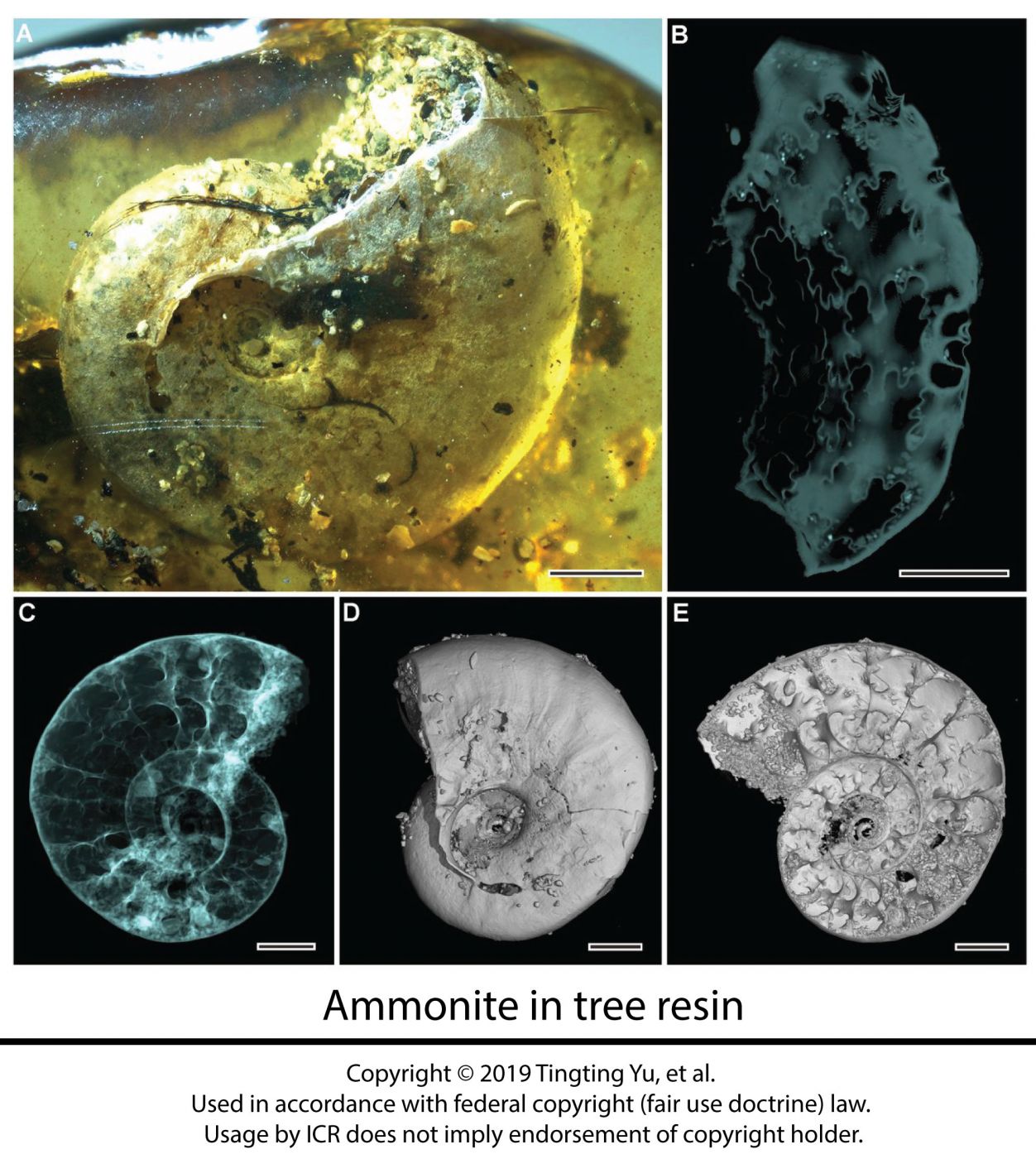
“Amber—ancient resins from trees—commonly traps only some terrestrial [land] insects, plants, or animals,” said coauthor Bo Wang, also from the Nanjing Institute. “It’s very rare to find some sea animals in amber.”6
There are 40 other individual fossils found in the amber specimens along with the ammonite, and many are terrestrial, such as mites, spider, wasps, and even cockroachs.1
“This extraordinary assemblage, a true and beautiful snapshot of a beach in the Cretaceous, is just mind-blowing,” said Jann Vendetti, a paleontologist at the Natural History Museum of Los Angeles County.6 Adding, “Oh my gosh—I probably would say that I don’t know how that would happen, because amber is from trees. How is that going to get into a marine environment to entomb a living, moving cephalopod [ammonite]? But I don’t know!”6
This specimen is truly extraordinary and mind-blowing. The ammonite fossil was tentatively identified as a juvenile Puzosia (Bhimaites), a subspecies of ammonite found in Cretaceous marine sediments across multiple continents.1
Yu and colleagues offer three different scenarios to explain this remarkable discovery.
“The shells may record an exceptionally high, perhaps storm-generated tide, or even a tsunami or other high-energy event. Alternatively, and even more likely, the resin fell to the beach from coastal trees, picking up terrestrial arthropods and beach shells and, exceptionally, surviving the high-energy beach environment to be preserved as amber.”1
Why they preferred the latter and least probable explanation is a testament to their uniformitarian worldview—they appear to be unable to think outside of it. The more likely explanations, involving large storms and tsunamis seem far more probable. And this is what we expect a global Flood would have accomplished to create the ammonite fossil in amber.

Michael Greshko reports “Finding an ammonite shell in a land-formed fossil is therefore as eyebrow-raising as finding dinosaur remains on the bottom of an ancient seafloor.”6
And yet, that has already been found too.7 And even more compelling than that, a Plateosaurus dinosaur bone has been found washed out over 70 miles to sea and buried about a mile and a half deep in the North Sea.8
The unimaginable and massive tsunami-like waves of the Flood washed marine animals hundreds of miles inland9 and also washed many land animals way out to the sea. Only the power and high-energy of a global event could explain these fossils and the “extraordinary” and “mind-blowing” ammonite in amber.
References
1. Yu, T. et al. 2019. An ammonite trapped in Burmese amber. Proceedings of the National Academy of Science. Posted at pnas.org on May 13, 2019, accessed May 15, 2019. doi/10.1073.pnas.1821292116
2. Romey, K. 2017. Baby Bird from Time of Dinosaurs Found Fossilized in Amber. Article posted at news.nationalgeographic.com on June 7, 2017, accessed May 14, 2019.
3. Thomas, B. 2016. Stunning Amber Bird Wings. Creation Science Update. Article posted at ICR.org on July 11, 2016.
4. Thomas, B. 2016. Amber-Encased Lizards Showcase Recent Creation. Creation Science Update. Article posted at ICR.org on April 11, 2016.
5. Clarey, T. 2015. Dinosaurs in Marine Sediments: A Worldwide Phenomenon. Acts & Facts. 44 (6): 16.
6. Greshko, M. 2019. This ancient sea creature fossilized in tree resin. How’d that happen? Article posted at news.nationalgeographic.com on May 13, 2019.
7. Greshko, M. 2017. The Amazing Dinosaur Found (Accidentally) by Miners in Canada. National Geographic Magazine. Article posted at nationalgeographic.com, accessed May 14, 2019.
8. Hurum, J. et al. 2006. A Late Triassic dinosaur bone, offshore Norway. Norwegian Journal of Geology. 86: 117-123.
9. Clarey, T. 2019. Marine Fossils Mixed with Hell Creek Dinosaurs. Acts & Facts. 48 (4): 10.
Stage image: ammonite in tree resin
Stage image credit: Copyright © 2019 Tingting Yu, et al. Used in accordance with federal copyright (fair use doctrine) law. Usage by ICR does not imply endorsement of copyright holder.
Dr. Clarey is Research Associate is at ICR. He has a doctorate in geology from Western Michigan University.