Readers of Acts & Facts and other creation science literature are well aware of the influence of Sir Charles Lyell. He, more than any other, was responsible for turning the scientific enterprise toward the principle of uniformitarianism. Beginning as long ago as the ancient Greek philosophers, there had been advocates of a great age for the earth. The decades before Lyell, there had been many who had advocated the same. James Hutton had been foremost in this effort, but then his cause was picked up by Lyell and popularized to specialists and non-specialists alike. With the publication of his book Principles of Geology, Lyell downgraded God’s work in creation and on earth during the great Flood, replacing it with slow and gradual processes acting over long ages. The Bible, supposedly, had essentially been disproved.
Unfortunately, Lyell’s influence didn’t stop there. He met and mentored a young, but disillusioned, seminary student turned amateur naturalist by the name of Charles Darwin and arranged for him to join a scientific exploration trip around the world as its on-board naturalist. Darwin carried Lyell’s book with him on the HMS Beagle’s voyage around the world and acted as a geologist for the bulk of the trip, interpreting landforms and fossils through a uniformitarian lens. The voyage must have been a rancorous one, for several scientists, surveyors, and anthropologists were present, and records indicate they were not in full agreement with young Darwin. Especially Captain Robert Fitzroy, who would later publically challenge Darwin’s views.
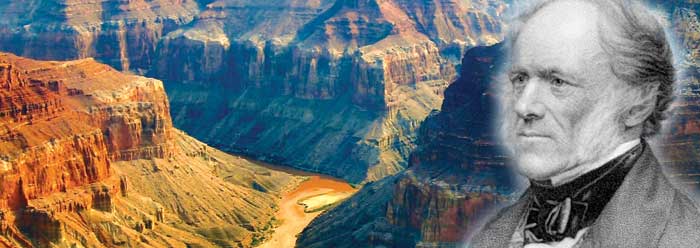
One of Darwin’s stops was in southeastern Argentina, along the shore of the Santa Cruz River. The river extends from the Atlantic up into the high Andes Mountains, which are today covered by ice and snow. He and the other scientists present spent several weeks exploring and surveying the broad canyon upriver. They documented the gravel bars and volcanic deposits on either side. The canyon is flanked on both sides by flat-lying strata, much like the more familiar Grand Canyon in North America. Scientists now agree the river and its canyon were carved by major Ice Age meltwater floods, as well as occasional flooding—but Darwin was thinking in terms of uniformity. Postulating ever-so-slow river erosion, he felt the river itself was responsible for carving the wide canyon through the same processes and energy levels it now employs. With Lyell’s book in hand, he interpreted the river system as the result of millions of years of calm river flow. In his journal, he wrote:
The river, though it has so little power in transporting even inconsiderable fragments, yet in the lapse of ages might produce by its gradual erosion an effect of which it is difficult to judge the amount.1
The HMS Beagle’s very next (and most famous) stop was on the Galapagos Islands, where Darwin’s pattern of wrong thinking set the stage for his claim of evolution by natural selection, eventually resulting in his famous book On the Origin of Species, which has successfully challenged the biblical worldview to this day.
But just as Darwin made a wrong turn on the Santa Cruz River canyon in Argentina, he was wrong about his claim of slow and gradual changes in the Galapagos animal populations. They were not new species in the process of evolving. The celebrated finch species are now known to all interbreed. The salt and marine iguanas also interbreed. The different species of large Galapagos turtles are only varieties of the same animal “kind.”
Both Lyell and Darwin were wrong. Neither evolution nor long-age concepts represent reality. Evidences wrongly used for both or either can be better understood and interpreted within the creation/biblical model.
Reference
- Darwin, C. 1839. Voyage of the Beagle. London: Smith, Elder. Quoting from chapter 9 under the entry dated April 26, 1834.
* Dr. Morris is President of the Institute for Creation Research.
Cite this article: Morris, J. 2011. The Failed History of Uniformitarianism. Acts & Facts. 40 (12): 15.