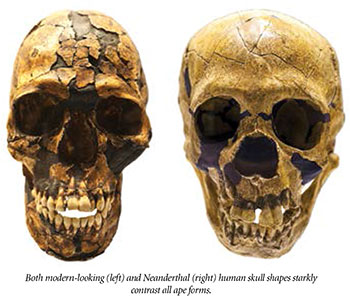
When people think of Neanderthals, an evolutionary image of primitive cave men might come to mind. This is bolstered by the perception that they looked very different from modern humans. However, Neanderthals bore four key features that assure us they were human and confirm the Genesis account of humanity’s recent origin.
First, Neanderthal (pronounced Nee–AN–der–tahl) peoples acted quite human. Instead of leaving their dead out in the open, they buried them in caves found in Europe and parts of Asia. This shows a very human-like spiritual awareness. Also, they and their contemporaries left behind artifacts like musical instruments, tools, cosmetics, jewelry, and purses,1 demonstrating human-like intelligence and creativity.
 Second, in-depth analyses of ancient DNA extracted from Neanderthal bones show an overall similarity to modern human DNA. Certain modern human populations even contain Neanderthal DNA sequences.2
Third, Neanderthal bone structure differences should not overshadow their basically human form. They had prominent eyebrow ridges and sloped foreheads, and their upper arm bones tended to be shorter in proportion to their lower arm bones than those of most modern people. But one can find the same features in living humans. Neanderthals didn’t look that different after all.
Fourth, modern-looking ancients intermarried with Neanderthal people. Some Neanderthal burial sites include individuals that looked just like the folks across the street. Other sites reveal individuals with in-between features.3 And since Noah’s Flood formed the rock layers with the caves that Neanderthals later used to bury their dead, we can assume that these ancient peoples descended from Noah. These four features (burials, DNA, skeletons, and in-betweens) show that Neanderthals were certainly human.
So how did Neanderthal features, only rarely found in today’s population, concentrate into one group that went extinct? A clue can be found in modern humans.
Europeans and Asians have different body ratios. Europeans have shorter torsos with longer arms, while Asians have longer torsos with shorter arms. Most likely, each of these people groups descended from one or a group of ancestors with these physical traits.4 Those ancestral fathers must have moved apart, just as Genesis 11 says happened to the 70 families at the Tower of Babel.5  Each family probably carried its unique language and skeletal features.
Similarly, Neanderthals could have descended from one of these 70 families. If so, then Neanderthals went extinct like many ancient nations, but not before they shared some genes and traits with other groups. No wonder they looked so similar to you and me.
References
- Thomas, B. Boats and Jewelry: ‘Stone Age’ People Were Surprisingly Modern. Creation Science Update. Posted on ICR.org January 25, 2010, accessed April 27, 2016.
- Tomkins, J. DNA Proof That Neanderthals Are Just Humans. Creation Science Update. Posted on ICR.org February 21, 2014, accessed May 9, 2016.
- Thomas, B. Neanderthals Mixed with Humans in China. Creation Science Update. Posted on ICR.org November 3, 2010, accessed April 28, 2016.
- A new study of Y chromosomes from 26 different populations found that half of Europeans trace back to a single man. See Poznik, G. D. et al. Punctuated bursts in human male demography inferred from 1,244 worldwide Y-chromosome sequences. Nature Genetics. Published on nature.com April 25, 2016, accessed April 28, 2016.
- Genesis 10:32; 11:9.
* Mr. Thomas is Science Writer at the Institute for Creation Research.