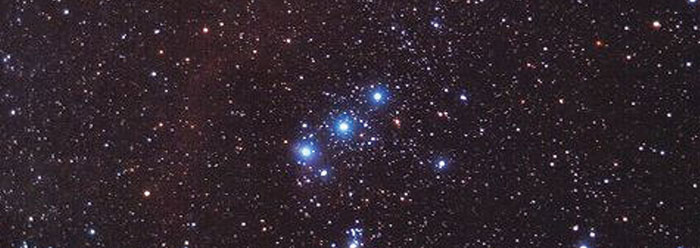
Orion is one of the most well-known and easily recognized constellations of the winter sky. The three bright blue stars in Orion’s belt seem to draw our attention instantly.1 Such stars are a strong confirmation of the biblical timescale.
Most stars generate energy by the process of nuclear fusion of hydrogen into helium in the stellar core. This is a very efficient power source. Theoretically, a star like the sun has enough hydrogen in its core to keep it burning for ten billion years. But that’s not the case with blue stars.
Blue stars are always more massive than the sun. This means they have more hydrogen available as fuel. Yet, blue stars are much brighter than the sun; some are over 200,000 times brighter!2 They are “burning” their fuel much more quickly than the sun, and therefore cannot last billions of years. Based on their observed luminosity, the most massive blue stars cannot last even one million years before running out of fuel.
None of this is a problem for the biblical timescale of about 6,000 years for the age of the universe. But if the universe were 13.7 billion years old, as secularists allege, then it really shouldn’t have blue stars. Yet blue stars abound in every known spiral galaxy. It seems that these galaxies cannot be even one million years old.
Secular astronomers must assume that new blue stars have formed recently to replace all those that have burned out over deep time. They claim that some nebulae (clouds of hydrogen gas) eventually collapse under their own gravity to form a new star. Some astronomy textbooks even have pictures of nebulae labeled as “star-forming regions” or “stellar nurseries,” as if star formation were an observed fact. But it is not. Star formation has never been observed.
Star formation is problematic at best.3 Gas is very resistant to being compressed. On earth, gas always fills its container. In space, there is no container. So gas expands indefinitely. If the gas could be forced into a sphere that is very small (in comparison to a nebula) such as the sun, then the gas would be held together by its own gravity. However, in a typical nebula, the gas pressure far exceeds the miniscule force of gravity. Secular astronomers now believe that external forces, such as a shockwave from an exploding star, are necessary in most cases to trigger star formation.4 Observations confirm that gas clouds expand; they do not appear to collapse into stars.
Even if we could compress the nebula sufficiently to the point that the force of gravity was strong enough to prevent the gas from expanding, other effects would kick in, thereby preventing the formation of a star. Clouds of gas always have a weak magnetic field, which would be concentrated if the cloud were compressed. This dramatically increases the field strength. The magnetic pressure would halt a shrinking cloud and drive it to re-expand.5 It’s a bit like trying to push the like poles of two magnets together.
Also, gas clouds always have a small amount of angular momentum; they rotate, if ever so slowly. But much like a skater who pulls her arms and legs in as she spins, a collapsing gas cloud would spin-up dramatically. The “centrifugal force” generated would tend to prevent any further collapse. Gas pressure, magnetic field strength, and angular momentum all work to prevent star formation. From a scientific perspective, naturalistic star formation appears unlikely at best. The evidence seems far more consistent with the biblical account—it appears that stars were supernaturally created only thousands of years ago. With blue stars scattered across the cosmos, our universe certainly “looks” young.
References
- Going from east to west, the stars are named Alnitak, Alnilam, and Mintaka.
- Alnilam—the center star in Orion’s belt—is a blue supergiant with a luminosity that is 275,000 times greater than the sun.
- Wiebe, D. Z. et al. 2008. Problems of Star Formation Theory and Prospects of Submillimeter Observations. Cornell University Library. Posted on arxiv.org July 21, 2008, accessed July 13, 2012.
- But, of course, this would require a previous star, and so it cannot be used to explain the formation of the first stars.
- Hartmann, L. 2008. Accretion Processes in Star Formation, 2nd edition. Cambridge, UK: Cambridge University Press, 57-58.
* Dr. Lisle is Director of Physical Sciences at the Institute for Creation Research and received his Ph.D. in Astrophysics from the University of Colorado.
Cite this article: Lisle, J. 2012. Blue Stars Confirm Recent Creation. Acts & Facts. 41 (9): 16.