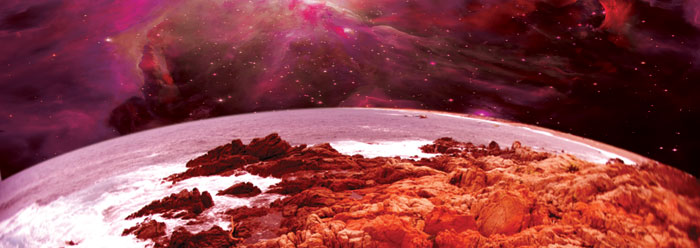
The secular mantra is ongoing: "Creationism is religion and evolution is science." When evidence is offered for The Non-Darwinian Alternative, evolutionists seem to respond by becoming even more dogmatic in their commitment to metaphysical naturalism.
For example, Eric Chaisson and Steve McMillan display an "Arrow of Time" in their text Astronomy Today. Their description of time’s arrow of "progress" is as amusing as it is unscientific:
The major phases of cosmic evolution [are]: evolution of primal energy into elementary particles; of atoms into galaxies and stars; of stars into heavy elements; of elements into solid, rocky planets; of those same elements into the molecular building blocks of life; of those molecules into life itself; and of advanced life forms into intelligence, culture, and technological civilization.1
This is an overtly religious description. For instance, just what is "primal energy"? Ironically, the two authors said in their opening chapter:
We describe the slow progress of scientific knowledge, from chariots and gods to today’s well-tested theories and physical laws, and explain why we now rely on science rather than on myth to help us explain the universe.2
Apart from the fact that this is a not-so-subtle dig at those who hold to biblical authority, the reader should understand that intelligence and culture evolving from "solid, rocky planets" is not science…rather, it is a strange philosophical conviction. Indeed, a 1964 Nobel Prize winner in physics stated, "Somehow intelligence must have been involved in the laws of the universe."3
Chaisson and McMillan promise to tell how "atoms [became] galaxies and stars." Really? How, exactly, considering that an evolutionist in Scientific American stated:
It might seem that star formation is a problem that has been solved. But nothing could be further from the truth. The birth of stars remains one of the most vibrant topics in astrophysics today.4
They also describe "elements [turning] into solid, rocky planets," but there are serious scientific problems with this idea of planet formation. In 2011, National Geographic News reported:
The more new planets we find, the less we seem to know about how planetary systems are born, according to a leading planet hunter.5
Our clearly designed solar system further challenges this simplistic Arrow of Time. A New Scientist article stated:
You might also think that these disparate bodies are scattered across the solar system without rhyme or reason. But move any piece of the solar system today, or try to add anything more, and the whole construction would be thrown fatally out of kilter. So how exactly did this delicate architecture come to be?6
Well, at least it’s known how earth’s closest celestial neighbor formed, right? No…an evolutionary website reported in 2008:
The finding [of lunar water] calls into question some critical aspects of the "giant impact" theory of the Moon’s formation.7
Finally, there have always been serious challenges to the bizarre idea that over time inorganic nonlife became organic life. "The origin of animals is almost as much a mystery as the origin of life itself," said one evolutionist.8
If people really want to know their origin, as well as the origin of the universe, they would do well to consult the written record of the One who was there "in the beginning."
References
- Chaisson, E. and S. McMillan. 2011. Astronomy Today, 7th ed. Boston: Addison-Wesley, 708.
- Ibid, 5.
- Begley, S. Science Finds God. Newsweek. July 20, 1998, 48.
- Young, E. T. Mysteries of How a Star Is Born. Scientific American, February 1, 2010, 34. See also Thomas, B. Distant Galactic Cluster Should Not Exist. ICR News. Posted on icr. org May 21, 2010.
- Lovett, R. A. Three Theories of Planet Formation Busted, Expert Says. National Geographic News. Posted on news.nationalgeographic.com February 22, 2011. See also Asphaug, E. 2009. Growth and Evolution of Asteroids. Annual Review of Earth and Planetary Sciences. 37: 413-48. See generally Spike Psarris’ DVD Our Created Solar System (available from www.creation.com).
- Webb, R. 2009. Unknown solar system 1: How was the solar system built? New Scientist. 2693: 31.
- Moon water discovered: Dampens Moon-formation theory. Carnegie Institution news release, July 9, 2008, reporting on research published in Saal, A. E. et al. 2008. Volatile content of lunar volcanic glasses and the presence of water in the Moon’s interior. Nature. 454 (7210): 192-195.
- Donoghue, P. C. J. 2007. Paleontology: Embryonic identity crisis. Nature. 445 (7124): 155.
* Mr. Sherwin is Research Associate, Senior Lecturer and Science Writer at the Institute for Creation Research.
Cite this article: Sherwin, F. 2011. From Rocks...to Brains. Acts & Facts. 40 (9): 17.