ICR has long had a deep interest in magnificent Grand Canyon. This awesome wonder of the natural world, we believe, bears eloquent testimony to the great flood of Noah's day.
Visitors to Grand Canyon as well as eighth grade earth science students have been traditionally taught that the Colorado River, migrating back and forth for 65 million years, coupled with side canyon erosion, has carved out this immense gorge. In recent years, scientists have disproved that idea, leaning now on a great volume of water rushing through the area at a high velocity not very long ago which carved the canyon. (Unfortunately, school students are still being taught the older, long-age model.)
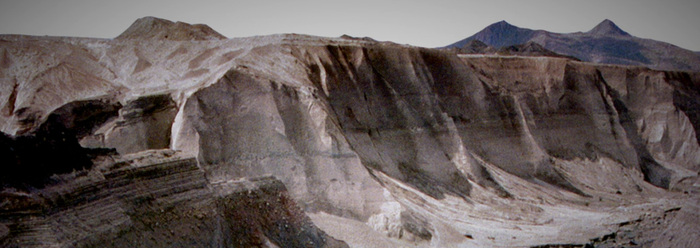
Let me introduce you to Burlingame Canyon near Walla Walla, Washington. It measures 1500 feet long, up to 120 feet deep, and 120 feet wide, winding through a hillside. A small-scale analogy to Grand Canyon it was observed to form in less than six days.
In 1904 the Gardena Farming District constructed a series of irrigation canals to provide water to this normally rather arid high desert area. In March, 1926, winds collected tumbleweeds at a concrete constriction along one of the canals situated on an elevated mesa, choking the flow of water, which at 80 cubic feet per second was unusually high due to spring rains. In order to clean out the obstruction, engineers diverted the flow into a diversion ditch leading to nearby Pine Creek. Prior to this time the ditch was rather small, at no location greater than 10-feet-deep and six-feet-wide, and often with no water in it at all.
The abnormally high flow crowded into the ditch, and careened along until it cascaded down the mesa in an impressive waterfall. Suddenly, under this extreme pressure and velocity, the underlying stratum gave way and headward erosion began in earnest. What once was an insignificant ditch became a gully. The gully became a gulch. The gulch became a miniature Grand Canyon.
The eroded strata consisted of rather soft sand and clay saturated by the recent rains. The dewatering of the saturated sediments into the now-open ditch enhanced the erosion. The rapidly moving water could both dislodge the particles and carry them down stream, leaving underlying sediments vulnerable to erosion. In total, these six days of runaway ditch erosion removed nearly five million cubic feet of silt, sand, and rock.
Yes, canyons can form rapidly. A good maxim to remember is that, "It either takes a little water and a long time, or a lot of water and a short time." But then, we've never seen a canyon form slowly with just a little water. Whenever scientific observations are made, it's a lot of water and a short time.
Cite this article: Morris, J. 2001. How Long Does It Take for a Canyon to Form? Acts & Facts. 30 (12).